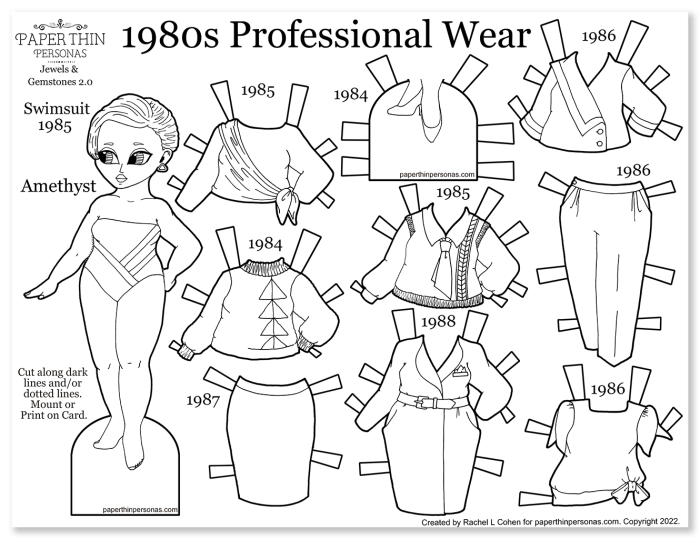
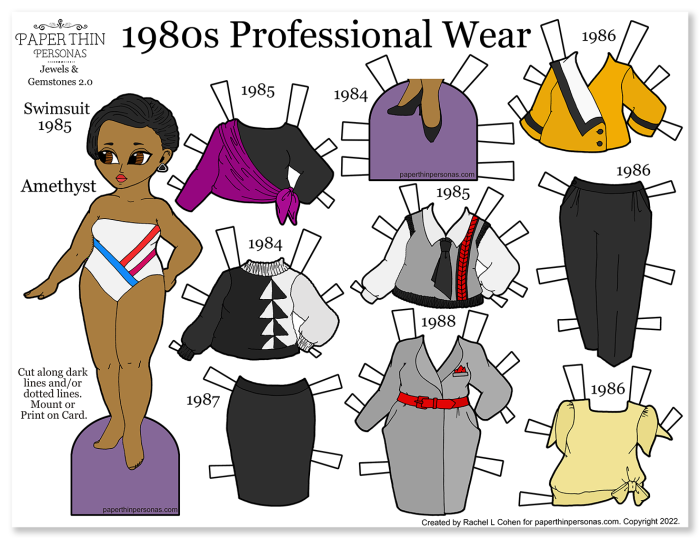
I fell in love with the 1980s power fashion clothing as I was looking through these old catalogs. So, clearly, the thing I needed to do was draw a 1980s fashion paper doll ready to take over the board room.
The mix and match options seemed really cool here, because so many pf these clothing pieces were designed to match with the black pencil skirts and black trousers, specifically pleated ones. Pleated trousers are super comfortable, so I can get behind that. One perk of this was that just doing two bottoms and then five tops gives a lot of options which I think is a big part of paper doll functionality- which is a passion of mine. This paper doll has 11 outfits, which is a lot for 9 pieces of clothing.
Listen, some people contemplate how to make the perfect pulled pork bbq, I think about how to make a functional one sheet paper doll. We all have our hobbies.
A few other thoughts- one thing that really struck me about 1980s clothing was how color was used. If you look at the black and white sweater (original here), it’s really the way the shirt is color blocked that makes it 1980s. The pattern could be today, but something about the color blocking really dates it to the decade of the 1980s.
So now Amethyst is ready to go rock the corporate world in huge shoulder pads!
Honestly, the 1940s and the 1980s are both super into the giant shoulder pad thing and I try to get it (I do), but I just don’t. I guess if I’m going to draw a 1980s fashion paper doll I just need to get into the whole shoulder pad thing, but… Oh well, I barely understand modern fashion. I just like drawing paper dolls.
I have a pretty bad tendency to get super tangled up in myself. For the last few years, my Patrons have been requesting two historical time periods in every poll- the 1980s and Italian Renaissance. In my whole costume book collection, I only own one book on Italian Renaissance clothing and it’s a translation of a 1590s text, so not the most useful when trying to do overview research.
What became abundantly clear to me as I did my digging into the topic was that styles in Italy were not standardized across the entire country, as we know it today. At the time, Italy was a collection of city-states (it remained this way until it unified around the 1870s), so every area had its own fashion which makes things super confusing.
Plus, since most of these are taken from portraits of the period and the identify of the sitters isn’t always known, it’s nigh impossible to be certain where the paintings were painted. Is that lady wearing Naples fashions or those from Rome? Who knows?
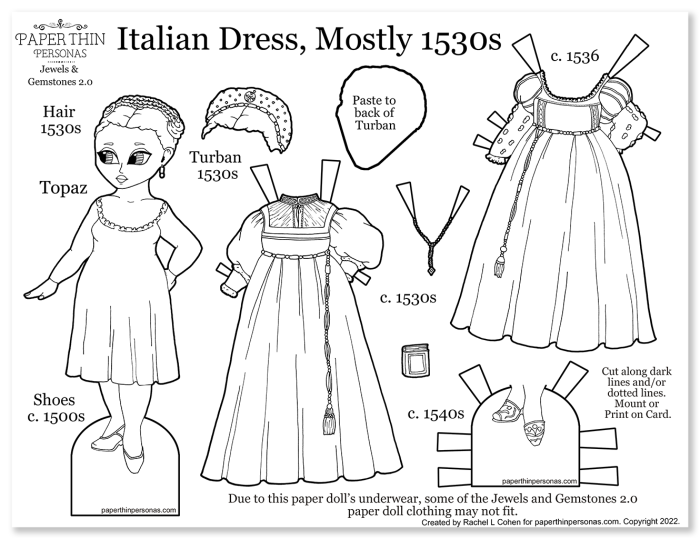
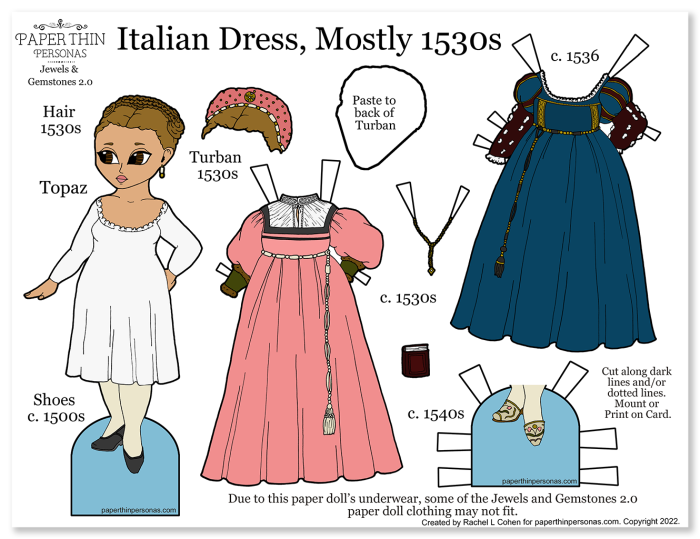
Anyway, I got myself all wrapped up in my worry about not being “right” that I avoided drawing anything claiming to be Italian Renaissance for two years. Finally, I realized I was being ridiculous. So, I looked through all the paintings I had collected on my Pinterest Board devoted to Italy. I read what I could find and then I set to work. Here’s what I know- These dresses are based on those in two portraits.
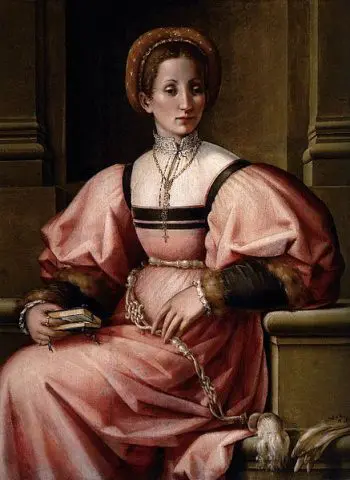
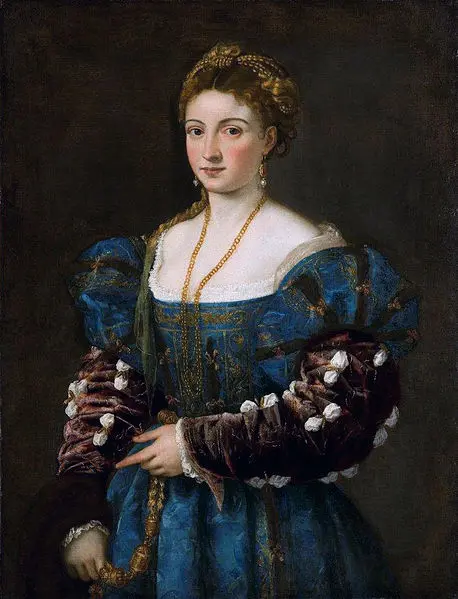
Portrait of a Lady by Pier Francesco Foschi, 1530-1535?La Bella by Titian, c. 1536
The dress on the left is based on Portrait of a Lady by Pier Francesco Foschi. Dress on the right is based on La Bella by Titian. Both painting date from the 1530s.
Pier Francesco Foschi (1502–1567) was an Italian painter active in Florence. It’s possible the lady in this painting is also from Florence. There are other examples of this dress style here and here. Since those are also unidentified, it’s impossible to know exactly where this combination was being worn. The fur trimmed sleeves, black trimmed bodices, raised waists, long gridles, and high collared camisoles seem to be the common elements.
Meanwhile, on the right, Titian was a Venetian painter whose work is well regarded. The person in this painting is unknown, so the area this style of dress was worn is also unknown. Titian worked all over Italy, which adds to the confusion. The low neckline seems to be somewhat unusual for this period, as most dresses I saw had something filling in that space. In my rendition, I think I made the waist too high, but that’s neither here nor there.
A few things I noticed generally, unlike Tudor dress which is super stiff, the sleeves and skirts of these gowns fall more softly. I wasn’t able to find any full length portraits of these dresses, so I am guessing they fell to the floor without knowing for sure.
There’s some debate if these dresses were worn over some sort of stays. I have no idea, but I do know the flattened bust of these dresses wouldn’t have been possible without either some sort of support in the bodice of the dresses or underneath them. It does seem like wide open necked shifts were often worn and are referenced in several books I have.
Anyway, shoes were snagged from a few different places like here and my favorite- Stepping Through Time by Olaf Goubitz. Of course, from Stepping Through Time focuses on Netherlands and this is Italian, so… mileage may vary.
All in all, while there’s things I would change for next time, I’m okay with that. I have one more Italian renaissance foray to share and I just got a few books on order about the period from the library so… there may yet be more of this to come. I’m sure after I’ve done more research, I’ll approach it differently, but I didn’t want my own need to “be sure” get too much in the way of finishing some new paper dolls.
And if you’d like to get to vote on future polls about “what I should draw next” join us on Patreon.
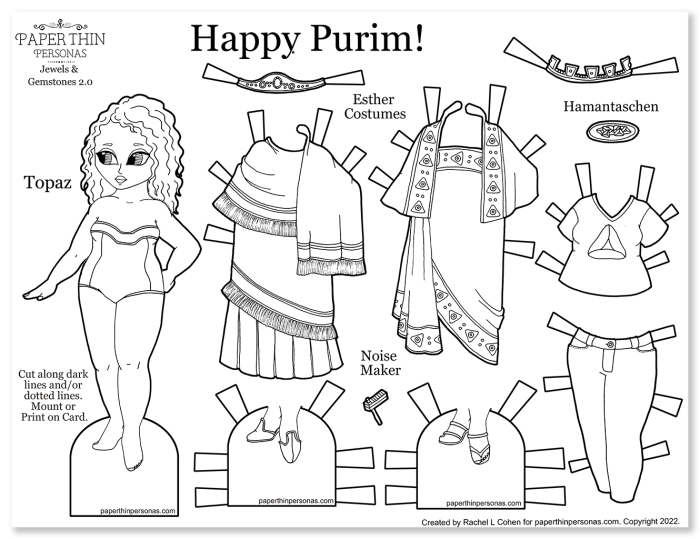
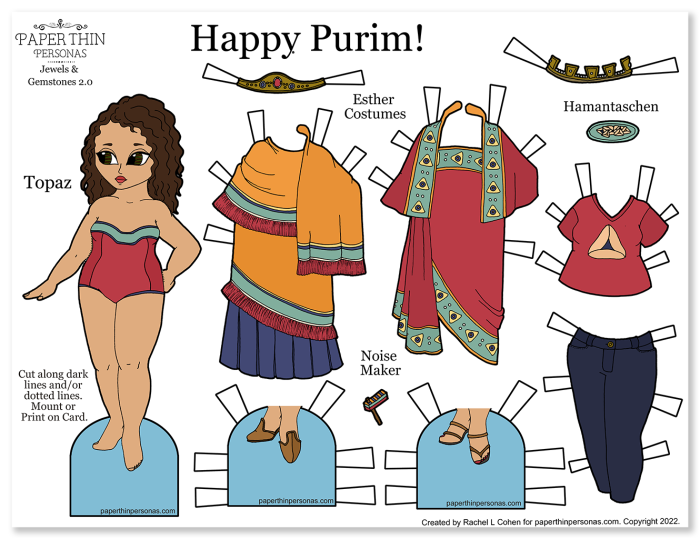
Oh, where to start… Okay, so Purim begins at sunset tonight and as it is a Jewish holiday where dressing up is a tradition, I’m sort of embarrassed I haven’t done a Purim paper doll since this one way back in 2011. So, here we are to rectify that situation. To be honest, I tend to forget about Purim until after the fact which is not really fair to what is technically one of my favorite Jewish holidays (which I am like 80% into because of the amazing cookies involved.)
So, what is Purim? Well, Purim is a holiday that usually falls in March or April and commemorates the saving of the Jewish people from Haman, who was planning to have all of Persia’s Jewish subjects killed, by Esther and Mordecai as recounted in the Book of Esther. There’s more to the story of course (some of it involving a lot of drinking and nudity, oh my!), but to make a long story short, the day that the Jews weren’t killed is now remembered as Purim. If any of this did actually happen (a subject of some debate) it would have been around 400-500 BCE in the Persian empire of the time. By the way, this is the cutest 4 minute video of this story ever, if you want a kid-friendly primer.
Reading the Book of Esther from the Esther Scroll (the Book of Esther doesn’t appear in the Torah) is a religious requirement of Purim, as is giving to the poor, exchanging food with friends, and eating a celebratory meal. Non-religious traditions of the holiday include making noise (using a noise maker or just booing loudly) when the name Hamen heard during the reading of the Book of Esther, dressing up in costume as characters in the story (or just costume in general), and making hamentashen. Hamentashen are a traditional cookie shaped like a triangle and filled with poppy seed, prune, or apricot filling (or, if you’re me, raspberry). It is said they looked like Hamen’s hat, but I think there’s no historical backing for that one.
I like this hamentashen recipe, though I sub out the brandy usually with orange juice, and I think it is better than my Grandma’s recipe. (Don’t tell!) I usually buy my poppy seed filling, because I’m a little lazy about it. However, you can make your own poppy seed filling which I might have to do, because poppy seed filling is super hard to find in the grocery stores around here. I would add that if you’re used to making cookies with butter, than traditional hamentashen will taste odd perhaps, because they’re usually made without dairy for kosher cooking reasons. I’ve been known to make hamantashen outside of Purim as a non-dairy cookie for friends who don’t eat dairy.
Anyway, as a kid, I loved Purim. I love getting to dress up as Esther, or one memorable year, as a hamantashen. I loved getting to use a noise maker, hearing the story of Esther, and the general feeling of celebration the holiday creates. There’s also something about the slow slog towards spring when everything still is frozen up here in Alaska which makes baking some cookies and having a party seem like a really good thing to be doing.
I didn’t want to make a paper doll of Esther, because honestly, that was way more research than I was about to undertake. What did Jewish people wear in Persia in 400BCE? No idea!
Instead, I decided to draw someone celebrating Purim with a hamantashen t-shirt (because that’s fun) and some Esther costumes. For some reason I had it in my head that this whole thing took place in 1400 BCE, not 400 BCE, while I was sketching, so these outfits are way too early for the actual period, but I’m not sweating it. The trim on the second costume is supposed to look a little like hamentashen. I also included a traditional noise maker called a gragger (or grogger, or grager, or… there’s like a million ways to transliterate Yiddish, I swear) and plate of hamantashen. (Note: Drawing a plate of cookies is hard!)
For anyone else celebrating, have a happy Purim! For everyone not celebrating, have an amazing Wednesday evening and Thursday! I’m spending mine baking.
In my world, it is still way below zero and the snow is still deep. People tell me spring will come, but I am beginning to have my doubts. I’m antsy and super tired of winter. Up here, some people call this feeling the “heebie-jeebies” – that antsy icky anxiety that comes from wanting winter to end. This time of the year time seems to blur together. There’s not enough day light yet and there’s not enough changes in the weather. You start wonder- will Winter ever end?
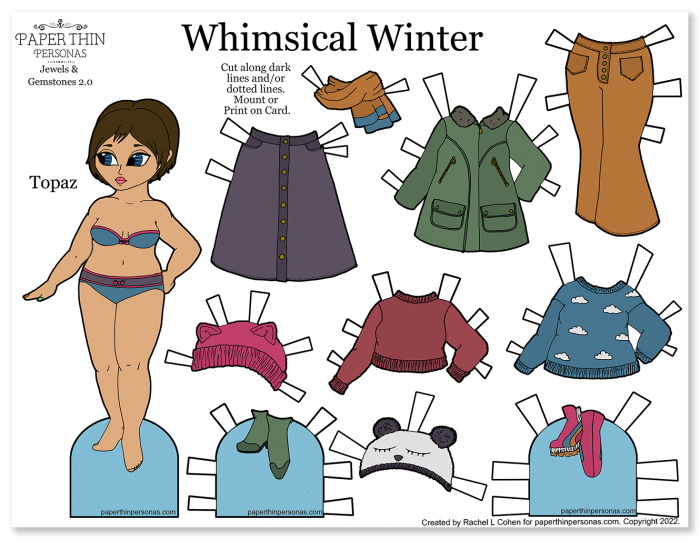
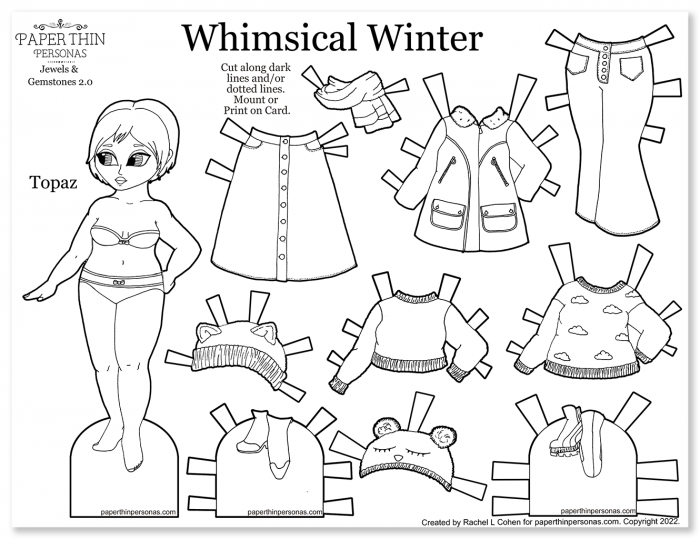
Different people deal in different ways. I deal by being deeply and intensely attracted to all things cheerful and whimsical. I want hats that look like pandas and pink shoes. So, I designed this paper doll set to capture the whimsy of winter- the things I seem to crave as the dark and cold feels like it will never end.
Other coping strategies this time of the year for me include covering my planner in flower stickers and sticking unicorn washi tape all over my journal . What do you do to deal with long winters? Or do you live in a place where spring is already on the way? I’m only a little jealous.
By the way, I have restarted my newsletter for 2022 quietly. If you haven’t signed up, you can do that here- Newsletter Sign Up. It usually goes out about every two weeks and there’s a paper doll coloring page in every issue.
If you’d like to support PTP in a more direct way (plus get extra paper dolls very month and access to a backlog of wonderful things as well) you can sign up to be a patron on Patreon. It was a slow start to 2022, so you haven’t missed anything new there.
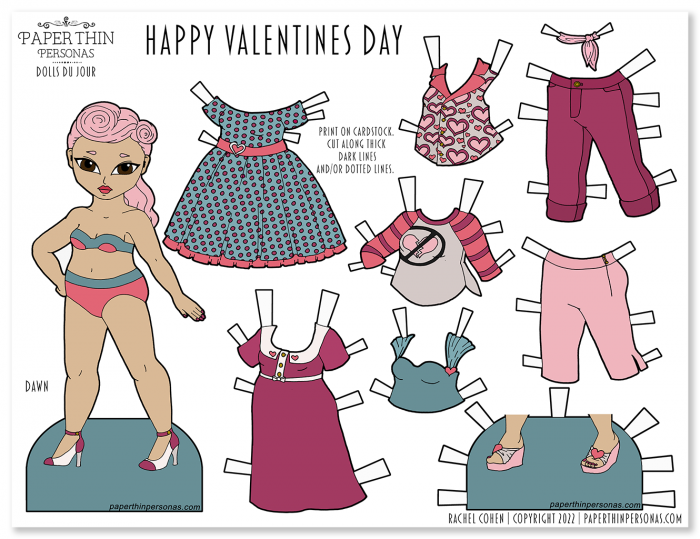
I have a deep fondness for Valentine’s Day paper dolls despite having a long history of having truly awful Valentine’s Days. However, my grandmother used to send me and my sister cards for Valentine’s Day and they often included paper dolls, so I like to continue that tradition here in her honor.
So, first off, Happy Valentine’s Day. I hope it is, if not great, at least uneventful and, tomorrow, there’s a lot of cheap chocolate available which always seems like a nice perk. It’s also a good time to get some roses on sale if you like roses. I confess to being more of a peonies person myself, but each to their own.
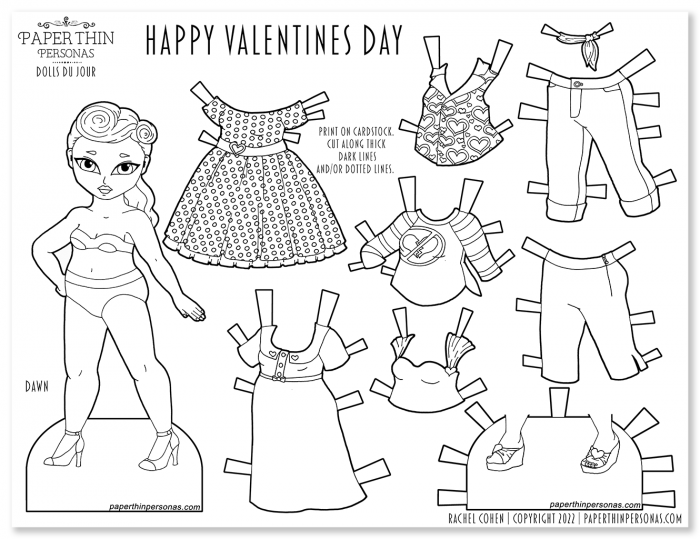
For today’s Valentine’s Day paper doll I wanted try out something I hadn’t done before, so I slipped into the world of vintage inspired rockabilly fashion. If that wasn’t a stretch enough, I then gave myself the challenge of coloring the whole thing without using any red, because I do think the color schemes for Valentine’s Day can get a little boring. How. much pink and red does one person need?
Meanwhile, you can get any number of additional Valentine’s Day paper dolls from previous years here and let me know if you’ve got plans for the holiday in a comment.
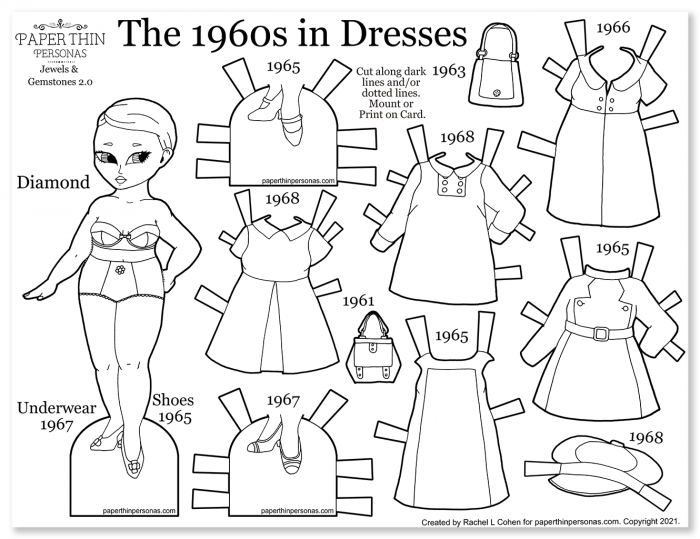
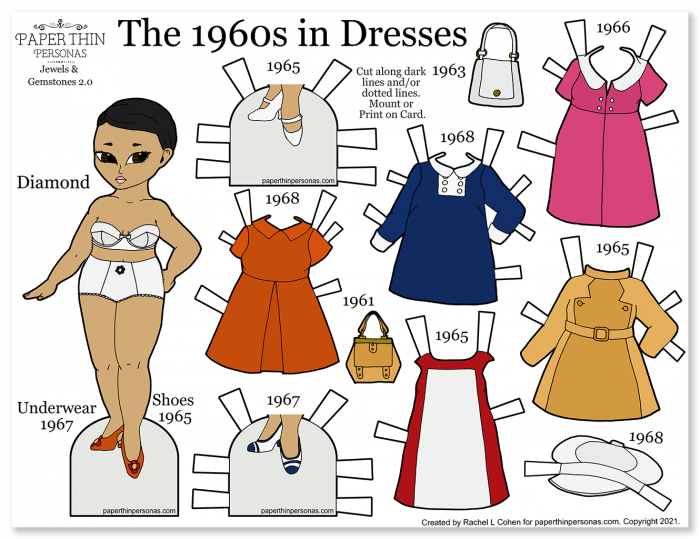
When I think of the 1960s, these playful swing dresses come to mind. They really don’t show up until the second half of the decade, but they are so iconic. I knew when I decided to so some 1960s sets that I wanted one to be mod styles like these. My other two themes are sophisticated (see Sapphire from last week) and a beach summer set which was a Patreon piece.
Her flower shoes are here from Charles Jordan in 1965. Her other shoes, hats, and purses are from John Peacocks’s 20th Century Fashion Source Book.
I have one more paper doll from 2021 that I have finished to share, than there will be a round up post for all the 2021 (though I know it is 2022) paper dolls for the Jewels and Gemstones. After that I plan to take a few weeks off as a treat and we’ll see how I feel. I love doing my Valentine’s paper dolls, so I don’t want to miss that this year.
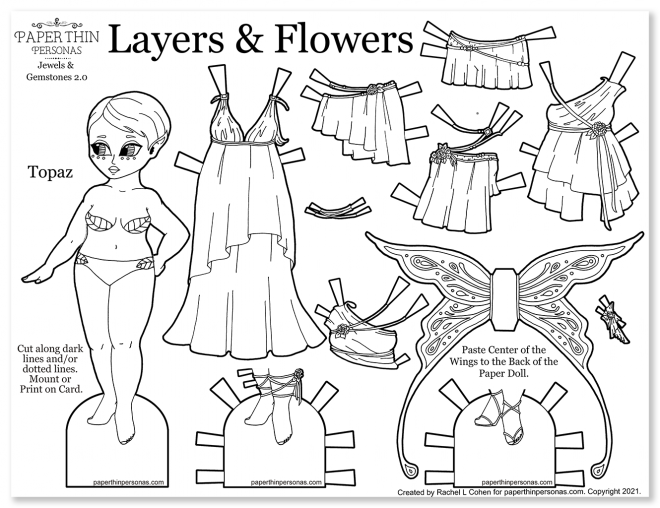
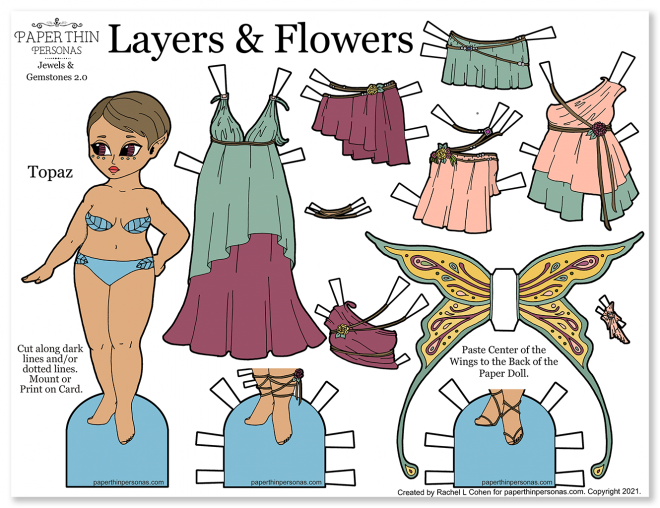
One of the nice things about working with the Jewels and Gemstones 2.0 collection is when I feel a little stumped or frustrated, I have a back log of older Jewels and Gemstones stuff to refer to and build on. This set, for example, came from a Topaz as a Woodland Fairy set combined with a Fairy Wings and Gown set. I added a few things, removed a few things and then recolored everything to feel cohesive. This is actually the first of two fairy sets I have been working on.
While I recommend gluing the fairy wings to the doll for sturdiness, you could also use adhesive Velcro (or hook and loop tape if we’re being more general) dots and apply on to the back of the doll (or maybe two, depending on size) and then one or two to the wings and that would give you a way to have removable wings. I would add that not all adhesive velcro is paper friendly (some is specifically designed for fabric), so I would double check that.
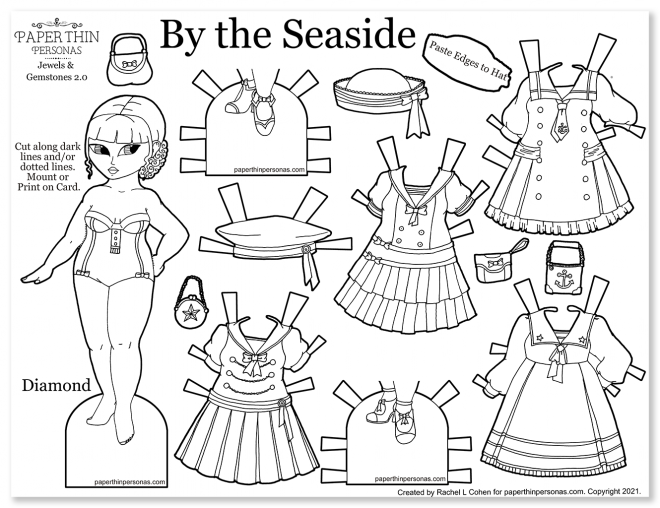
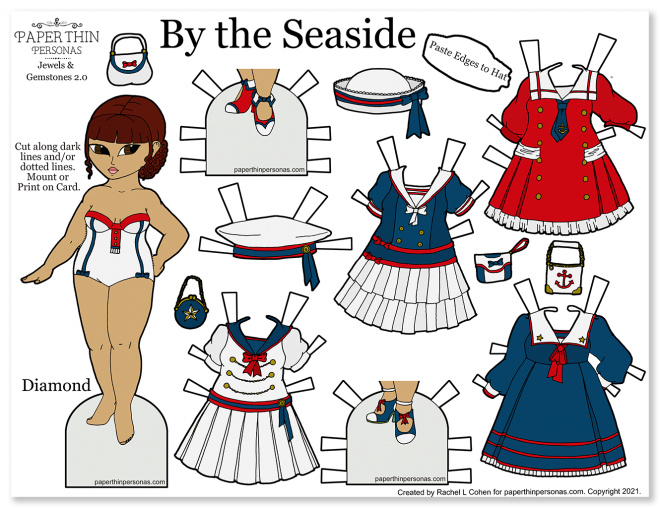
Lolita fashion is a Japanese alternative fashion style that is based on Victorian children’s clothing and all things cute. Let me be clear- if you know anything about actual Victorian clothing, this is not Victorian clothing. It’s Victorian clothing taken to the absolute extreme of ruffles and matching and theme. Like anything in this world, there’s a lot of sub-genre’s of Lolita fashion.
Sailor Lolita, one of the many genres of this style, emphasizes pleats, sailor collars, and all things nautical. If you want to see more of this style, I have a Pinterest section for Military and Sailor Lolita Fashion. While I love a lot of different Lolita styles, the thing them I find most interesting is that (despite the name) it is a hyper-feminine style without being sexualized- necklines tend to be high, skirts are at least knee length, shoes are often without heels.
One thing I find interesting is that elements of Lolita fashion has become more mainstream as the cottagecore trend seems to be flourishing at the moment. I’ll be curious to see how these hyper-feminine styles evolve over time and if they stick around after the trauma of the pandemic. Cultural upheaval often seems to bring about a flourishing of feminine clothing styles- the Great Depression, the Aftermath of World War 2… etc.
Anyhow, this isn’t the first time I’ve done Lolita fashion for Jewels and Gemstones 2.0 paper dolls, I did a Gothic Lolita foray back in 2020. To fill out my themes, there are several other Lolita sub-genres I should explore like sweet, wa, qi, and classic. However, for the moment, here’s nautical. (And yes, some of these pieces came from a Jewels and Gemstones 1.0 set.)
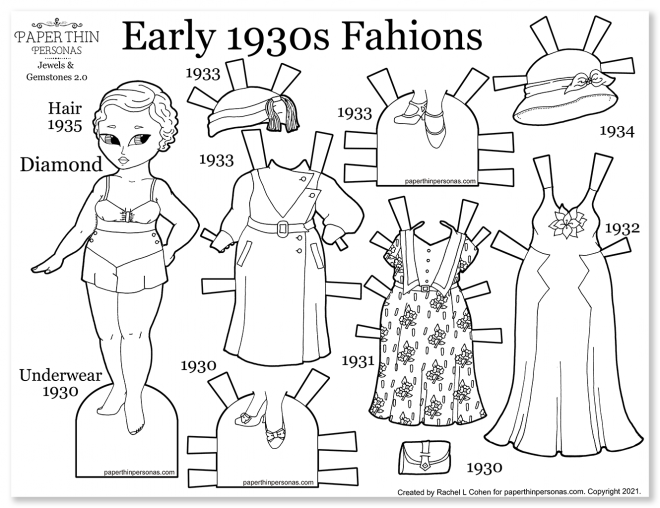
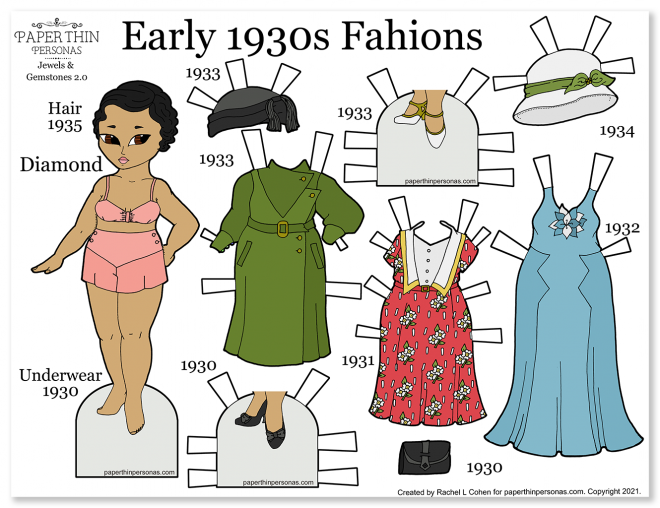
As I was working on writing up alt-text for my images, I realized this printable paper dolls sort of has a little mini-wardrobe. Since, she has an evening dress, a coat, and a day dress. Plus with the two hats, she’s ready for anything. And, of course, she can share clothing with Amethyst and her 1930s clothing.
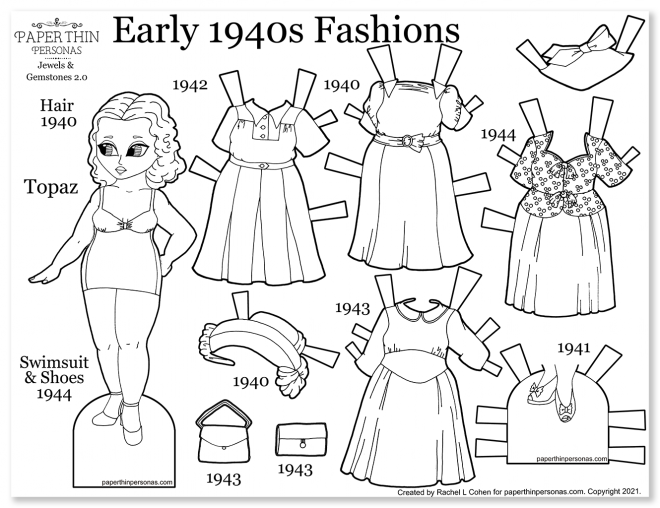
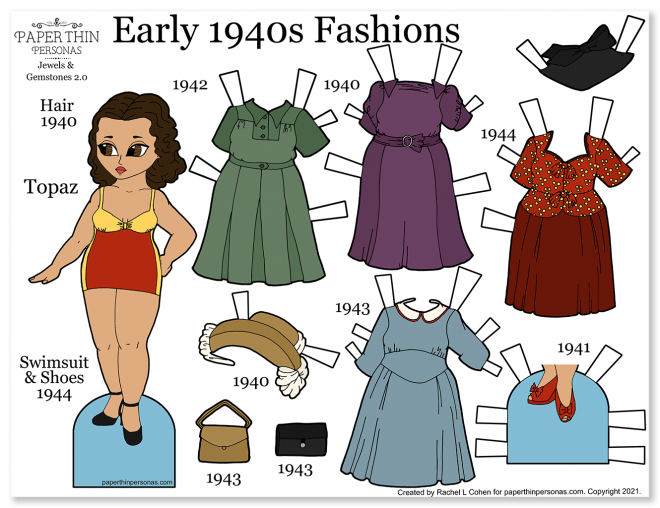
When I am drawing a historical fashion set, like today’s 1940s fashion paper doll, I always struggle a little to find sources. Since most things after 1924 are perceived as being still in copyright, there’s just not as much out there on the internet. I won’t get into my personal opinions about that one, but I did discover an amazing resource when I was working on this 1940s fashion paper doll was this site called Christmas Catalogs & Holiday Wishbooks. It doesn’t just contain Christmas catalogs, but also have general Sears, Montgomery Ward, and a few JCPenney catalogs from the mid-20th century. Super fun to look through- one thing I noticed was the gradual decline of space given to the topic of hats for women in the catalogs from the 1940s to the end of the 1960s.
You can see more of my sources on my 1940s Fashion Pinterest Board. I also used my books, as I usually do. There’s going to one more from this collection. The first one was last month’s Patreon paper doll. I’m also doing a Patreon poll on the next decade I should do (I already have a 1960s and 1930s sets in the works). Currently, the 1980s is in the lead. If you are a patron, go vote!
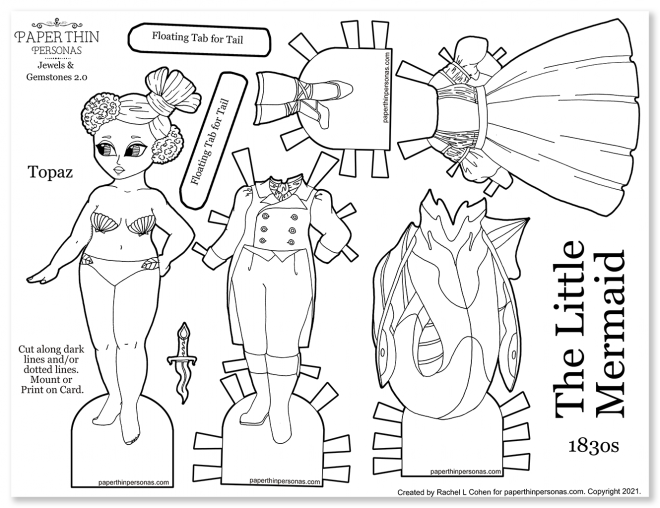
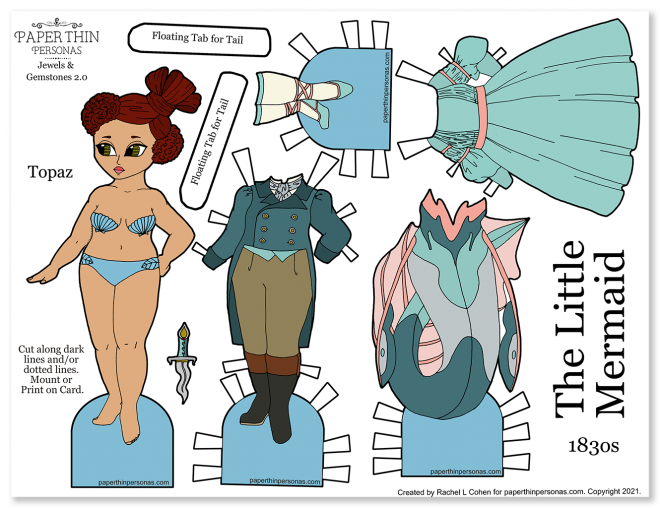
To end the month of Mer-May, I wanted to share this Little Mermaid paper doll. As you probably know, the Little Mermaid by Hans Christian Andersen is the classic tale of a mermaid who becomes obsessed with a prince, gives up everything for him, ends up in agonizing pain until he marries someone else, nearly kills him, kills herself, and gets to spend 300 years doing good deeds for humans, so that she might someday win a soul to go to heaven.
Most illustrated versions of the tale I’ve seen place the story in a orientalist fantasy setting, but I wanted to draw on fashions from around 1837 when the story was written. So, the paper doll’s dress is based on this dress from 1837, this dress from 1833-1837, plus this dress from 1837-1839. Her hair is from the early 1830s and I love those silly hair styles. I used this fashion plate. Despite appearances, it’s actually simplified.
The men’s outfit references a line in the story where the Prince has a page outfit made for the Little Mermaid, so she could ride with him. My paper dolls’ riding costume is based on this coat from 1830 to 1840 and this suit from the 1830s. Though the cut is a bit more regency than it is 1830s and the boots are very regency, I confess.
The knife with the paper doll is the one that the Little Mermaid’s sisters trade their hair for to try to save the Little Mermaid’s life by having her stab the Prince to death. By the way, if you’ve never read the original, I think you should. It is not the Disney tale most people think of.
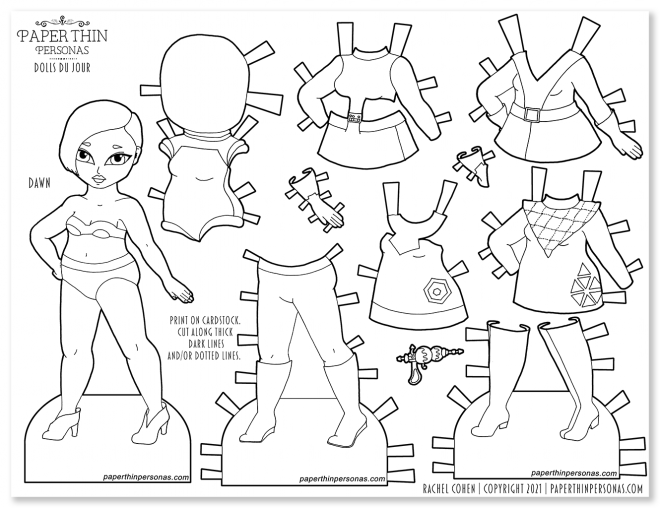
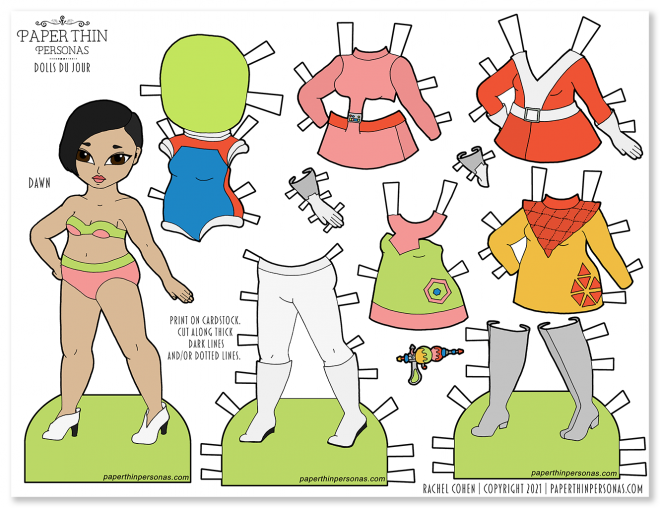
There’s something really fun about retro futuristic clothing of the 1960s and I had fun drawing it for today’s printable paper doll. I was tickled when I saw it mentioned in the latest issue of Paper Doll Review. Anyway, I’m always up for drawing paper dolls with retro space clothing. I’ve been watching Star Trek: The Original Series with my partner during the pandemic and it’s a hoot. So, here we have four space mini-dresses, a totally impractical space suit and some very important space boots.
Want to support the blog and access to more paper doll every month? Join us on Patreon!
Manage Consent
To provide the best experiences, we use technologies like cookies to store and/or access device information. Consenting to these technologies will allow us to process data such as browsing behavior or unique IDs on this site. Not consenting or withdrawing consent, may adversely affect certain features and functions.
Functional Always active
The technical storage or access is strictly necessary for the legitimate purpose of enabling the use of a specific service explicitly requested by the subscriber or user, or for the sole purpose of carrying out the transmission of a communication over an electronic communications network.
Preferences
The technical storage or access is necessary for the legitimate purpose of storing preferences that are not requested by the subscriber or user.
Statistics
The technical storage or access that is used exclusively for statistical purposes.The technical storage or access that is used exclusively for anonymous statistical purposes. Without a subpoena, voluntary compliance on the part of your Internet Service Provider, or additional records from a third party, information stored or retrieved for this purpose alone cannot usually be used to identify you.
Marketing
The technical storage or access is required to create user profiles to send advertising, or to track the user on a website or across several websites for similar marketing purposes.