Peony In the 1860s: A Dress from August 1864


{View Larger} {View the PDF} {View Black & White} {View the Black & White PDF}
{More Poppets Paper Dolls}


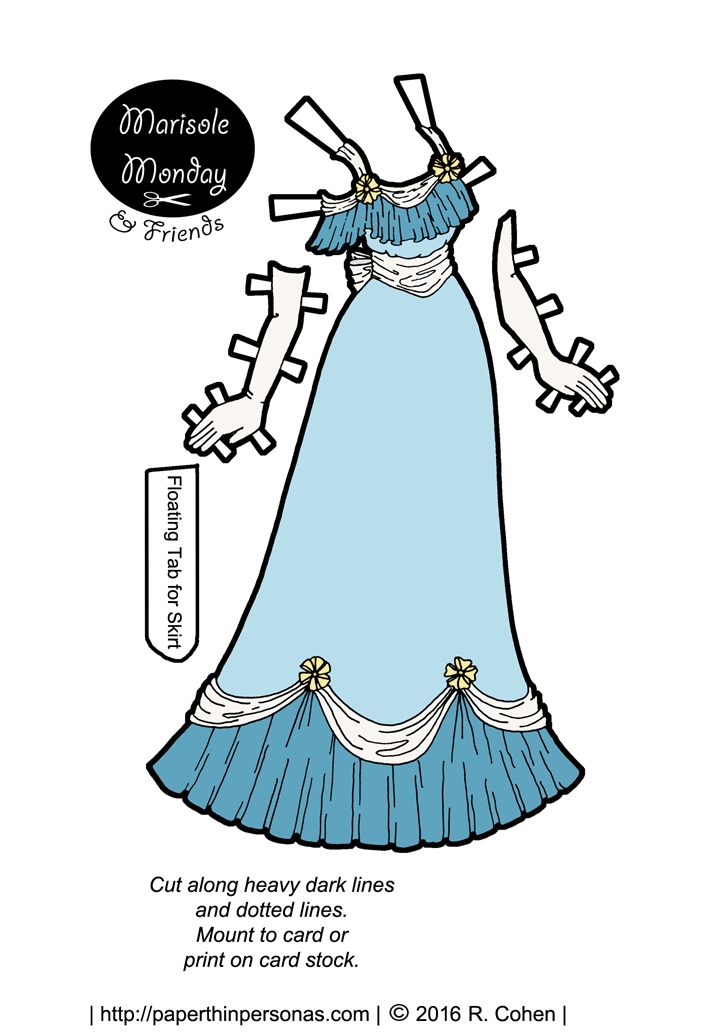
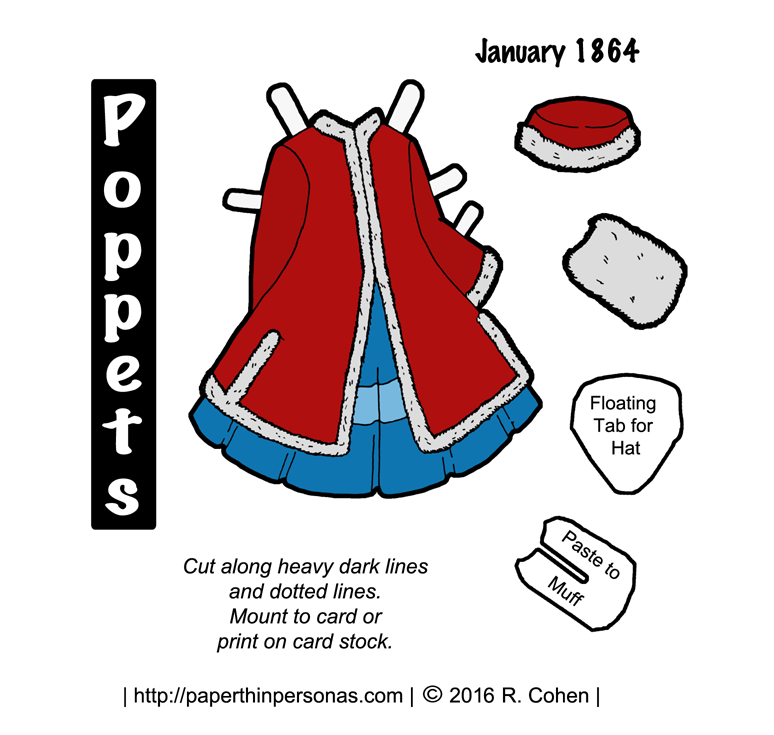
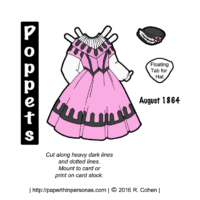
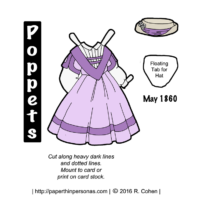
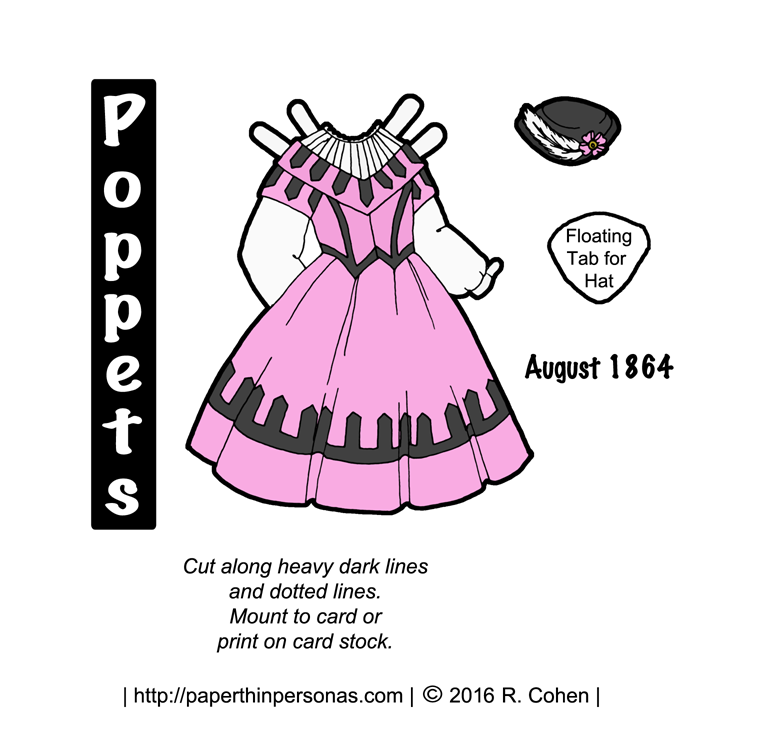
Poppets paper dolls dress with pink and black color scheme from August of 1864. From paperthinpersonas.com.

It’s day two of our Civil War children’s clothing week. Today’s paper doll dress is a mix of two dresses from the 1860s. A fashion plate from August 1864 inspired the dress design. The color scheme is from a different fashion plate from June 1865. The pink and black combination from that fashion plate was so contemporary that I wanted to use it. I think it is easy to forget how bold the Victorians could be.

This dress would have been in several parts. It’s not clear from the illustration, but I think the bodice and skirt are meant to be separate pieces. Underneath the bodice, a guimpe is worn. While It is also possible that the bodice and skirt connect, like a jumper, that is not how adult women’s dresses in this era were made.

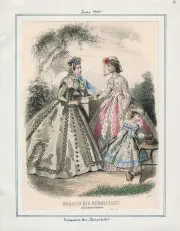
fashion-plate2-1864
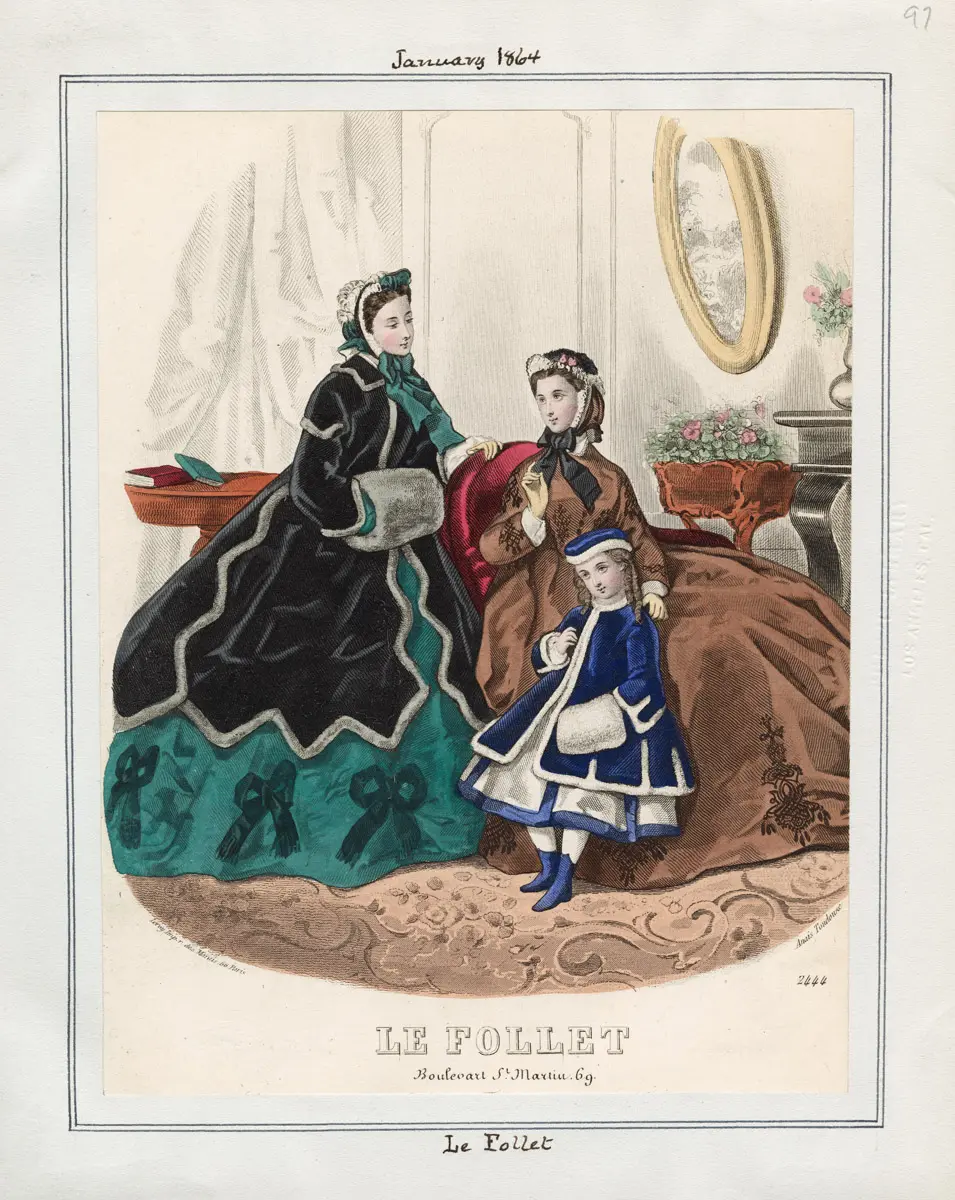
The dress design comes from this fashion plate.

If you’ve never heard the word guimpe before, don’t fret. It’s not a word that gets tossed around in most conversations. A guimpe was a high necked blouse-like garment women and children wore underneath a low-necked dress. Think of it like like a dickie or a camisole today. A guimpe was never supposed to be seen without a something over it. Some weren’t even complete blouses, but were just dickies and matching sleeves. Part of the appeal of the guimpe, I suspect, was that washing it was more easy than washing the entire dress.

(If you ever have a time and interest, laundry practices of the 19th century are actually fascinating if, you know, you’re me.)

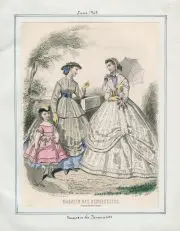
fashion-plate3-1865
The color scheme comes from this fashion plate.

Both of the inspirational fashion plates come from the same publication Magasin des Demoiselles. This French fashion magazine in the 19th century was very popular. Many of the 1860s plates from Magasin des Demoiselles include children, along with the ladies. It’s a great resource for what the fashionable girl, or, more rarely, boy, would have worn while running about and being a kid.

Not that running around being a kid was really condoned too much in this era.

Both fashion plates are from the Casey Fashion Plate index which is an excellent resource for 19th century fashion plates.

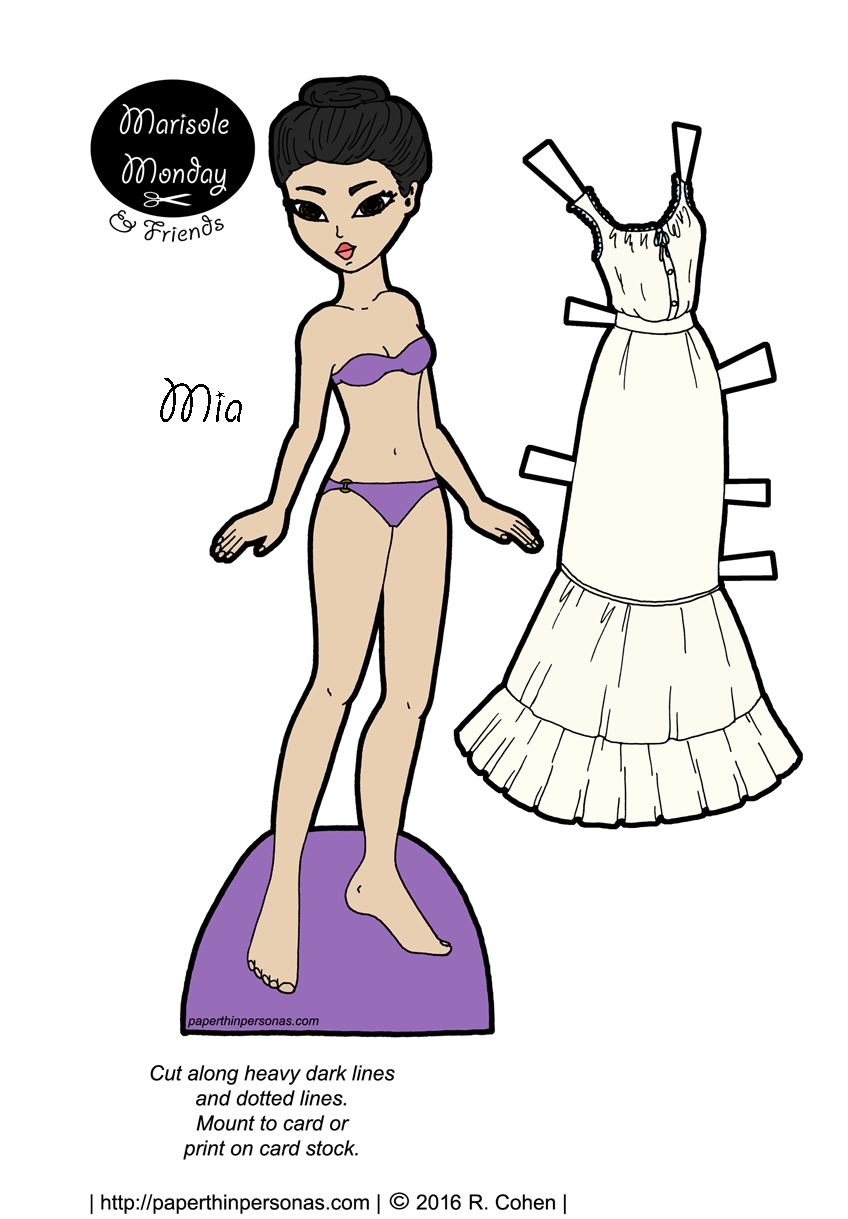
As a friendly reminder, the black and white versions are linked above with the PDFs. Also, if you need a doll, here she is from Monday.

So, what do you think of my pink and black color scheme? Too bold for the era or okay? I always love to know what you think. Love the blog? Consider supporting it by becoming a Patron, every dollar is lovely.

Peony in the 1860s: A Paper Doll Dress from August 1862


{View Larger} {View the PDF} {View Black & White} {View the Black & White PDF}
{More Poppets Paper Dolls}


A paper doll with a dress from August 1862, boots and a hat from paperthinpersonas.com. Part of a week of civil war children's clothing designs for the Poppets paper doll series.This week I’m diving into civil war children’s clothing with the help of the Casey Fashion Plate Index from the Los Angeles Public Library. This fantastic resource has literally hundreds of fashion plates. Today’s Poppet dress comes from Magasin des Demoiselles, a French fashion magazine of the 19th century.

I named today’s Poppet paper doll Peony. I thought I was out of P flower names, but I never did a Peony, so Peony it is! Then I’ll have to decide what to do about Poppet paper dolls and their P names.

Despite what I was once told in a costume history class, children of the 19th century didn’t dress like miniature adults. There were, in fact, many complex social rules governing how children were dressed.

While adult women did not expose their arms unless they were attending a ball (or swimming, sometimes), children could have short sleeves, especially in the heat of summer. Today’s dress is and example of this from August 1862. I simplified some of the trimming and chose blue tonal color scheme over the red and black scheme of the original Civil War children’s clothing dress design.

Fashion plate from Casey fashion plate collection from August 1862 featuring two women and a child.

Alternatively, you can download the black and white version from the links at the top of the post.

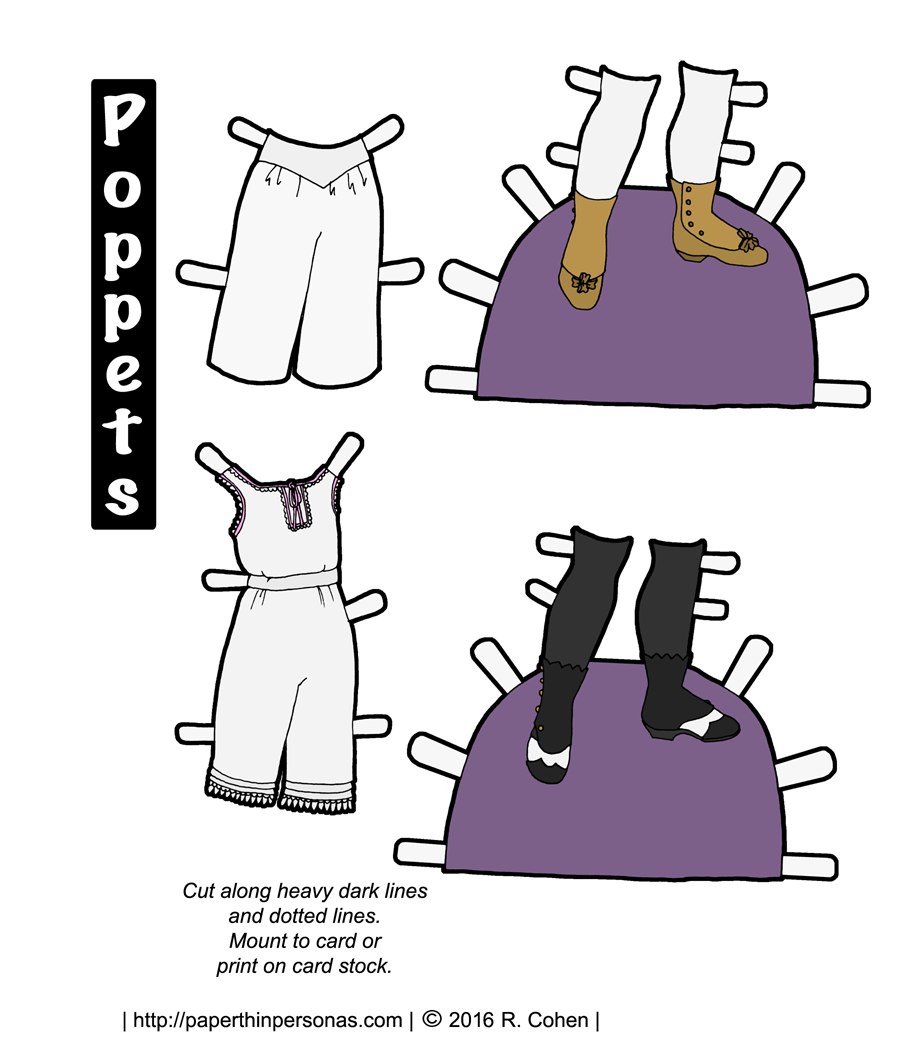
Peony’s hat is trimmed in contrasting yellow roses and matching blue ribbon. Her boots are flat soled and side lacing, which was typical for civil war era shoes. Side laced and button up boots were both worn in the 1860s, but by the end of the decade button boots were much more popular. Her stockings should really be tights or held up by a garter belt, but in the interest of making things simpler, I decided to ignore that particular fact of history.

Should you be worried about her going commando, than fear not- she’ll get some proper undergarments on Accessory Thursday.

If you need another set of dolls to wear this clothing, here’s more of the Poppet family, just be sure to print them from the PDF without fit to page and everything should work out.

Thoughts? Comments? Solutions to my “P flower names” problem? As always, I love to hear from y’all and if you like the blog, consider supporting it by becoming a Patron.

1930’s Historical Fashion Paper Doll With Maeghan

1930s-summer-logo Over the years, I have made several other paper dolls of the 1930s, but never a Marisole Monday & Friend’s set, so it seems fitting to rectify that in my goal of 10 historical paper dolls this year. Meaghan is modeling this set, though I’m sure she’d be happy to share with Mia, Monica, Marisole, or Margot.

The 1930s introduced beach pajamas for women, so Meaghan has a set of those with a striped sweater. Other trends of the era include bias cut evening dresses, of which she also has one. And no lady could leave her house without a fashionable hat and gloves, of course. Shoes wise, she has sandals, since this is a summer set and she needs sandals.

Whenever I see vintage fashions and I am jealous of them, I am reminded that I rather wouldn’t want to wear hats and gloves all the time.

A paper doll coloring page celebrating the 1930s with a five piece wardrobe, hats and accessories. Free to print from paperthinpersonas.com.

{Click Here for a PDF to Print} {Click Here for a PNG to Print} {Click Here for More Marisole Monday & Friends Printable Paper Dolls}
Originally, I was planning a red, white and blue sort of nautical color scheme, but I didn’t like the idea of it once I actually started coloring. Once I was in the midst of the coloring, I decided to go with a coral, yellow and pale blue scheme. The colors are summery and bright.

There is no black at all in the set, I chose white as my neutral color instead. Something about white just screams summer to me.

A printable paper doll celebrating the 1930s with a five piece wardrobe, hats and accessories. Free to print from paperthinpersonas.com.

{Click Here for a PDF to Print in Color} {Click Here for a PNG to Print in Color} {Click Here for More Marisole Monday & Friends Printable Paper Dolls}
This is normally where I put down a list of sources. I confess that I drew these dresses so long ago, that I simply can not recall all of them.

I remember two inspirations though. This post from Wearing History from 1936 and this pattern cover from 1934.

I’ve only done two other historical paper dolls this year and so I need to get on the ball with that one, huh?

And I need your help…

[poll id=”16″]

A 1300s Fashion Paper Doll

1300s-historical-paper-doll-logo Once again, we are dabbling in the 1300s with today’s paper doll. There’s no new sources for this one, so if you want to know what I referenced, than I would recommend returning to my last paper doll of the 1300s with a sources list at the bottom.

One of my goals for 2016 was to draw ten historical paper dolls. I confess I am far from achieving that goal and we’re halfway though the year (nearly), so I seriously need to get my act together on this one. So, my goal for the next few days is to buckle down and get some drawing, scanning and finishing done.

We’ll see how that goes.

I have a few days off work and I always start these things with a long list of “goals”, but I fear my plans are often larger than my capacity. Still, I’m out of backlog and nothing is as good as an artist motivation as desperation.

A 1300s fashion paper doll coloring page with a five piece wardrobe. Free to print and color from paperthinpersonas.com.

{Download a PDF of this paper doll to Color} {View a 150 dpi PNG of this Paper Doll to Color} {More Bodacious & Buxom Paper Dolls}

Picking out colors wasn’t very hard, since I seem to always come back to the same ones when it comes to the 1300s. I blame it on medieval manuscripts I have seen. I always think of the 14th century was being red and blue and gold.

Sterotypical, perhaps, but none the less. There we are.

A 1300s fashion paper doll with a five piece wardrobe. Free to print from paperthinpersonas.com.

{Download a PDF of this paper doll in Color} {View a 150 dpi PNG of this Paper Doll in Color{More Bodacious & Buxom Paper Dolls}

Between my new 1300s Buxom and Bodacious paper doll, my viking paper doll, and my Cranach paper doll, we’re starting to get a pretty nice set of early Western Fashions. I keep promising myself I’ll do one from a decade of the 19th century, but I can’t pick one. So, 19th century B&B series suggestions would be welcomed.

Lastly, I hope everyone has a delightful week.

An 1830s Historical Paper Doll Coloring Page Featuring Greta

1830s-greta-logo The 1830s is an era of Western fashion that I have generally found mystifying. Poke bonnets, giant sleeves, caplets are all features of this era of historical dress and none of them have ever really appealed that deeply.

And yet, I am nothing if not someone who like to learn about stuff and sometimes I try to challenge myself. I want to embrace periods of fashion that I don’t really like all that much and so I found myself deciding that this year, I was going to try out the Romantic period.

I would, I told myself, draw a paper doll with 1830s fashions and I would enjoy it!

(Or at least not totally hate it.)

The 1830s are an interesting time fashion wise though. The introduction of the metal eyelet in 1828 means that the 1830s are the first era when corsets were really capable of being laced terribly tightly (metal eyelets can take a lot more stress than handsewn ones) and to make matters more interesting, vulcanized rubber was used in clothing as well for the first time in the 1830s. Innovations all around.

The cage carioline which was used to support skirts in the 1860s doesn’t exist yet, so skirts are held out with horse hair petticoats and horsehair sewn in the hems. That means the silhouette isn’t as full as it would become in a few decades.

A historical fashion coloring page featuring a paper doll and her 1830s wardrobe. Exclusive to paperthinpersonas.com

{Download a PDF to Print} {View a 150 dpi PNG} {Check out some More Mini-Maiden Printable Paper Dolls}

All right, so Greta, the paper doll modeling these 1830s outfits has a full set of underwear from this era which includes a chemise, corset, petticoat and sleeve supports. In order to fill out huge leg-o-mutton sleeves of the era, women used a variety of sleeve supports of various sizes. I made hers small so the underwear could easily layer.

She has two dresses. A day dress based on this garment and a ballgown. I swear the ballgown is based on something, but try as I might, I just couldn’t find the reference image I used. So… Trust me? Greta also had a poke bonnet and some false hair styled in the Apollo Knot style.

Women in the 1830s went a little nuts in the hair department. See this fashion plate and you know what I mean.

I hope everyone enjoys this little foray into the 1830s. This is an era I should stick around with? Drop me a comment and let me know!

Also, I am looking for questions to answer in a video about inking paper dolls. So, if you have a question that you’ve always wanted answered, put it in the comments. 🙂

A 1960s Paper Doll to Color Featuring Isadora

Mini Maidens Logo IsadoraI have, over the years, created a lot of paper doll sets and I just couldn’t believe I’ve only done one 1960s paper doll and I haven’t felt comfortable calling her historical, because I can’t verify my sources on her. So, here’s another one, giving me two 1960s paper dolls.

Let’s talk sources, since that’s what divides “historical” paper dolls from “inspired by” paper dolls. (At least that’s my standard today, I haven’t always been SO militant about it.)

The dresses for this paper doll set were drawn based on this image and this image both of which are Creators Studios fashion illustrations from the New York Public Library Digital Gallery.  Two of the other dresses were based on pattern covers from McCalls in 1965 and Simplicity in 1965. Ankle boots from the V&A dated 1967.

Another of the dresses is an André Courrèges mini-dresses from 1965 thanks to the FIDM Museum Blog which is totally my favorite museum blog. Is that bad? Am I allowed to have a favorite? Cause I totally do.

I swear I had a reference for her other boots and her pants and matching top, but I’ll be darned if I can find them… So, I’ll add them if I track them down.

One of my 1960s paper dolls, Isadora is rocking a mod wardrobe of 11 pieces. Free to print from paperthinpersonas.com

{Download a PDF to Print} {View a 150 dpi PNG} {Check out some More Mini-Maiden Printable Paper Dolls}

So, can I confess that I tend to get Isadora and Hazel confused? I totally do. And so as I was working on this post, I actually had it labeled as Hazel for a few hours before I realized that I wasn’t looking at Hazel.

How embarrassing!

Today’s 1960s paper doll was a request from one of my Patrons. (Want to join?) At the end of 2015, I sent a private survey to all my Patrons asking for ideas for 2016. It was anonymous, so I don’t know who put down 1960s, but I do confess it made me realize I’d done very few 1960s paper dolls.

And that was easy to fix!

Thoughts on Isadora and her sixties fashions?

At the Seaside: 1890s Paper Doll Children’s Clothes

Poppet logo. 1890s historical paper doll children's clothes. First of all, Merry Christmas to anyone who celebrates. Today we have a completely non-thematic set of paper doll clothes. 🙂 This is what happens to me at the end of the year. I’m just all about getting the stuff I have done posted, so today we have some 1890s beachwear for the Poppets with a sailor suit and a swim suit.

Sailor suits were very popular in the 1890s and they were worn by all different ages of children (and some adults). You can find examples all over the place if you happen to be looking. I used the book Children’s Fashions, 1860–1912: 1,065 Costume Designs from “La Mode Illustree” which happens to be out of print, but is a great resource. Both the swimming costume and the sailor suit come from the illustrations in this book.

One of the interesting things about sailor suits is that they didn’t change in style much. Here is an example from La Semaine De Suzette in 1908. (La Semaine De Suzette was a French children’s magazine that published sewing patterns for the doll Bleuette through out its many year run. There are passionate collectors of the dolls who make the wonderful patterns. Someday I would love to do a paper doll of some of the amazing Bleuette patterns.) Some more examples from various eras include this sailor suit from the 1920s, a magazine illustration from 1890 and an extant example from 1905. Clearly, the sailor suit stuck around for a long while, making them a great subject for paper doll clothes.

A set of 1890s paper doll clothes for the Poppet printable paper doll series. Free to print in color from Paperthinpersonas.com A set of 1890s paper doll clothes for the Poppet printable paper doll series. Free to print from Paperthinpersonas.com

{Download a PDF in Color} {View a 150 dpi PNG in Color}{Download a PDF to Color} {View a 150 dpi PNG to Color} {Poppet Paper Dolls to Wear These Clothes}

Our paper doll’s swimsuit is also from Children’s Fashions, 1860–1912: 1,065 Costume Designs from “La Mode Illustree”. Swimsuits in this era never look like they would be very comfortable or easy to swim in to me. Still I liked the little ruffles on the sleeves.

Posey is the paper doll modeling today’s 1890s outfits, but Peach probably has the most historical hair style of the bunch with her curls.

I hope everyone is having a Merry Christmas with family or not, as you prefer. 🙂

Smart Winter Clothes: 1940s Printable Paper Doll Clothes

poppet-1940s-logoThere aren’t a lot of really good books on historical children’s clothing. I know I’ve mentioned before my pet-peeve of people making the assumption that “children dressed like adults” which is a huge over simplification of the history of childhood.

For this 1940’s outfit, I used Children’s Fashions 1900-1950 As Pictured in Sears Catalogs. The book is out of print, which I think is a pity, since it is one of the few fashion history books that specifically focuses on children’s dress. There are a few others, but this is one of my favorites.

The original dress was patterned, but I worried if I added a pattern I would lose the heart shaped pocket details and the pleats, so I went patternless. Sometimes I think busy patterns obscure some of the more interesting design details.

I stuck with simple underwear- just a pair of panties- and shoes with socks. Mary-Janes are my favorites in any era. There would probably be a slip worn under this dress, but it didn’t occur to me to draw one until later, so we’re going slipless.

poppets-1940s-paper-doll poppets-1940s-paper-doll-bw

{Download a PDF in Color} {View a 150 dpi PNG in Color}{Download a PDF to Color} {View a 150 dpi PNG to Color} {More Poppet Printable Paper Dolls}

The color scheme I think came from a catalog page, but now I can’t find it. I usually save these things on Pinterest, but alas. So, you’ll just have to trust me on this one. Both these garments are from the early part of the decade before World War Two. Once the war starts, things like pleated skirts are largely out of the picture due to fabric rationing. However, before the war, they are very much in style.

For those of you who might be curious, Petunia is modeling our 1940s outfit.

So, I hope everyone in the US had a fantastic Thanksgiving. I made pie! Everything’s better with pie. After nearly a decade, I think I have finally mastered my mother’s pie crust recipe. I still think she makes better pie than me. There is something about the pie made by family. Nothing is ever as good.

As usual, I always love to hear from readers in the comments. And if you like the paper dolls, please consider supporting PTP through Patreon.

A 1950s Paper Doll with Some Curves

A printable paper doll with a 1950's vintage wardrobe in black and white. She has a suit, a cocktail dress and a day dress.Today’s printable paper doll has a retro flare- 1950s fashions abound. My goal was to make ten Buxom and Bodacious paper dolls before the end of 2015. I’m going to be honest, I don’t know right now if I’ll make it. My other goal was to have ten historical paper dolls by the end of 2015 and I have certainly made that goal, even if I count the massive 18th century Pixie paper doll set from August as one one set and not several.

Next week I’ll have a 1940s Poppet set up. It’s very cute and I’m very excited about it.

Actually, I’m very content with where I am in blogging and life at the moment. If I can just stop thinking of January as “a long way off.”

A printable paper doll with a 1950's vintage wardrobe in black and white. She has a suit, a cocktail dress and a day dress.

{Download a PDF of this paper doll to Color} {View a 150 dpi PNG of this Paper Doll to Color}
So, my sources for these 1950s paper doll dresses were this day dress from the V&A, this Dior suit from the Chicago history Museum. The cocktail dress comes from a site called Vintageous which sells vintage formal-wear. I couldn’t find the original cocktail dress, but you can see it on my 1950’s Fashion Pinterest board. My only major regret with these dresses is that I ended up with such a busy pattern on the day dress. It is reflect the original well, but I think it also obscures some of the details.

It’s okay though. Not every plan works out well.

A printable paper doll with a 1950's vintage wardrobe in black and white. She has a suit, a cocktail dress and a day dress.

{Download a PDF of this paper doll to Color} {View a 150 dpi PNG of this Paper Doll to Color}
I choose to use mostly secondary colors in this set. Orange, green and purple with some dark navy and light blue thrown in for fun. I went with black for the accessories, since any well dressed lady of this era had shoes that matched her purse. I wish there was a way to fit more than one pair of shoes into these B&B sets, but alas… there really isn’t.

I was listening to West Side Story while I colored this paper doll set, so I based her skintone, hair color and eyes on a Puerto Rican friend I had in high-school.

I have a quick poll for my readers:

[poll id=”12″]

As always I love to hear what you think in the comments and would appreciate your support through Patreon. 🙂

Brooches and Smokkr: A Viking Paper Doll

A paper doll of a viking woman from the 10th century with two historical outfits based on the work of scholars in Viking dress in color. She also has shoes and historical accessories.In truth, we know very little about what Viking women wore, so that makes drawing a Viking paper doll sorta exciting (and scary). Unlike the 10th century Anglo-Saxons, the Vikings did not have a manuscript culture. Their art was generally metal work or stone carving and highly stylized. Making things more rather than less complicated, textiles rot extremely quickly in soil and those which remain in tact are often saved by their proximity to other materials such as metal, while metal breaks down it releases salts that protect the textile.

This means that what remains we have of Viking garments are fragmentary at best. While working on my Viking paper doll, I did my research, as always, and then made decisions based on my understanding of Viking garments. My understanding isn’t perfect. I am not an archaeologist, nor do I study Viking cultures extensively. My post Wednesday, Viking Women’s Dress in the 10th Century  covers my sources and what I understand about Viking garments.

A paper doll of a viking woman from the 10th century with two historical outfits based on the work of scholars in Viking dress in black and white. She also has shoes and historical accessories.

{Download a PDF of this paper doll to Color} {View a 150 dpi PNG of this Paper Doll to Color} {More Paper Dolls in the Bodacious & Buxom Series}
Though I came away from my research with the conclusion that there is more supposition than certainty in Viking dress research, I couldn’t be more pleased by how my printable paper doll came out. Her two apron-dresses or smokkrs over shirts were both designed based on the work of some excellent scholars. I chose a closed smokkr, because I agree with Ewing’s and Geijer’s views on the shape of the smokkr. I added an apron on one, based on the work of Bau and Ewing. To the other, I added pleats based on the reconstruction of a smokkr by Hilde Thunem. She has a key, a cup, a comb and a small knife. From the brooches on her left smokkr hang a pair of scissors, a small knife and a needle case.

Her shoes are based on finds at Viking York and her stockings and garters are based on the work of Ewing who argues that Viking men wore garters. I have no reason to believe if men were wearing them than women weren’t. Besides, Scandinavia is rather chilly to be wandering around bare legged.

A paper doll of a viking woman from the 10th century with two historical outfits based on the work of scholars in Viking dress in color. She also has shoes and historical accessories.

{Download a PDF of this paper doll to Color} {View a 150 dpi PNG of this Paper Doll to Color} {More Paper Dolls in the Bodacious & Buxom Series}
When selecting colors, I tried to be aware of what colors were known to be used by Vikings. There were several references to brown twills in the articles I read (sources here) and the Kostup find is known to have been blue. Her brown smokkr, or apron-dress, has different colored straps, because linen loops were sometimes used on wool smokkrs. Linen, unlike wool, doesn’t take dye very well. I wanted to make a nod to that practice. Both the serks or shirts, I left undyed in lighter colors. One shirt is pleated, as is found in many Birka graves, and one is unpleated. The paper doll has a hair covering as referenced in Ewing’s book, Viking Clothing.

I made my Viking paper doll blond really only because when I think of Vikings, I think of blonds. Perhaps an unfair assumption, but there you go.

As with my Anglo-Saxon paper doll of the same century, I strongly recommend reading my little article and then reading my sources. I would also caution that most of the research on Vikings is not published in English. Until more of the articles are translated into English, I did the best I could with what sources were readily available.

I know people have been waiting on this printable paper doll, so I hope the wait was worth it. I certainly am nothing but pleased with how she came out.

As always, if you like the paper dolls and want to support the blog than check out my Patreon. 🙂

Viking Women’s Clothing in the 9th and 10th Century

An actual Viking oval brooch from the 10th Century- The Met- Accession Number: 1982.323.1

Today, we’re going talk about Viking women’s clothing, because I was working on a Viking paper doll. As always happens with me, I did a lot of research. This post could have been many more paragraphs, but what I wanted to do today was write a quick overview. The truth is that we actually don’t know what Viking women wore. Rather, scholars have examined various pieces of archaeological evidence and have come up with theories which, at times, completely contradict each other. In the this post, I tried to summarize the major scholars on the topic and explain what I learned while researching my Viking paper doll.

I maybe many things, but I am not a scholar on Viking dress.

Who were the Vikings?

The Vikings were a Germanic Norse seafaring culture which existed from about 700 ACE until about 1000 ACE. The main strongholds of Viking culture were Norway, Sweden and Denmark, but there where were Viking settlements in England, Ireland, Iceland and Greenland.  The Vikings also made contact as far as the Middle East, Russia, and China. Seriously, these dudes got around.  Their travels and expansion heavily influenced European medieval cultures.

Basic Overview

It is generally agreed that Viking women wore clothing; however, theories differ on what this clothing looked like.  Most agree that women wore a shirt of some kind underneath a dress suspended from two oval brooches. This dress is often called an apron-dress or smokkr. If you need to modern version, imagine a jumper. The apron-dress was held up by oval brooches, sometimes called dwarf brooches. Over top of the apron-dress women may have worn an apron in front, a pleated train in back, a caftan coat, a cloak or a shawl. That’s one of the areas  scholars disagree on. The exact meaning of the apron-dress and who was entitled to wear it is also a topic of debate. I’m not going to get into that discussion here. It should, however, be noted that this apron-dress does not appear to have been universally worn by women of all social statuses and ages.

More Here

Calash Bonnets & Chemise a la Reine: Late 18th Century Paper Doll Dresses


logo-late-18th-centLate 18th Century gowns before the waist begin to rise at the turn of the century are often defined by simpler lines. You can see in some of them the beginings of the aesthetic and gave rise to the Greek inspired looks of the Empire period in France and the Regency period in England.

Working left to right, as is my usual practice, she has a caraco jacket with a peticoat based on this caraco and quilted petticoat from the Museum of Antwerp and this outfit circa 1785-1790 from the V&A.

The middle dress is based on a robe à l’anglaise from the Kyoto Costume Institute that is dated to the 1780s. I have seen very few other examples of this style of gown in museums, though I would be curious to know how wide spread the style was. The belt is particularly distinct in these gowns and I can only recall having seen one other.

On the far right,there is a gaulle, or chemise a la reine. This radical style was introduced by Marie Antoinette in the early 1780s. I based my version of this iconic garment off a portrait of Antoine-Laurent Lavoisier and His Wife from 1788. To understand the shock such a garment would have induced in the 18th century, consider the reaction people might have if the First Lady of the US suddenly started talking around in her bra and panties in public, rather than chic clothing. Never the less, as is often the case with fashion, the simple lines of the gown caught on and it wasn’t long before all sorts of women were being painted in elegant and simple versions of the chemise a la reine. In fact, this gown could be seen as a direct predecessor to the simpler styles of the Regency and Empire periods. Very few of these gowns seem to have survived from the 18th century, but here is one example from the Manchester Art Gallery.

late-18th-cent-paper-doll-gowns-black-white

{Download a PDF to Print and Color} {Download a PNG to Print and Color}{More Pixie & Puck Printable Paper Dolls}

There are two distinct hats to go with today’s paper doll gowns. The first hat is a formal hat and comes from a portrait of Adélaïde Labille-Guiard from 1785 held at the Met. Adélaïde Labille-Guiard was an accomplished female painter in 18th century France. She was inducted into the French Académie Royale in 1783. Also, she clearly had excellent taste in hats.

The other hat is what was called a Calash. Calashes were a type of bonnet that was boned and could fold down for storage (and also was tall enough to get over the crazy high hairstyles of the century.) Calashes can be found easily in museums. Here are a few examples of them- one, two, three from the Met and one from the MFA in Boston. The Calash isn’t just an 18th century thing, either, these bonnets can be found in the 19th century as well.

The shoes are fairly standard 18th century style and aren’t based on anything specifically. I just thought my three paper dolls might need another pair of shoes.

late-18th-cent-paper-doll-gowns-color

{Download a PDF in Color} {Download a PNG to in Color} {More Pixie & Puck Printable Paper Dolls}

The color selections were all dictated by the original garments colors, except for the caraco jacket ensemble on the left. The one I wanted to do in warm autumnal colors since the chemise a la reine always seems a summer or spring sort of style to me.

This brings us to the end of this little series. If you missed any, check out the entire 18th Century Pixie series.