It’s Monday! And that means a new printable paper doll!
I previewed this set last Wednesday. As I said before, this paper doll was inspired by the idea of woodlands, fauns and spirits of the forest. I wanted to create something that felt layered and collected, rather than planned or purchased.
When I designed these pieces, I was thinking of autumn. Of course, it’s not autumn here. Summer is officially here in Alabama, which means it was in the 90s today and horrible humid. I have been hot and miserable every-time I go outside. I don’t know who invented air conditioning, but I am so grateful to them.
Today’s woodland paper doll is being modeled by Margot. There’s sixteen pieces with today’s paper doll set which is a lot of mix and match options.
I went back and forth and back and forth about color options here. I wanted to do a autumn scheme at first with all oranges and browns and yellows, but that looked kinda dull. So, green got tossed in to the mix to add some zest and brightness.
The light browns were based on colors of deer, which I always think as being a big part of the forest. I’ve always loved deer, both as beautiful animals and as tasty chili. (Seriously, venison chili is amazing.)
Many of my paper dolls are really characters I invent in my head who come from well formed worlds. Today’s is less so. I was thinking maybe a fairy of some type or a druid or perhaps a mage who focuses on woodland magics.
In truth, I don’t really know who this Margot paper doll is, but perhaps you have an idea you’d like to share in the comments?
One of my early paper dolls with an elaborate background.
Today, I want to talk about Artistic Quality and my belief that paper dolls should be beautiful both before and after they are cut out.
Listen, let’s do something radical for a moment, let’s think about Art.
No, let me say right now that I do not think of myself as an Artist. I just don’t 99% of the time. I am an avid doodler, a lover of paper dolls and someone who likes to draw.
But in that 1% of the time I do slip into that Artistic Head-Space, I realize a few things.
The first is that paper dolls are not fine art. There, I said it.
Now before people get out their pitch forks, let me tell you why.
Art is useless. By definition, a piece of art has only a decorative function. And this is wonderful. Making art is part of what makes us human and we should darn well continue doing it, but paper dolls are toys.
One of my more recent paper dolls with her custom background and layout.
That means they have a function- to be a plaything. (Remember my first Principle about playability?)
So, I think of paper dolls not as an art form, but more as a craft like sewing or quilting or knitting.
(This is not the place or the time to get into a debate about craft vs art. I will NOT go there, today.)
However, in the 1% of the time when I enter Artist Mode, I do consider two things.
The first is that paper dolls actually exist in two states.
State One is as a flat print object of a doll figure and her clothes. Sometimes, as a booklet, but often just as a flat sheet.
State Two is when the pieces have been cut out and then the paper doll can be fully realized as a toy.
If a paper doll is art, it is when it is in State One- flat sheet mode, before it has been cut.
Sometimes I use the same backgrounds on all the paper dolls in a series for coherence.
So, when the paper doll is just a sheet it needs to be attractive, just as it needs to be attractive when it is cut out.
The point I am making here is this- Layout and Format Matter!
The backgrounds I put on my paper dolls are there, because I think it makes for a more attractive work before it is cut out.
Now none of this matters if you are just creating for you, but once you start putting your work into the world, you have to ask, “Does this look good before it is cut? Does it look good after it is cut?”
So, I charge anyone who is thinking about these issues to go look at their favorite paper dolls and notice the layout, notice the time spent thinking about spacing, about placement, about clarity. These things are all important.
It’s not just about the doll and her clothes, it is about the whole experience.
I have a whole list of paper dolls I am trying to get finished. Some are destined for the blog and some I hope to put up for sale eventually, once I get my act together.
First up we have one of the Sprites. She’s a mermaid, but a modern one. I liked the idea of a modern mermaid girl with some contemporary beach clothing along with her tail. Plus any excuse to draw an aqua-blue afro.
My little mermaid paper doll in progress.
One of the requests from my Patrons (Join if you wanna) was to create some more fantasy gowns for the Ms. Mannequin series. So, here are some! I actually drew these back in December, but just now have gotten around to posting any pictures of them. I am still coloring. I haven’t really settled on a color scheme for these, so it’s been a struggle.
Some fantasy gowns for the Ms. Mannequin series.
Third up is another Patron request which was “Woodland”. So, here’s my woodland fairy/fantasy set that I have been working on. I am thinking a green and autummal color scheme with lots of browns, greens, oranges, yellows and rusts.
A woodland paper doll set for one of the Marisole Monday & Friend’s paper dolls.
And that’s what I’ve been working on!
Along with all this, I am also working on a series of videos about drawing paper dolls and am looking for questions about my process so I can answer them. I’ve gotten a great one so far, so anymore would be appreciated. Just leave them in the comments!
(Or anything else you want in the comments. I’m flexible.)
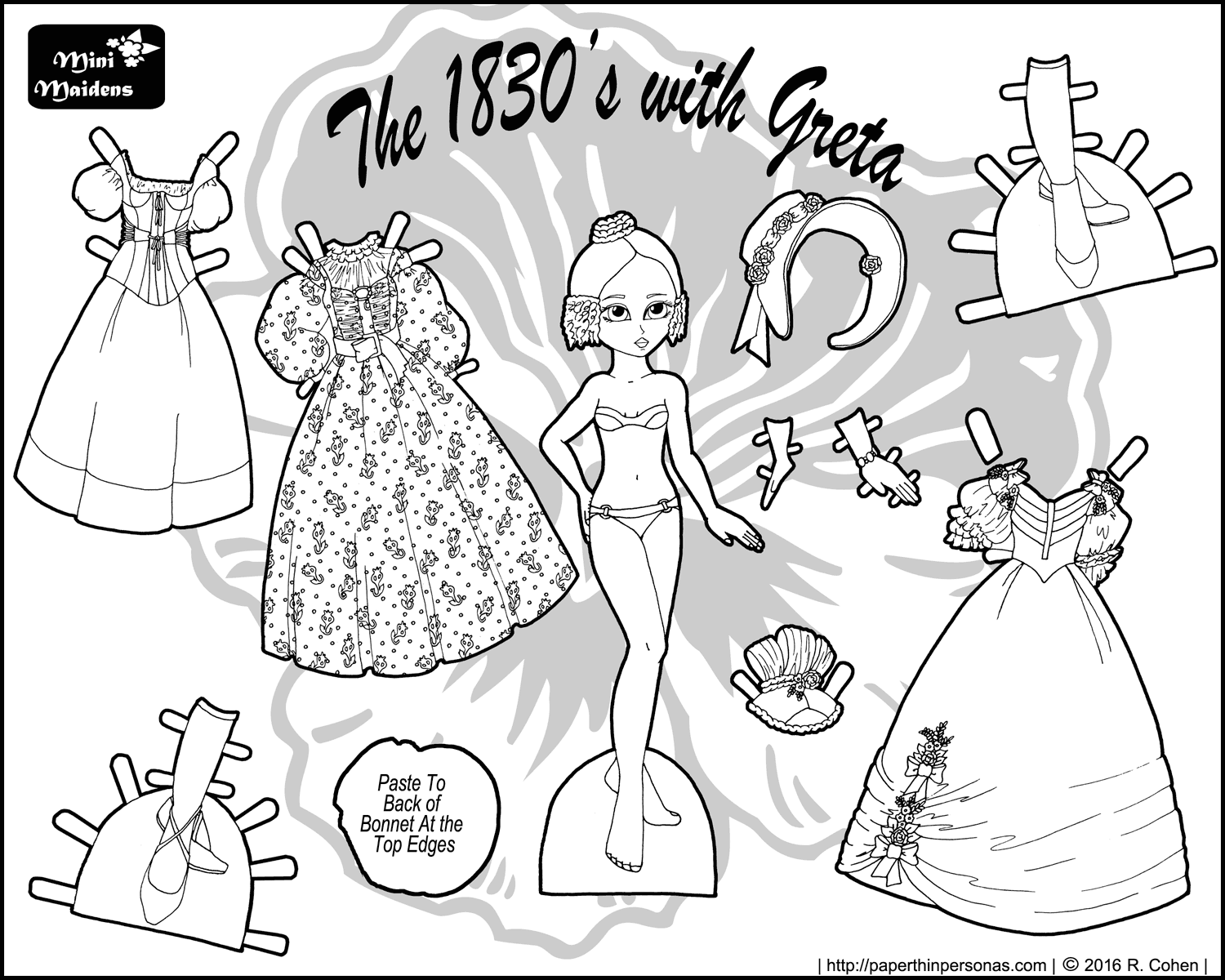
The 1830s is an era of Western fashion that I have generally found mystifying. Poke bonnets, giant sleeves, caplets are all features of this era of historical dress and none of them have ever really appealed that deeply.
And yet, I am nothing if not someone who like to learn about stuff and sometimes I try to challenge myself. I want to embrace periods of fashion that I don’t really like all that much and so I found myself deciding that this year, I was going to try out the Romantic period.
I would, I told myself, draw a paper doll with 1830s fashions and I would enjoy it!
(Or at least not totally hate it.)
The 1830s are an interesting time fashion wise though. The introduction of the metal eyelet in 1828 means that the 1830s are the first era when corsets were really capable of being laced terribly tightly (metal eyelets can take a lot more stress than handsewn ones) and to make matters more interesting, vulcanized rubber was used in clothing as well for the first time in the 1830s. Innovations all around.
The cage carioline which was used to support skirts in the 1860s doesn’t exist yet, so skirts are held out with horse hair petticoats and horsehair sewn in the hems. That means the silhouette isn’t as full as it would become in a few decades.
All right, so Greta, the paper doll modeling these 1830s outfits has a full set of underwear from this era which includes a chemise, corset, petticoat and sleeve supports. In order to fill out huge leg-o-mutton sleeves of the era, women used a variety of sleeve supports of various sizes. I made hers small so the underwear could easily layer.
She has two dresses. A day dress based on this garment and a ballgown. I swear the ballgown is based on something, but try as I might, I just couldn’t find the reference image I used. So… Trust me? Greta also had a poke bonnet and some false hair styled in the Apollo Knot style.
Women in the 1830s went a little nuts in the hair department. See this fashion plate and you know what I mean.
I hope everyone enjoys this little foray into the 1830s. This is an era I should stick around with? Drop me a comment and let me know!
Also, I am looking for questions to answer in a video about inking paper dolls. So, if you have a question that you’ve always wanted answered, put it in the comments. 🙂
Back when I started drawing, I was taught proportion using the “heads” method. This is because we tend to think heads are larger than they are, so this method using the head as the basis of measurement and keeps them from getting huge. (Says the girl who draws lots of HUGE heads.)
The “Heads Method”
In the “Heads Method” The average female figure is 7 heads or 7.5 heads tall. The .5 head accommodates the length of the foot. Some people go with eight heads, which gives you a longer leaner figure. Fashion illustration often uses nine heads with the extra head usually put into the length of the legs.
The width of the shoulders is usually 2 to 2.5 heads. The hips at their widest point measure 2 heads and the waist usually measures 1 to 1.5 heads.
Now, let me be clear: No one in the real world has perfect proportions, but these numbers can act as guides for when you’re working on a figure.
But wait, you’re thinking, your paper dolls have HUGE heads. How do I manage that?
Ratios, baby. Ratios.
I actually prefer to think in ratios. I find it easier than thinking in heads.
The “Ratio Method”
In the “ratio” method, the body is broken into parts and they are measured based on the size of other parts.
For example, the distance from the top of the head to the waist is one third. The distance between the waist and the knees is another third. The distance between the knees and the bottom of the feet is another third. This creates an elongated figure who is nine heads tall.
For a “seven” heads figure, the distance between the top of the head and the crotch is the same as the distance from the waist to the bottom of the foot. (Blue lines above.)
But if you want to ignore the head completely, because you, like me, want to draw people with huge heads, than you can measure from the neck to the crotch is the same distance as from the crotch to the bottom of the foot. (Yellow Lines Above.)
On the left above is part of the B&B series. As you can see, she had the same distance from the top of her neck to her crotch as she does to the buttom of her foot. In short, she is proportional, ignoring her huge head.
On the right is Monica of the Marisole Monday & Friends Family. Monica is NOT proportional. I wanted to show that NOT ALL my paper dolls have proper proportions.
However, the more I draw, the more I find I like things better when I do pay attention to my ratios.
My finished dolls, Claudia (right) and Olivia (left) got to hang out on my chair before I sent them off into the world.
For my birthday last year, my Sister got my a copy of The Making of a Rag Doll by Jess Brown. Jess Brown is an extremely talented and well regarded doll-maker whose work is sold by her own website, Land of Nod and other high-end stores. While nominally for children, her dolls are highly sophisticated and transcend that market. (You can listen to a great interview with her from the While She Naps Podcast.)
My original dolls on the left had no noises and their hair was craft felt that I pinned in place. Jess Brown’s book is on the right.
They are also very distinct. Once you see a Jess Brown doll, than you immediately know it is one of her pieces of work and her style has influenced a lot of other doll-makers. I feel like I see “Jess Brown-esque” work all over the handmade doll world.
When I sewed these two dolls from her pattern, I actually had to sew three bodies, because one arm tore off while I was trying to turn it. After stuffing, I did a version of Jess Brown’s distinct star shaped eyes and cut up some felt for hair. My two annoyances at Jess Brown’s book are that there are not really any instructions for hair and that the patterns are printed on green ink on brown paper. I had to take them into work to get a decent copy of them for cutting up.
Anyway, I pinned their hair on and stitching them up some bloomers and then… well, sadly, then they sat in a box for over a year.
Needless to say, I finally got my act together and started working on them in late April after I finished my baby gifts.
All the fabrics I first selected were based on the dark grey patterned fabric in the center. I did not end up using all these fabrics.
I pulled out my fabrics, sorted through my stash, and put together a collection of fabrics I liked for a wardrobe. I based my selections off this wonderful grey floral fabric from Cloud9 that I found at Joanne’s (the only place locally that carries Cloud9, sadly). I added fabrics to the collection as I realized I didn’t have enough of some of these to make a whole dress and had to adapt to my smaller amounts. (The book said that a 1/4 yard cut was enough to make a dress, but I found it was JUST shy of the pattern if you were following grain lines.)
The whole wardrobe of dolls was based around the grey floral fabric. Each doll also got two bags.
I don’t remember what my original plan was (it has been a year), but my “new” plan was to make the dolls three or four dresses, two or three pinafores, at least one coat, a second pair of fancier pantaloons with lace trim, and some bags. I discovered how much I loved applying ric-rac to basically everything and happily applied it to the red bag above in two stripes.
Most of the clothing patterns in the book are not hemmed, but rather use stay-stitching. I have written a poem about how I feel about exposed stay stitching:
I do not like stay stitching, Sam-I Am. I do not like it in a box. I do not like it on a fox. I do not like it on my doll. I do not like it at all. I do not like how it looks. I do not think it belongs in books. I do not like it on a dress. I think it is a mess.
Thank you.
But all joking and poetry aside, what I respect about Jess Brown, and all my favorite dollmakers/soft toy designers, is that there is no doubt that her work is her work. From sewing her dolls with dark thread that shows when they are stuffed to visible stay stitching, Jess Brown has a distinct style. All of her choices are specific. I do not believe Jess Brown uses stay stitching, because she can’t roll a hem. I believe she uses it, because she has made an artistic choice. And I respect that, even if when I made a doll from her patterns, I am going to make a different artistic choice.
That’s the thing about patterns- they are a place to start, not a place to end.
On the left is Olivia (the blond doll) and on the right is Claudia (the brunette).
I re-stuffed both dolls eventually and made their hair by hand stitching on squares of wool-blend felt. Originally, both dolls were gong to have pigtails, but I actually really liked the short hair look, so I left them off the brunette. Hand stitching the felt hair onto the dolls heads took all one evening while I watched TV. I used DMC floss to match the felt. I wanted the hair to be clearly handmade without looking sloppy.
Jess Brown dolls don’t have noses, but I think dolls need noses.
So, eventually, I gave both my dolls noses using thread. I actually really like the way the noses turned out and I want to try this technique again in the future.
Sewing up the doll clothes was totally addictive. Nearly everything was three pieces or less. No tiny sleeves to set in. No waist bands to attach. Everything was simple and I found, to my surprise, that I loved the simplicity. This surprised me. In paper dolls, I like complexity. I really thrive on tiny details, but while working on these dolls, I found I enjoyed the simple shapes that really let wonderful textile patterns shine.
Process photos working on the doll’s clothing.
Since the dress pattern was that it was just three pieces, it became a canvas for pockets (on the grey dress), lace trim (the flowed grey dress) and a pleat in the front. The only dress I was frustrated by was the pleated front dress. I struggled to get the bottom curved him to lay flat an the pleat should have been deeper than I made it. Oh well.. You live and you learn.
Each doll got two coats and two pairs of bloomers. The bloomers were a little hard to make, because of the dolls very wide and long hips. The body is triangular and that makes the proportions for pants a trifle odd. Still, my mother taught me all dolls need underwear.
On the left, you can see some of Jack the Seam Ripper’s handy work. On the right is a button covering a snap.
I didn’t end up using Jack the Seam Ripper a lot, but the curved hems on some of the clothes did give me some trouble. You can see some of my work in the picture above.
One of my favorite tricks is to cover snaps (which I think always look messy when I sew them on) with a button. I bought a big pack of these thin cheap shell buttons. Some were really warped, so I had to shift through them. I tried to pick out buttons that were “old fashioned” without feeling too old fashioned, if that makes any sense.
Part of this process wasn’t just about making two dolls for two people I love. It was also about trying out new things and doing something out of my comfort zone. I wanted to see what would happen if I made a Jess Brown doll, even though I am not a huge Jess Brown doll fan. I wanted to see if I could adapt this style into something I loved.
And I needed to figure out what I loved. What did I like in a cloth doll?
I’m beginning to learn it is very different than what I like in a paper doll. That’s okay though- it is part of the process.
Claudia with her entire wardrobe was sent off to my Sister.
In the end, each doll ended up with two pairs of bloomers, two coats, four dresses, two bags and three pinafores/aprons. I also made two little necklaces out of some chain and charms. Nothing really fancy, but I thought they needed some extra accessories.
Claudia’s blue dress ( I think of as her “fancy” dress) has an interior facing pleat. She has blue, pink and cream pinafores, along with a red bag with ric-rac and a pink bag trimmed in lace. Otherwise, her wardrobe is identical to her sister, Olivia.
Olivia with her wardrobe. She was sent to my Mom.
Olivia’s “fancy dress” has an exterior pleat. She has a grey, a pink and a cream pinafore. Her bags are also pink and red, but the red one is made from a different fabric. Otherwise, her wardrobe is identical to Claudia’s wardrobe.
My mother’s reaction to her was to remark that her feet looked very cold without any shoes. So, I recommended she knit her some socks. I don’t knit, but my mother does.
I have to confess, I sort of had to stop myself. I was completely ready to make them even more dresses and even more bags and other things. Still, at some point one has to declare a project “done” and I think 36 outfit combinations is enough. 🙂
Playing dress up with them before I sent them off to their new homes.
I thought I would close with a few photos of me playing dress up with the girls.
Next doll project is going to be one I can share IN PROGRESS and then I won’t end up with a post this long at the end. So, no surprises for anyone anymore.
Things I still need to work on include being able to backstitch without ending up with a nest of thread (though this stopped somewhat when I sorted out my tension), doll hair attachment and stuffing. Stuffing is something I need to get better at.
There’s a wonderful line in Into The Woods where Prince Charming says, “I was raised to be charming, not sincere.”
Well, I prefer my fairy tale prince paper dolls to be sincere, thank you very much. Hence why I named today’s paper doll, A Sincere Prince.
Over the years, I have drawn a few different “prince” paper dolls (no relation to the rockstar) and I think of them as coming from different fantasy worlds, much like I think of my Princesses as coming from different fantasy worlds. Mostly, I group them based on vague time period associations.
So, today’s Prince Marcus has a sort of renaissance feel to it while Prince and Gentleman was more 18th or 19th century and Marcus the Warrior was more Anglo-Saxon or Viking inspired.
Picking out colors wasn’t that hard. I knew I didn’t want to use green. I tend to use a LOT of green in male paper dolls. I don’t know why, but I do. Anyway, so once I decided, “no green” than it was just a matter of picking some fun colors. I have done a Green Prince if you’re interested.
I’m a bit belated on today’s post. I managed to fall into that trap where I have a good bit of material ready, so I tell myself, “Oh, I don’t need to work on anything. I have time.”
But time has a way of flitting off when I am not paying enough attention.
Anyway, I hope everyone enjoys today’s fairytale prince paper doll!
Women’s magazines in the 19th century published fashion plates- illustrations of women’s clothing intended to guide the reader towards the latest styles. I love fashion plates, but often the scans of fashion magazines scan the plates very poorly. On the other hand, many wonderful repositories of just fashion plates exist such as the Casey Fashion Plate index, but since plates were so often cut from the magazines, these collections omit the contextual information we need to understand the plates.
So, I spent some time pairing up beautifully scanned plates from the Casey Fashion Plate Index with their descriptions from various fashion magazines. I did excerpted the descriptions, added punctuation where needed, and corrected some truly strange spellings and archaic word choices. Riband means ribbon, apparently, though I did have to look that one up.
I chose to focus on 1834. Maybe because I am working on a paper doll from this era… Maybe….
Godey’s Lady’s Book Fashion Plates from 1834
If there ever was a magazine that barely needs an introduction, it is Godey’s Lady’s Book. In the 19th century, it was the most widely circulated magazine in the United States. That’s not just the most widely circulated women’s magazine, the most widely circulated magazine period. It began in 1830, but didn’t reach the height of its popularity until after Sarah Josepha Hale took over as the editor in 1837. She was an amazing woman and helped found the holiday of Thanksgiving. She also wrote the nursery rhyme “Mary Had a Little Lamb.”
(The Court Magazine and Monthly Critic describes identical dresses in their November 1833 issue.)
Evening Dress (left) – The robe is composed of a new kind of gauze, called gaze fleur des anges, a rose-colored ground, flowered in… a blond lace pattern, and worn over a satin slip to correspond. The corsage is low, cut in a very graceful manner on the shoulders… The lappel, bust, and bottom of the corsage, are each edged with blond lace. Bouffant sleeve slashed in front of the arm. The hair parted on the forehead, is disposed in light loose curls… A half wreath of blue wild flowers is placed rather far back (on the head) … gloves of white knitted silk, resembling double-grounded lace. Black satin slippers of the sandal kind.
Carriage Dress (right- identified as a Morning Dress) – A pelisse of lemon-colored gros frincesse… The sleeves very large from the shoulder to the bend of the arm, sit nearly, but not quite close to the wrist…. Pelerine (cape) of two falls, deep on the back and shoulders…. and knots of ribbon much larger than those on the sleeves are placed at equal distances from the waist to the bottom of the skirt. Lemon-colored satin hat, lined with pale lilac velvet… The trimming consists of knots of lemon-colored gauze ribbon and… flowers to correspond. Cashmere scarf. Lilac kid gloves.
Evening Dress (left) –Robe of.. satin; a low corsage, plain behind, but disposed in drapery folds in front… and turning back round the bust in the pelerine form. The lappel and the bust… are both bordered with blond lace… The sleeves are of the double bouffant form; the lower bouffant is extremely small; it is shaded by a row of blond lace… The border of the dress is embroidered in detached bouquets in silk to correspond… a turban of white and blue gauze… A white ostrich feather, tipped with blue, rises from the bandeau, and completes the trimming.
Evening Dress (right) – Satin under-dress of a peculiar shade of gray; the corsage is cut low, sits close to the shape, and is bordered with blond lace… A deep flounce of blond lace encircles the border of the dress… the sleeves of the single bouffant form over satin… Knots of fire-colored gauze riband decorate the sleeves, and the sides of the robe. The hair is divided on the forehead, falls in loose curls at the sides of the face, and is combed up tight to the summit of the head, where it is arranged in a cluster of light bows, in which a sprig composed of colored gems is inserted. A bandeau, composed also of colored gems is brought from the sprig round the forehead.
Ladies’ Pocket Magazine Fashion Plates from 1834
The Ladies’ Pocket Magazine was published in London. As far as I can tell, it came out twice a year and was small format (pocket-sized) and included a variety of content from stories to non-fiction, poems, essays and fashion plates. The plates were divided between styles from London and styles from Paris.
Dinner Dress- A green satin round dress a low body the front crossed in full drapery folds on the bosom. Long sleeves very wide and terminating in deep tight cuffs. Blond lace mantelet… The cap also composed of blond… is trimmed with an ornament of cut ribbon on one side and a bow on the other.
Evening Dress- A velvet robe of a new color bordering on lilac. The body cut low and square is trimmed with blond lace arranged in the lapel style. Bouffant sleeves… The hair is dressed in loose curls at the sides and in high light bows on the summit of the head. It is adorned with a bandeau of fancy jewelry and a sprig of… roses inserted in the bows.
Walking Dress- A pelisse of apple-green satin… trimming of white fox fur descends in a straight band down the corsage and passes from thence to the bottom of the skirt…. Green satin bonnet to correspond round and rather deep brim bordered with a blond lace ruche… The trimming of the crown is composed of ribbon which forms a point in the centre and two full blown roses inserted one on each side of the band on the top.
Lady’s Magazine and Museum of the Belles Lettres, Fine Arts, Music, Drama, Fashions, etc. Fashion Plates from 1834
The Lady’s Magazine and Museum was born after two older ladies magazines came together- The Lady’s Magazine and the Lady’s Monthly Museum. Both magazines began in the late 18th century in England to cater to the women’s market. By the 1830s, facing competition, they combined into one publication and continued until 1847.
Toilette de Ville – Hat of… satin ornamented with two ostrich feathers. Cloak… lined with satin… The cape is about half the length of the cloak… The cape is cut open at each side… and shows the sleeves which are immense… The collar and cuffs of black velvet.
Child’s Dress- Cloak of pink satin made with large sleeves and pelerine…. the cloak is fastened round the waist by a… boa of swan’s down… Frock and trousers… to match and trimmed at the tops with swan’s down. Satin hat with a plain ribbon crossed in front and descending at the sides.
Costume de Soiree– Dress of organdy embroidered in colored worsteds [in a pattern of] rose buds and foliage… The embroidery is continued in a light wreath round the bottom of the skirt to mark where the hem should come… The cap is… a plain crown and excessively full border which is very deep in front and diminishes gradually towards the sides… White gloves, white silk stockings, and black satin shoes.
The sitting figure shows the back of the same gown. This was a common “trick” in plates of this era and I think it’s pretty charming.
Thoughts on the 1830s? Other periods of fashion I should take on?
My best-friend in highschool and middle-school was a curvy girl with a goth and punk style. Now, this might not seem like an odd thing to be today, but in Juneau, Alaska, in the early 2000s, this was practically unheard of. In the early days of internet commerce, buying a corset in Alaska required a willingness to shop online when the online options were limited to Amazon and a few catalog retailers. So, when I sat down to draw today’s curvy goth paper doll, I knew I wanted to celebrate my old friend and her willingness to break the mold.
Despite my interest in alt-fashion, I have never really wanted to wear it in public, but I respect people whose style choices are much more adventurous than mine.
Not that it is hard to be more adventurous than the girl who wears white shirts and cardigans to work nearly every day.
Anyway, when I work on designing something for a fashion genre, I try very hard to be as authentic as possible. Of course, as an outsider to any cultural group, it is nearly impossible to capture all the nuances, but I wanted for my goth paper doll to have a nice range to mix and match pieces which could also share with other paper dolls. After all, maybe she’ll want to wear a sundress or some thigh high platform boots one day.
Color schemes for anything goth is going to be a lot of black (obviously) and I didn’t want to try to really break the mold here, so I stuck with my old friends favorite colors- black, red, and purple. Lavender was a Victorian color of mourning, so that seemed appropriate. Though the Victorians took their mourning culture way seriously.
While my natural tendency is to avoid patterns, I wanted at least one patterned piece in the bunch and a corset seemed like an obvious choice. The skull and roses pattern is mirrored in her purse and the limited color palette means I think it can go with either skirt.
I have always loved patent leather, so the boots were an obvious place to make some shiny-texture. I am out of practice with that technique though and it took three or four tries to get it right. I’m still not in love with the outcome, but I’ll live.
Looking for more goth paper dolls? I have a whole tag for gothic fashion, though looking through it, I confess I thought I had more gothic paper dolls.
Hmmm…. Maybe I need to draw some more, because there’s not a lot there.
[poll id=”15″]
As always, I always love to hear that you think of the paper doll!
Several readers have, over the years, asked about how I do pattern placement on my paper doll clothes. I actually use several different methods depending on the complexity of the pattern and the shape of the underlying garment.
Today, I am going to show you how to place a pattern onto a garment in Photoshop where the garment does not have folds, pleats or ruffles of any kind.
Garments like that include pencil skirts, most pants, most coats, many knit tops and suits. Really anything made of fairly structured fabric or style.
Last time on Paper Doll Principles, we discussed Playability. Today, I am going to talk about Diversity.
As I explained in my first post, here are the “commandments” of my paper doll world:
Playability: Every paper doll must be a functional toy.
Artistic Quality: All paper dolls must be beautiful before and after they are cut out.
Diversity: Every person deserves a paper doll that affirms their existence.
Now, let’s talk about paper doll diversity.
Paper Doll Diversity
Dover’s excellent book about Famous African-American women.
Seven or eight years ago, back when PTP was just a thought in my head, I was looking through my own paper doll collection and I discovered that I owned no black paper dolls that were not either paper dolls of actual people (like Dover’s excellent Famous African-American Women) or paper dolls of ethnic dress (like Traditional African Costumes Paper Dolls ). I don’t recall what made me dig through them looking for one, but I remember being surprised by this discovery. I also didn’t see a single Asian paper doll that wasn’t wearing ethnic clothing, like Dover’s beautiful Japanese Kimono Paper Dolls or were of specific people. Now, my own collection is a small sample of the paper dolls created in this world, but it very much struck me at the time.
I believe the omission of brown skin and Asian features from paper dolls is largely because in the United States, we default to the assumption that people are white. So, that is someone’s skin-tone or ethnicity is not stated, than white skin becomes the default. This is a phenomena which can be seen in more things than just paper dolls, but since this is a paper doll blog that’s what I’m focusing on.
In recent years there have been several paper doll sets published by major publishers that have challenged this phenomena, including Dover’s Ballet Dancer Paper Dolls, Teen Pop Stars and Fashion Models paper dolls, all of which feature four dolls in four different skin-tones by Elieen Russel Miller. China Town Paper Dolls by Kwei-lin Lum is another excellent set that celebrates the history of Chinese Americans in this country. I’m sure there are more, but these are the ones that I am currently aware of. While I would still like to see more of this, I do think it’s a wonderful sign that this might be changing for a more diverse paper doll world.
When as an artist, I depict people who are not like me, I believe I have a huge responsibility to do so with respect and care. There have been many unfortunate paper doll depictions of African-Americans in this country. Arabella Grayson, a passionate collector of black paper dolls, writes about this on her wonderful website 200 Years of Black Paper Dolls. I am unaware of a similar project documenting paper dolls of other ethnic groups, but if anyone knows of one, do tell. I am not perfect in this regard, but I decided years ago that I was going to try to create paper dolls that didn’t default to white. So, if you want a brown skinned paper doll wearing 1910s suits, I can hook you up. If you want a curvy, Asian, post-apocalyptic paper doll, I got that too.
But there are also times when the best of intentions, can become problematic. Cultural appropriation is a complex, nuanced, and often very difficult world to navigate. So, I am going to talk about not my successes in paper doll diversity, but what I think of as one of my failures.
The Parable of the African Fantasy Set
This could totally be subtitled, “One Paper Doll Rachel Kinda Regrets”.
So, back in 2011, I drew a paper doll called Inspired by Africa. At the time, I had been asked to do an African inspired fantasy set by a reader.
Naively, I drew the set, not really knowing what I was doing and then proceeded to post about it, making it as clear as I could that it was a fantasy set.
And I moved on with my life and kinda forgot about it.
The Inspired By Africa set which I worry is promoting stereotypes about Africa.
Two years later, in 2013, I noticed that Inspired By Africa had been linked on a forum for homeschooling stating that it was a paper doll of African ethnic costume and I couldn’t have been more mortified. To make matters worse, when I followed the link from the forum post to the original site, I found a webpage where someone had made the same statement and provided a link to the paper doll.
So, I emailed the site owner and asked to have the descriptive text changed to “fantasy”.
Even after all of that, when I look at that paper doll set, I have reservations about it.
First, I think her outfits are stereotypical. I worry that when I made her, I was doing the same thing people do when they throw buckskin on a paper doll and call it “Native American”. (Problem A)
I also know that one of the big issues Africa faces is that it is NOT one country, but many and am I supporting the view of a monolithic place when in reality it is not? (Problem B)
Further more, the paper dolls outfits are distinctly primitive. Am I promoting the idea that African is primitive and therefore inferior? (Problem C)
Despite all those second thoughts and worries, I haven’t taken her down, because one of the comments on that post came from a young girl living in Nigeria who said she loved the set.
And yet, I don’t know what I would say to someone if they asked me too remove it or told me it was stereotypical and problematic, because it is.
Moral of the Story: This stuff is WAY more complex than just throwing some brown skin on a princess and calling it good. The way people are depicted does matter, and as artists, we are responsible for our art. We are also responsible for recognizing that our art has a life of its own. Once created, our audience is not obligated to come back to us and ask what we meant. The art will be, and should be, judged on its qualities and not the intention of the artist.
In short, it doesn’t matter what you “meant” it matters what you did.
So, after all that, I am curious what y’all think…
[poll id=”14″]
Edit: There was a problem with the poll this morning, I thought I had it fixed, but I was wrong. It is now officially fixed. Sorry about that, but thank you to everyone who commented.
Comments? Questions? Have you ever drawn something you regretted? What did you do about it? What responsibilities do we as artists have to the ethnicities and races we depict?
Another printable princess paper doll this week. Clearly, I was in the mood to draw fantasy dresses. I did think about trying to get some other sets done and then breaking up my princesses, but in the end, that just didn’t work out. So, May has become a month of printable princess paper dolls for the Marisole Monday & Friends crowd and people are just going to have to deal.
So, in the 12th century, there was this garment called a “bliaut.” Now, I’ll be honest, I am still learning about 12th century clothing, but in my limited research the “bliaut” was a wide sleeved gown with a full skirt. The most famous example, I know of, is from the sculptures on the exterior of the Cathedral of Notre-Dame de Chartres. Another example is the Unshaw Virgin from the British Museum. I’m still mid-research to create a historical 12th century paper doll, so while I work on that, I thought I would draw a fantasy paper doll inspired by the 12th century.
Along with the 12th century, Maiden here owes a bit to Norse things with her bone comb and her knife. I think she could be a generation or two removed from my Maiden of the North paper doll from last year or maybe from the same “world”, but a different geographic region. I also think Marcus as a Warrior fits in as well.
Now, I will confess that I did try to make something very different from Monica’s Dreaming Princess set here. Despite the fact that they are both fantasy paper dolls with a distinctly princess vibe, the styles are pretty different. Maiden here is all about the 12th century while Dreaming Princess was all about the early Italian renaissance look. Plus, while Dreaming Princess was modeled by Monica, Margot is the model for Maiden, a title picked entirely because it fit in the space I had left after rearranging this set like a dozen times.
For colors, I wanted to use shades that reflected manuscript illustration. While Dreaming Princess was me channeling my inner-8 year old. This paper doll was much more my taste which tends towards more muted colors when I think of fantasy gowns.
Questions? Comments? I’d love to know what you think of today’s paper doll.
Manage Consent
To provide the best experiences, we use technologies like cookies to store and/or access device information. Consenting to these technologies will allow us to process data such as browsing behavior or unique IDs on this site. Not consenting or withdrawing consent, may adversely affect certain features and functions.
Functional Always active
The technical storage or access is strictly necessary for the legitimate purpose of enabling the use of a specific service explicitly requested by the subscriber or user, or for the sole purpose of carrying out the transmission of a communication over an electronic communications network.
Preferences
The technical storage or access is necessary for the legitimate purpose of storing preferences that are not requested by the subscriber or user.
Statistics
The technical storage or access that is used exclusively for statistical purposes.The technical storage or access that is used exclusively for anonymous statistical purposes. Without a subpoena, voluntary compliance on the part of your Internet Service Provider, or additional records from a third party, information stored or retrieved for this purpose alone cannot usually be used to identify you.
Marketing
The technical storage or access is required to create user profiles to send advertising, or to track the user on a website or across several websites for similar marketing purposes.