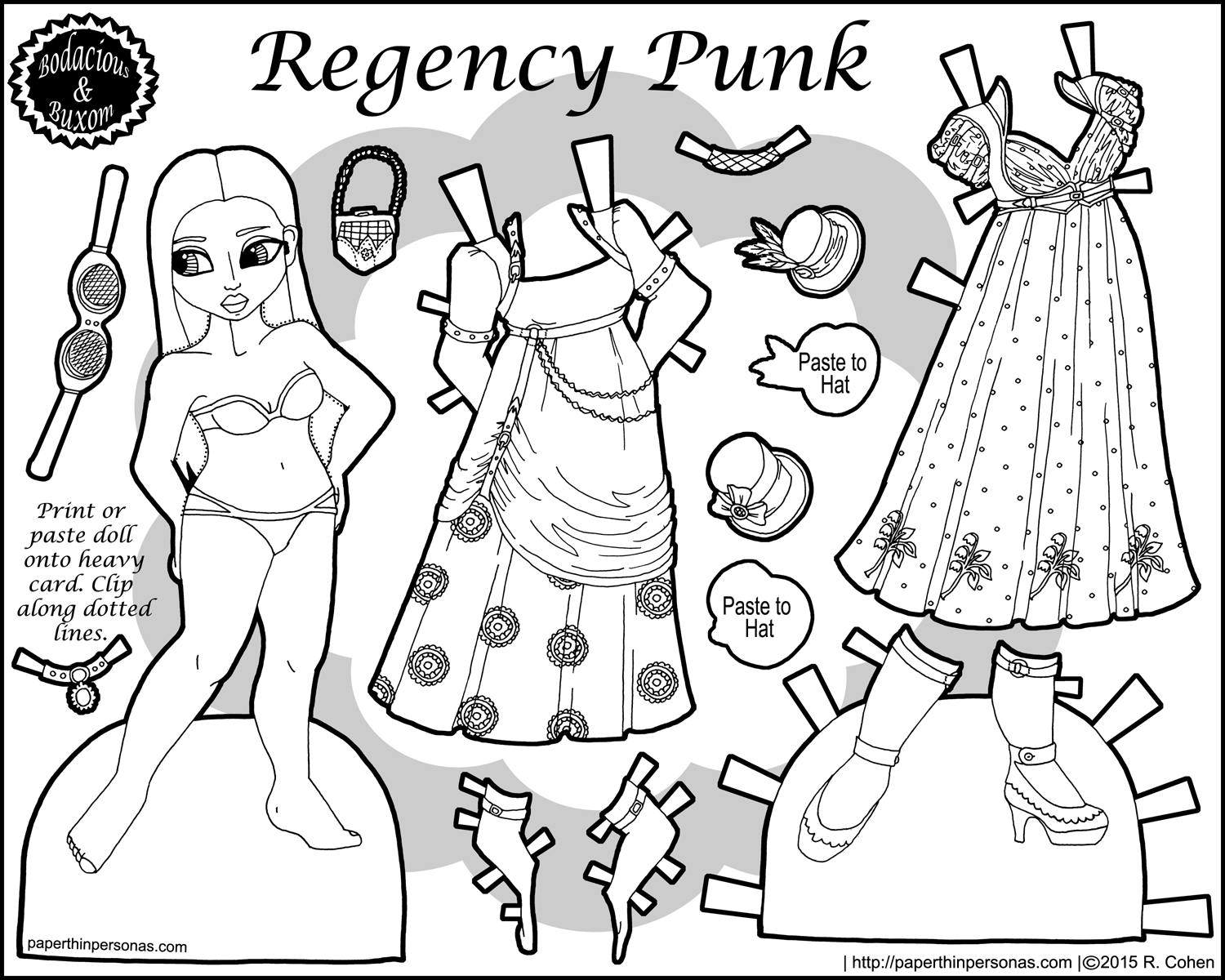
This isn’t my first foray into the whole “regency steampunk” genre, though I don’t know if this genre already exists or not. My first foray was back when I did my Best Friends set and one of their pages was regency steampunk.
This is my second foray into the genre. I think it is largely more successful, mostly because I am a better artist now than I was three years ago. I still struggle with making goggles that really “work”, but I have hopes that eventually I might figure it out.
Steampunk fascinates me just as much as Gothic fashions and Cyberpunk fashions fascinate me. I am always interested in alterative fashion cultures as they reflect some part of our cultural fabric. Despite finding them interesting, I have never had any desire to “dress up” in steampunk. I simply don’t like wearing costumes, a fact which shocks many people when they find out I draw paper dolls.
So, I’ve spoken before about my pet peeve that fantasy people are always white skinned, as a result I gave my steampunk regency paper doll a soft brown skin-tone. I was going to say “mocha” skintone, but I have been trying to avoid using food words to describe skintones. They just kinda creep me out. Something about my skin being called peach or cream, or calling someone else’s skin chocolate or spice, sorta… I dunno. I’m not sure I want to think of my skin as a food product. It’s a little Hannibal Lector, you know?
Anyway, moving on… The colors are based on actual common early 19th century colors including Turkey Red and Indigo. Both of these colors are produced by dyes from India or Turkey. They are such rich colors that I countered them with cream and black. Personally, I love how real natural indigo fabrics look. It’s an amazing color.
Be sure to cut along the dotted lines so she can wear her clothes and the floating tabs should keep her little top hats on her head.
I’ve never seen anyone else combine the early 1800s silhouettes with steampunk, so maybe it has a name already and I don’t know it. Either way, I am trying to decide what to call this new genre of fashion and therefore have a poll. Plus, you know, polls are fun.
[poll id=”8″]
By the way, if you want to get an email when the blog updates, just enter your email on the sidebar or you can follow me on twitter where I post announcements of updates and also random stuff about my life.
Let me state one thing first, on the record- Lynn’s underwear is not period. If I had drawn her period undergarments, than she’d never get to wear jeans. So, I chose to omit even a period slip for her in favor of fitting some fairly large hats onto a fairly small space. Pixies have big heads and therefore big hats.
I hope no one feels horribly cheated out of 1920’s undergarments.
It was really hard to give myself permission to do a small historical set for the Pixies. Normally, my historical Pixie sets are at least two pages and my Regency paper doll set was three. And I do have an 18th century set which has the dubious honor of being the largest collection I have ever drawn for the Pixies. It is literally five sketchbook pages. I’ve no idea how I am going to post it.
One of my big goals for 2015 was to draw historical paper dolls, because- frankly, I really like them.
But I also think if I always think “These sets must be huge” than it creates a lot of pressure to produce big sets. I think smaller sets can be just as fun.
The color scheme was fairly arbitrary. I do wish I had done something a little more fun with the shoes rather than playing it safe with black. I like to think that these three dresses cover day and evening wear fairly smoothly for Lynn. Long term, it is my hope to do more smaller historical sets for the Pixies. There’s no logical reason why they shouldn’t get to share in the single page historical paper doll fun.
I say this having just begun coloring the largest pixie set I have ever drawn of 18th century dress. I might be unable to keep this single page historical Pixie set concept alive.
Let me be clear here… this is not just a paper doll of the 1500s. Rather, my Margot paper doll is is showing off English Tudor dress from the mid-1500s, specifically Henrician gowns. This is an important distinction, because by the 1500s dress was highly regionalized, especially for people of wealth and status. My paper dolls nearly always have both wealth and status. (Mostly, because rich important people tend to get way cooler looking clothes.)
Both of Margot’s gowns are Henrician gowns, which are specifically gowns worn during the reign of Henry the 8th. She’s also got two french hoods (headdress A & C), one gable (or English) hood (headdress B), one pair of shoes and one set of underwear.
Please note that the underwear may not fit underneath the two gowns. I didn’t want to omit the smock from the underwear and smocks had really full sleeves that got crushed under the gowns and then were displayed through slits in the false sleeves and well… I didn’t want to deal with all that layering.
Moral of the story: She has under things. The underthings might not actually fit under things.
I should add that I knew very little about Tudor dress when I started researching this paper doll set and I am not about to claim that I have magically become an expert. I did my best to create an fairly accurate rendition of a noble woman’s garments of the 1540s through 1550s considering the restrictions of Margot’s pose.
As always, it is very important to me to be clear about what I studied at prior to drawing this paper doll set. Tudor clothing has always been very intimidating to me, but I wanted to challenge myself. A big part of my historical paper doll set goal is drawing things which “scare me”. Tudor dresses were one of those things.
Selected Sources:
Books:
Arnold, Janet. Patterns of Fashion: Englishwomen’s Dresses & Their Construction. London: Macmillan, 1983. Ashelford, Jane, and Andreas Einsiedel. The Art of Dress: Clothes through History, 1500-1914. London: National Trust, 1996. Mikhaila, Ninya, and Jane Malcolm-Davies. The Tudor Tailor: Reconstructing 16th-century Dress. Hollywood, CA: Costume and Fashion, 2006. Norris, Herbert. Tudor Costume and Fashion. Mineola, NY: Dover Publications, 1997. (Note: Norris’ book has some problems, since it was wirrten in 1927, but it’s useful as an accompaniment for other things.) Reynolds, Anna. In Fine Style: The Art of Tudor and Stuart Fashion. London: Royal Collection Trust, 2013.
Websites:
There is a fairly large community of people who reconstruct Tudor clothing. I am always dubious of such sites, as they often lack citation (and y’all know that drives me nuts), but they can be excellent sources to corroborate primary and academic secondary documentation. As always with internet research, Caveat emptor.
Tudor Tailor is the website of the people who wrote the excellent book “Tudor Tailor.” Though I think the book is more useful than the website, it would be remiss of me not to mention that it does exist. (Accessed: March 2015)
There are, of course, other sources of Tudor clothing and I am sure I missed some. I don’t think this will be my last trip to the 1500s. I really want to do a more “merchant class” tudor paper doll as well.
Last week, I talked about where this paper doll set was inspired from. This week, I want to talk a bit about color choices.
Color scares a lot of people. It scares me too. Truthfully, I use a lot of tools to help me develop color schemes. Some are as simple as searching Colour Lovers for a theme, but other times I use tools from ColourLovers to calculate diferent types of color schemes. My other favorite color scheme website is Design Seeds.
Normally, I try to keep my color schemes to five or six colors. There just aren’t enough pieces in the average paper doll set to justify more colors then than that. Even today’s set with all the pattern has only seven different colors, not including the warm soft brown of her skin tone. Choosing a skintone color is actually just as important as selecting a color scheme, because depending on the surrounding colors, all colors look different. I tend to think of the skintone choice as part of the color scheme selection, just as much as I am picking out colors for clothing, but I do try to keep to my palette, except with Asian skintones that generally have a strong yellow undertone. That can be very hard to not look jaundiced, so there’s often trial and error when I am coloring those paper dolls.
In today’s paper doll, I knew I wanted a rainbow scheme and I wanted it to feel a little bit like candy- bright and sweet colors. Pink stands in for my red, but other then that I have a purple, a blue, a yellow, an orange and a green. White acts as a neutral, rather than black, and that keeps the set feeling light and bright. The only black appears as the soles of her boots. Her nails are multicolored as are her hair ties to keep the sense of mismatched style.
I really am quite pleased with how she turned out.
There’s something about Lolita style clothes that I find appealing. I think part of it is that I love the Victorian inspired details of the outfits, but I also think it’s fascinating to see how a non-Western culture like Japan interprets Western European and American Victorian children’s clothing into something for adults.
There is a tendency when we talk about cultural adaptations to speak strictly of Western nations adapting Asian clothing and there’s a lot of great research on that topic, but non-Western countries are also adapting Western dress and transforming the meaning into something entirely different for their cultural needs. I find this back and forth to be one of the more interesting aspects of cultural contact.
To paraphrase Terry Pratchett, the act of observation doesn’t just change the object being observed, it also can change the observer. (Soul Music I think… but maybe Reaper Man… Can’t recall which at the moment.)
Plus, you know, pretty clothes.
So, Lolita, like any good alt-fashion scene, has many sub-genres that are confusing to me, as an outsider. Never the less, I did some research and wanted to so something in the County Lolita sub-genre. If regular Lolita is all about puffy skirts and ruffles, Country Lolita seems to be all about puffy skirts and gingham. Here’s a blog devoted to the style called, Country Lolita and here’s a post about Country Lolita from F Yeah Lolita, a great Lolita blog. (There is not gingham here… I can’t draw it to save my life.)
I wanted to play with the style, but I wouldn’t say my interpretation is strictly accurate. It’s more about seeing what happens when I try something new and the excuse to draw some giant cherries.
Honestly, I think I had mixed success. The yellow skirt has a better shape than the blue skirt. Both the cherry and the apple pattern came out cute and feel bright and country to me, but border prints are super popular it sems and . I wish I had gone with a darker blue to balance out of the pale yellow, but I’m not sure about that. When I look at it, sometimes I like it and sometimes I don’t. I settled on knee socks rater then tights, because I thought they would fit better on the page. I do want to know how you all think I did, so there’s a poll…
[poll id=”6″]
By the way, there is a doll to go with this set. She’ll be up sometime next week.
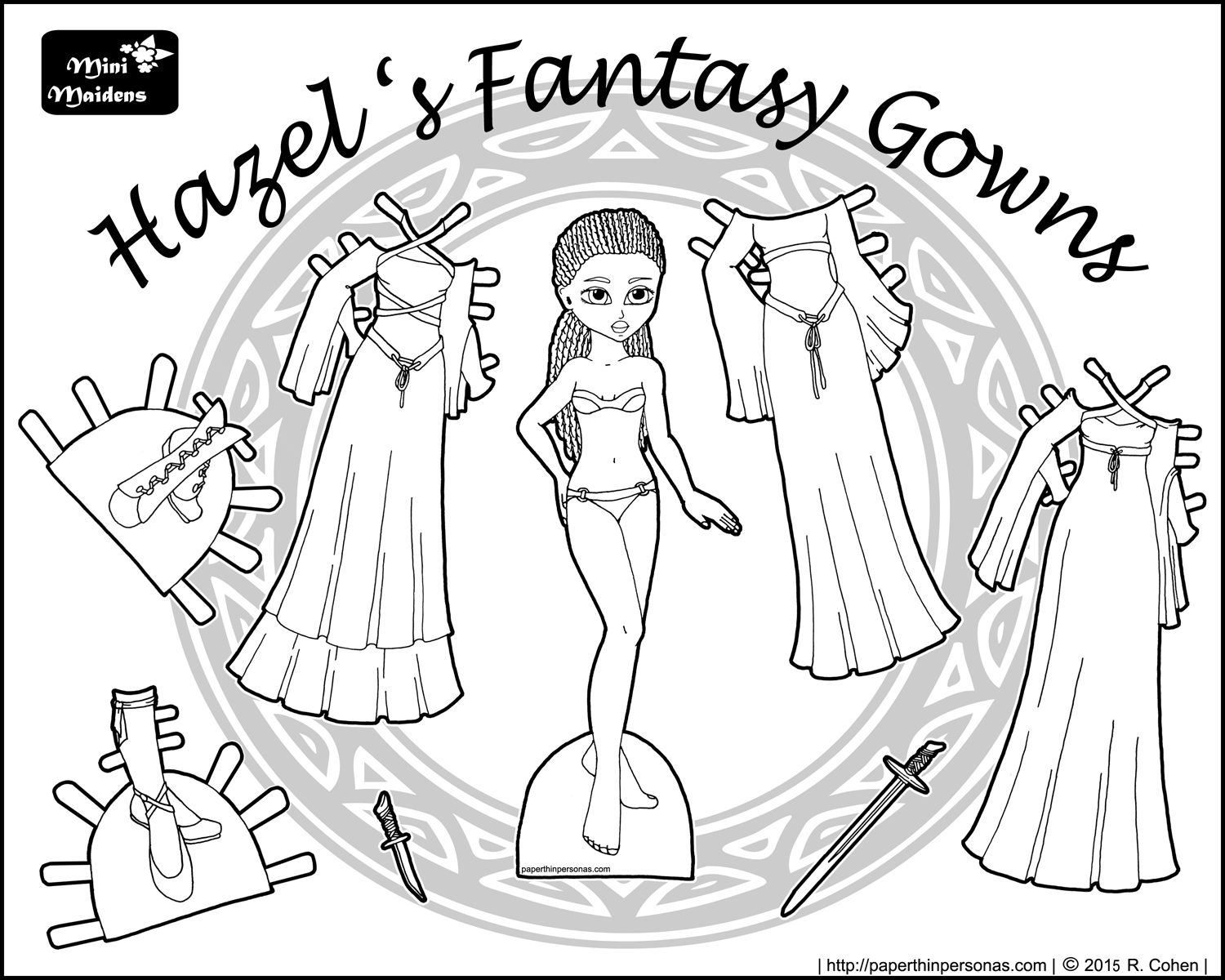
Today’s printable paper doll is Hazel getting to rock some fantasy gowns. Sometimes I feel odd posting a lot of the same styles of things in a row, as I know I have readers who are into all sorts of different things, but I have certainly been on a fantasy gown drawing kick. Never fear, the March fashion magazines are out and Monday there will be something “completely different.”
That is to say, my other contest winner will get her paper doll set and it is not a fantasy set in the traditional sense.
I suppose in some senses every set is a little bit fantasy. I mean, most of these pieces of clothing, even my contemporary ones, don’t exist in real life. However, I think it is more useful to think in terms of fantasy as a genre. Since I think it helps people find what they might like around here.
Later this week, I’ll show off some of the stuff from my sketchbook (likely tomorrow or Friday) and then Monday there will be a Marisole Monday Post and then I’m not sure what’ll go up next. I have a few different things done.
Last week, we got to see my mid-1300s paper doll set in black and white. This week, here she is in color. Historical printable paper dolls always make me a little nervous. In inevitably, choices have to be made about what to include or not include and how to render a period’s fashion. These choices are easier the more you know about the period and harder the less you know. One of the reasons I often turn to Medieval inspired or Renaissance inspired rather than actual historical paper dolls is the knowledge that I don’t know enough to always make appropriate choices.
What I am not comfortable doing is always trusting the many sites out there that don’t cite their sources with enough detail to actually find the material if you needed it or want to confirm it’s authenticity. While I love the internet, I find that I don’t use it that much when I am doing this sort of research. I seem to fall back on my library training and rely on reputable secondary sources published in scholars with names in the field, backed up my own knowledge of solid collections of digitized medieval manuscripts where I can dig for source images, plus a few tumblers and blogs that seem to know what they are doing.
And this method worked great until I got down the problem of color. Now, I always think of the 1300s as being richly red and blue and gold, because those are colors I have seen in medieval manuscripts. Just because, however, they made a dress red in a book doesn’t mean the dress was commonly red in real life. Pigments used for illumination aren’t the same a pigments used for dyeing cloth and medieval art is heavy on analogy and symbolism.
What I really didn’t want to do was do a ton a research on natural dye processes, because a lot of people have written a lot on the topic. Textile fragments like this one, an incredible velvet cope or this equally amazing cope from the V&A Collections proved to me that colors were rich in the 1300 hundreds. So, I used those images along with this Medieval Colors article from Aux Mailles Godefroy. The resulting colors are a little more muted than was probably possible in the 1300s, but I just couldn’t get over my preconceived notions of muted tones despite seeing examples of bright yellows produced with natural dyes. The truth is that both linen and wool, common fabrics in the 1300s, take dye really well. The world was likely a lot more vibrant than my preconceived notions of history suggest.
By the way, most of my primary and secondary sources for this paper doll set are listed on the black and white version. It was a long list and I didn’t want to repeat it here. So go check that out, if you want to see what I used to create my mid-1300’s paper doll.
Today’s printable paper doll is from the mid-1300s when set in sleeves came into existence and fashion was all about layers and hanging strips of fabric off sleeves called “tibbets.”
There are topics upon which I can speak authoritatively and there are topics where I know basically nothing. I would say that I am fairly knowledgeable about certain periods of Western dress, but there are others that are beyond me. As someone who just isn’t that into the medieval period in Europe (though it is growing on me), I have never spent much time doing research. After last years adventures in the 10th century, I knew I wanted to explore some more early periods and the 1300s seemed like a smart choice.
I settled on the 14th century (or the 1300s), because I’ve been wanting to illustrate that period ever since I stumbled across the entire Roman d’Alexandre digitized from the Bodleian Library which is full of illustrations of ladies in fashionable dress. As I usually do, I cobbled together my decisions about this paper doll from a variety of secondary and primary sources. One website that deserves a shout-out is Illumanu which not only posts manuscript images, actually cites them properly. Makes the librarian in me so happy.
A few specific choices I should note. The pattern on the sidecut surcoat was from Romance of Alexander from the Bodlein Library. The far left dress is based on this casket lid from the Met and the Romance of Alexander from the Bodlein Library folio 181 verso. The green dress on the far left seems to have buttons down the front and hanging sleeves. The other two gowns are mixtures of literally dozens of primary and secondary sources. You can check out below some of the sources I used.
The stockings are scrunched below the knee. I wasn’t able to find any records of garters being worn in the 1300s. The shoes are both from Stepping through Time: Archaeological Footwear from Prehistoric times until 1800 which I would totally buy if I could find it for a reasonable price. I also designed a new face for this paper doll. I like it a lot, so it might become a regular member of the family. I haven’t decided yet. What do you all think?
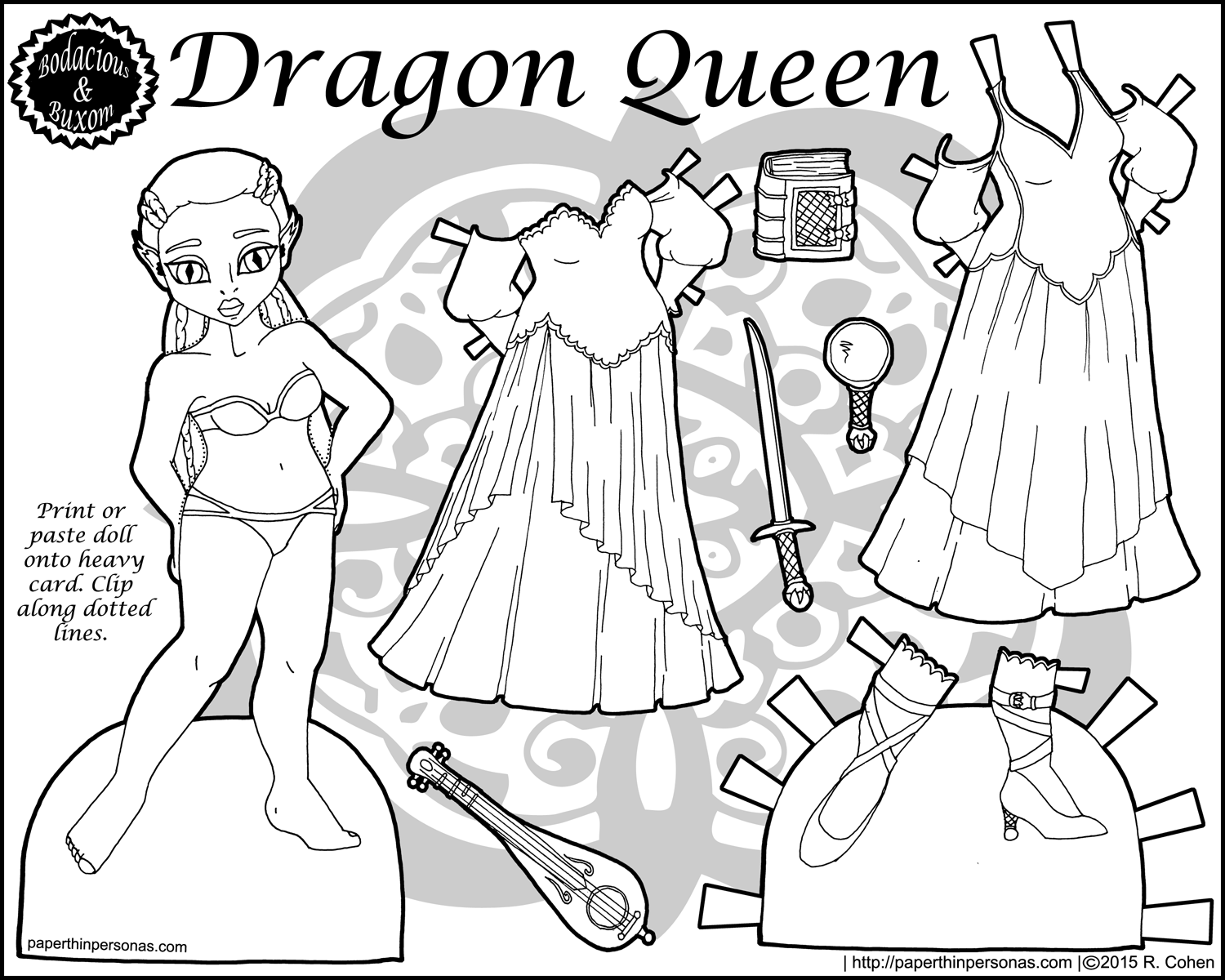
I had grand plans to get my 1300s Marisole Monday & Friends set done yesterday, but obviously that didn’t happen. So, we have Bodacious and Buxom instead with queens & dragons! (Sort of.)
So, when I posted my blog goals for 2015, I didn’t mention in my ten posts for Bodacious and Buxom that I had this post waiting quietly in the wings. Technically, I finished it when I finished the 1940s paper doll set, but I saved it as I don’t like to post two of the same series in a row.
I also have a nearly finished regency combined with steampunk set and a weird sort of farm girl thing in the works.
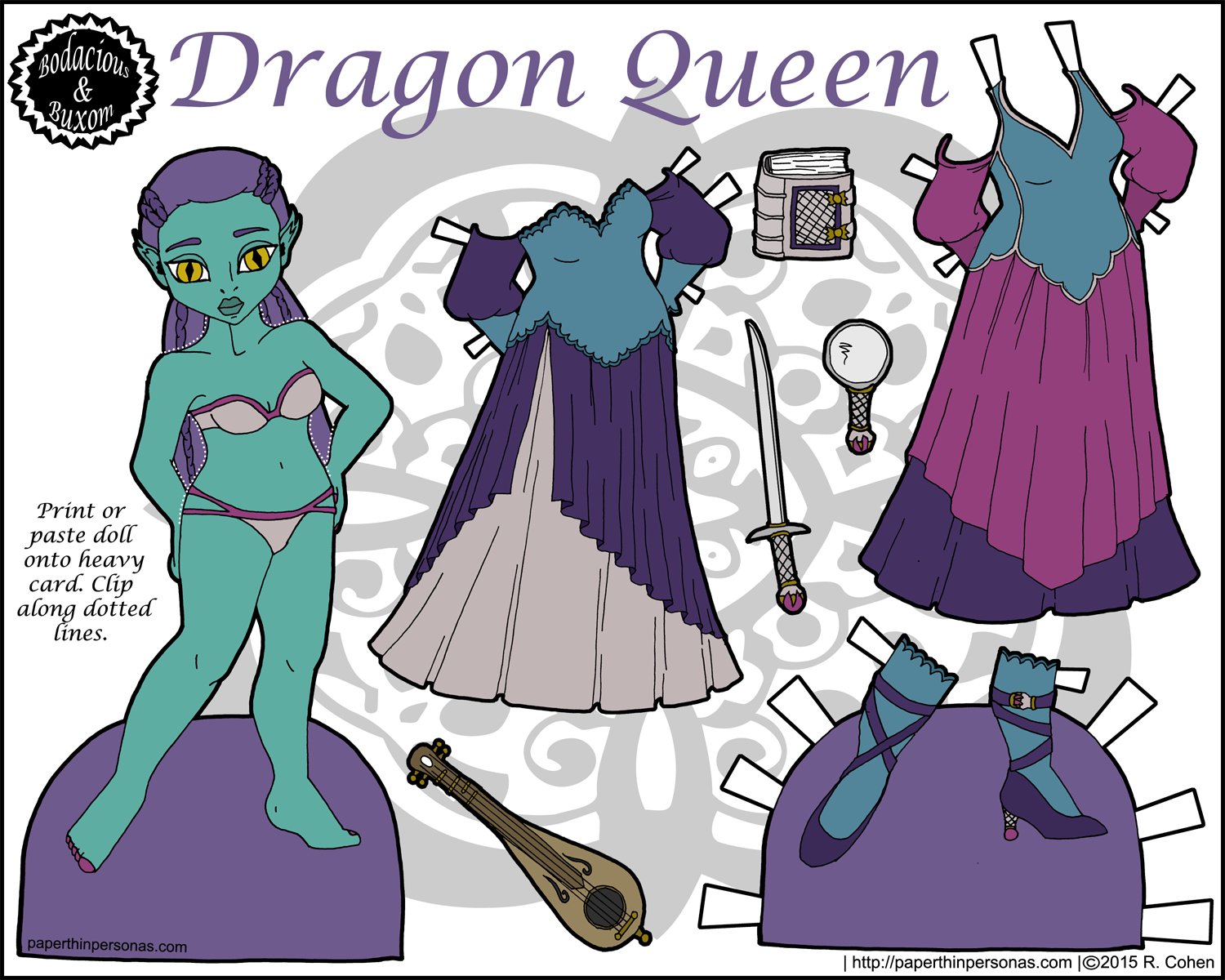
But today there are dragons, or at least humanoids who have some reptilian features. One of the things that my alchemist paper doll taught me is how many long dresses I can fit on a single page of the B&B series. The answer seems to be two dresses with a pair of shoes and some accessories. As a result, our Dragon Queen paper doll has two gowns, a sword, a mirror, a book and some shoes. Somehow I always imagine dragons as very vain creatures.
In my mind, today’s paper doll is either a dragon in humanoid form or from a species that believes they are descended from dragons. Her homeland is mountainous and rich in minerals. I imagine her people are sophisticated and tend to rely on their innate magic rather than technological acumen to solve their problems. Isolationists, they are uninterested in contact with other humanoid species, but maintain slight contact with the Dwarfs, for their technology and metalworking skills, and minor contact with the Elves, for their magic. Humans are, well, beneath them.
I chose a rich jewel toned color scheme for this paper doll set. I knew I wanted some sort of green skin, but I didn’t want it to feel too “lizard” like. I went with a rich teal. I also wanted her dresses to coordinate with her skin, as though they were chosen specifically to do so. I imagine she is wealthy enough to have her clothing tailored to match her coloring.
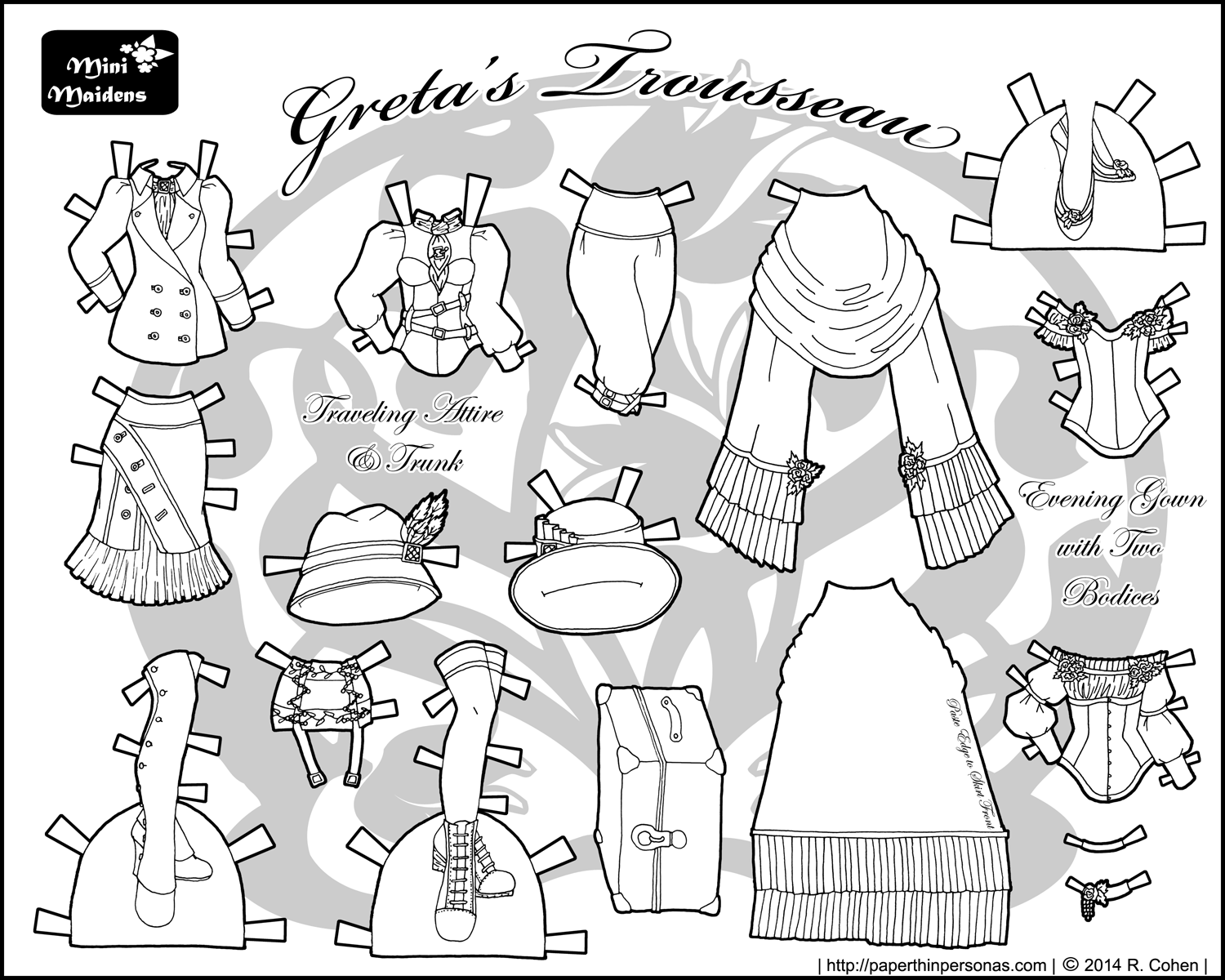
It has been a while since we’ve had to visit to Greta’s Trousseau. I have had these drawn for a few mnths and it has been taking me a long time to get my act together and sort out the adding of tabs. I loath having to add tabs, but it’s easier to add them than to remove them later for the fashion plates and I do like putting together the fashion plates.
So, in this page of Greta’s ever expanding trousseau, there is a ballgown which also has a more conservative long sleeved bodice. Dresses with two bodices were very common in the 19th century. Most “gowns” of the period are actually a top and a separate skirt. This women’s dress from the Museum of Fine Arts in Boston has an evening bodice and a day bodice. I imagine that Greta’s dress is more of a “ballgown” and then “dinner-dress” sort of arrangement.
Her traveling attire has two major outfits. One is a pair of bloomers with a blouse and hat for exploring or slightly rough and tumble travel. The other is a crisp traveling suit with a jacket, skirt and gaiters (or really long spats). These pieces can be mixed and matched for other outfit combinations, of course.
In total, this takes Greta’s Trousseau to over fifty outfit pieces and seventeen outfits. Technically, based on my paper doll outfit math than there’s about 1300 outfit combinations, more if you include hats, of course. I don’t actually think most of those outfit combinations make a lot of sense, but it was fun to work out how many existed. Greta’s Trousseau isn’t over, by any means. There are more sporting outfits to be finished (including a really cute croquet dress) and a set of clothing for seaside visits which includes a scuba suit, complete with helmet.
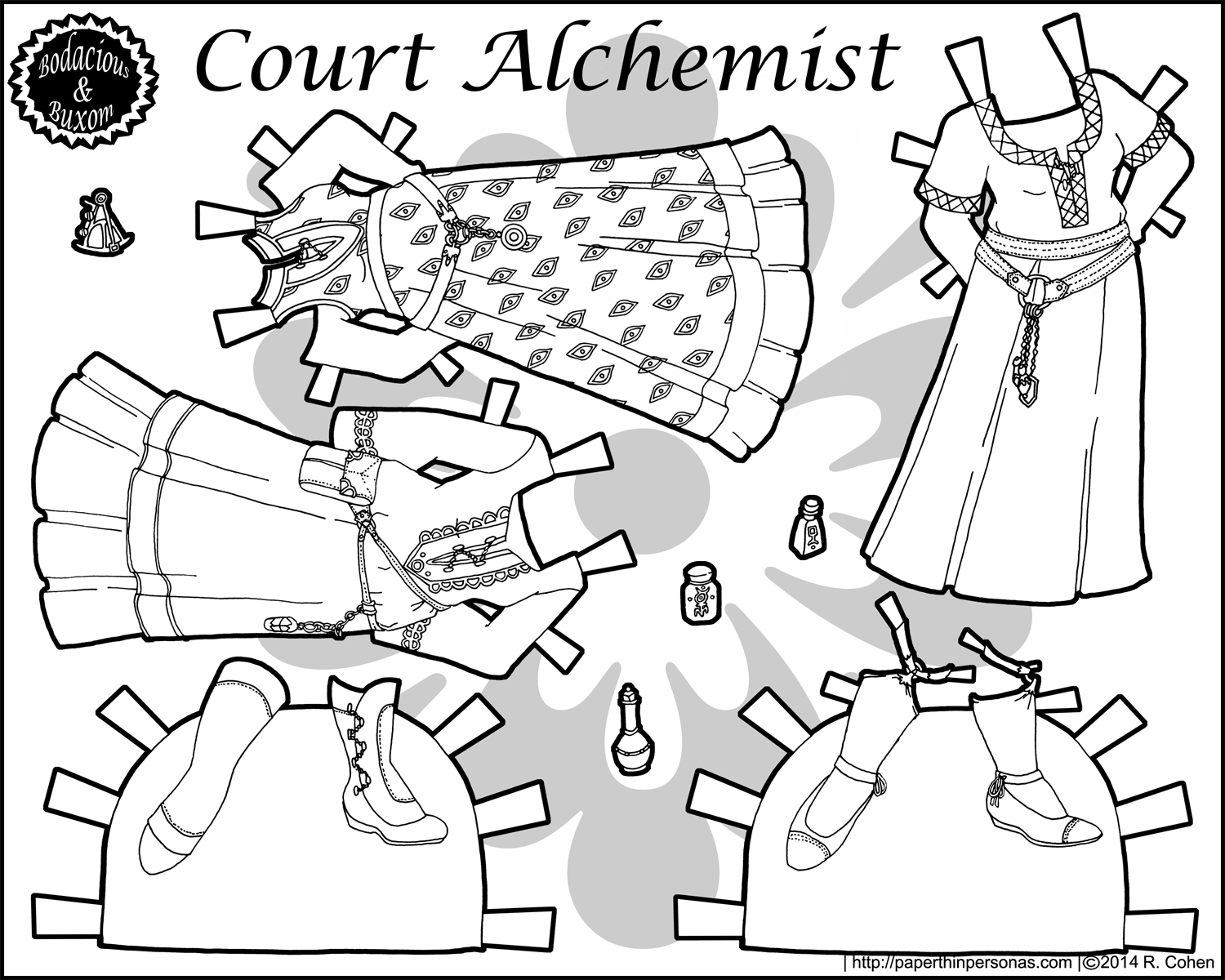
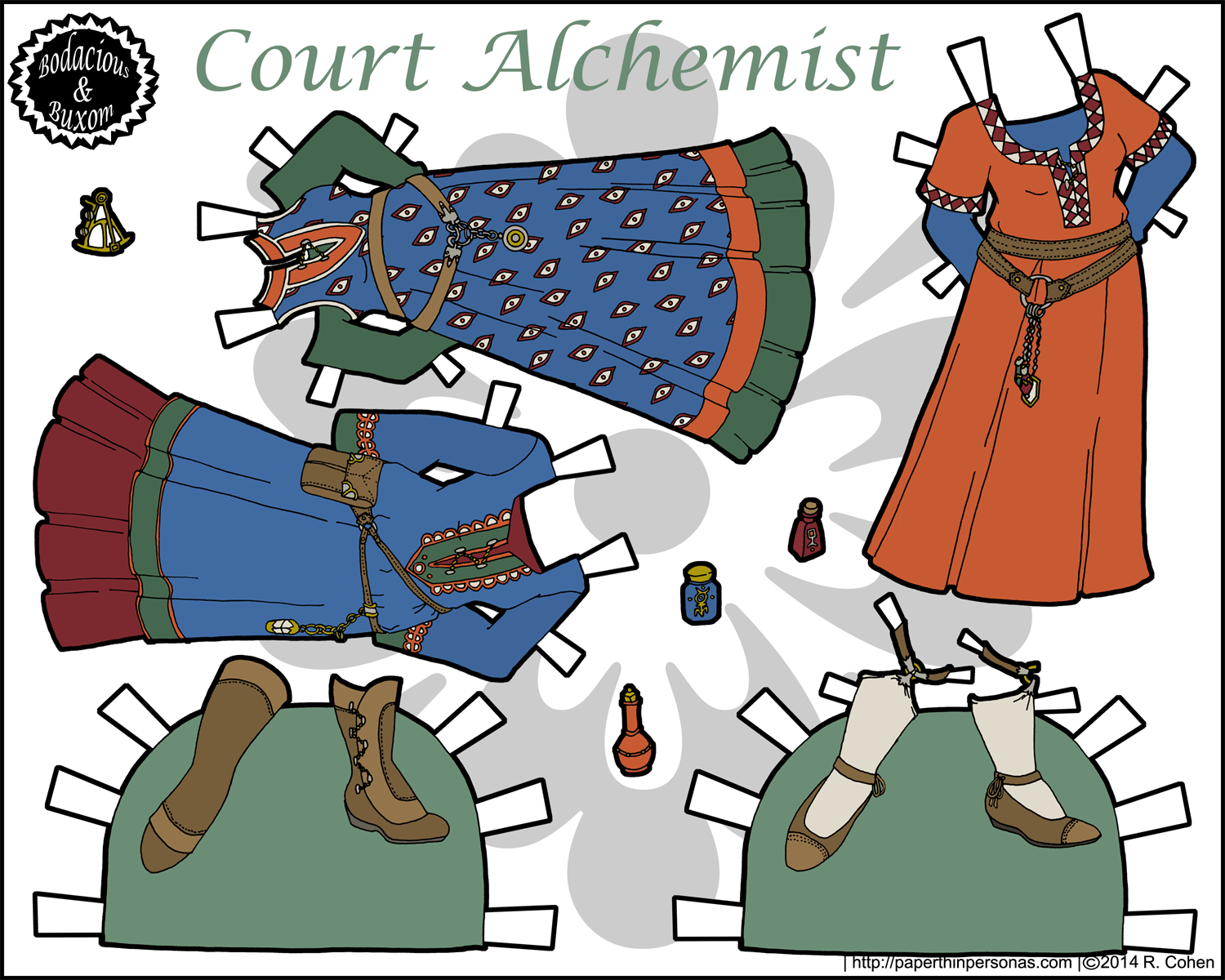
Last week, as you may recall, I posted my Court Alchemist paper doll. This week I am posting three more printable paper doll dresses and two pairs of shoes which gives her five outfits in total. I really do think the clothing makes the paper doll. I was always that kid who would have rather have had dozens of outfits over dozens of paper dolls.
In fact, I remember when American Girl magazine published paper dolls and I used to get so annoyed that the dolls were “almost” in the exact same pose, but not quite. So, they couldn’t perfectly share clothing. Drove me just nuts as a kid. Here is a picture of one of the paper dolls.
Are there any children’s magazines left that still publish paper dolls?
I recall with much fondness the feeling to getting to check the mail for my American Girl magazine and it’s promised paper doll. In fact, if you want a similar experience (and you have an HP web enabled printer), then you might consider my HP Paper Thin Personas Printer Ap which prints a full color or black and white paper doll every Monday, automatically. You can also print the paper dolls on demand directly from the printer which is, I have to confess, pretty neat.
So, there are three dresses in this set. In my head, these are all fairly informal dresses. And who doesn’t need socks held up by some odd sock suspenders? (There is something inherently hilarious to me about sock suspenders… I might have a problem.)
I went back and forth about the patterned dress. I wanted it to look like a pattern that could be woven on a simple loom, but it ended up looking sort of like abstract eyes and now all I can think is, “The dress is staring at me…”
As for tools, along with last week’s tool collection, this set adds a sextant, which is a tool for measuring the angle between any two visible objects, most often the horizon and stars. It was crucial for navigating back in the days before high levels of technology. As a girl with NO sense of direction, I am totally grateful to whoever invented GPS. If I had to navigate via sextant, I think I would end up lost way more often than I already am.
So, Friday there will be another page of Her Ladyship and Monday there will be an elf.
Meanwhile, you can follow me on twitter @paperpersonas for blog updates, random paper doll thoughts, and a smattering of librarianship.
Last week, the circus came to town in black and white for coloring, but here the paper doll set is in full color. I am really very pleased with how she came out. Sometimes, I know what I am doing with a paper doll set before I start coloring. Other times, I have no idea what I am going do with colors. In this paper doll’s case, I had a pretty clear idea of where I was going to go before I got there.
One thing I noticed as I was collecting images on my Dark Circus Pinterest board was that there was a bunch of red and black. I wasn’t sure what I wanted to do with the red and black, but I knew there was going to be a lot of it.
Creating a red and black paper doll set was kind a boring, so I did not go with a strictly red and black color scheme (though there is a lot of black and white here).
With straight red, black and white, I got bored very quickly and worried about the scheme clashing with the paper dolls pink hair. Instead, I decided to try basically creating two sets in one. There is a black and red set and also a pink and black set. Both sets had a pair of shoes and there are some pieces which can be worn with either color scheme.
I think this effect of “two sets” in one works, because circuses are all about costumes and costumes tend to match more than normal clothing.
Manage Consent
To provide the best experiences, we use technologies like cookies to store and/or access device information. Consenting to these technologies will allow us to process data such as browsing behavior or unique IDs on this site. Not consenting or withdrawing consent, may adversely affect certain features and functions.
Functional Always active
The technical storage or access is strictly necessary for the legitimate purpose of enabling the use of a specific service explicitly requested by the subscriber or user, or for the sole purpose of carrying out the transmission of a communication over an electronic communications network.
Preferences
The technical storage or access is necessary for the legitimate purpose of storing preferences that are not requested by the subscriber or user.
Statistics
The technical storage or access that is used exclusively for statistical purposes.The technical storage or access that is used exclusively for anonymous statistical purposes. Without a subpoena, voluntary compliance on the part of your Internet Service Provider, or additional records from a third party, information stored or retrieved for this purpose alone cannot usually be used to identify you.
Marketing
The technical storage or access is required to create user profiles to send advertising, or to track the user on a website or across several websites for similar marketing purposes.


 {Download a PDF of this paper doll to Color} {View a 150 dpi PNG of this Paper Doll to Color}