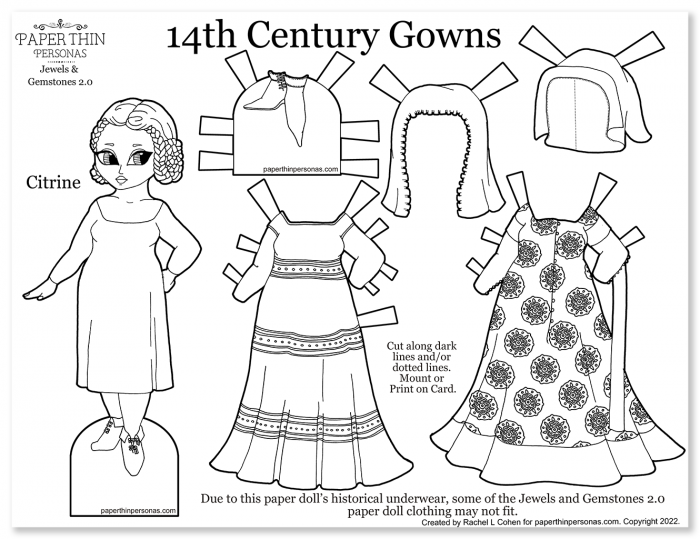
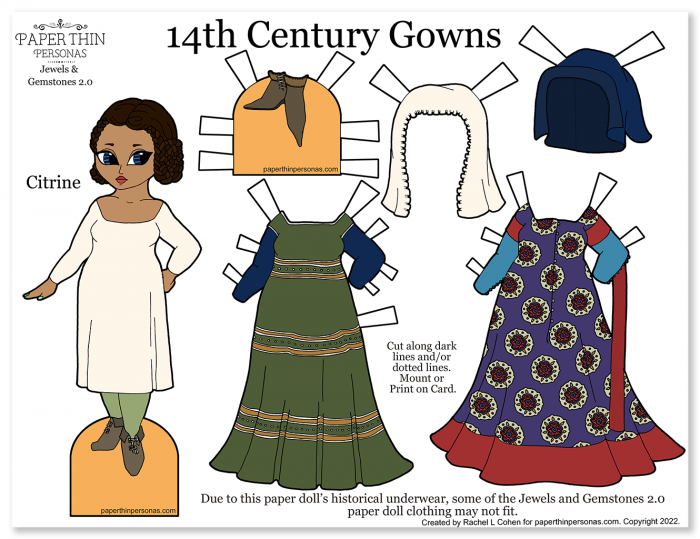
A 14th Century Fashion Paper Doll With Citrine

Download Black and White PDF | Download Color PDF | More Jewels & Gemstones 2.0

It has been a while since we had a Jewels and Gemstones 2.0 paper doll, hasn’t it? It feels weird to have taken a two week break from them, but here we are.

So, I actually had this drawn last year, but I needed one more piece of clothing to fill out the set, so I had to draw some last minute shoes which delayed it’s debut until now. But I technically meant this to go along with my 14th century Pearl set. While I never meant for the 14th century to become such a common time period on this site, every time I draw another 14th century paper doll set, I feel like I learn more about the period and get better at rendering it. And I like the learning aspect.

So, Citrine here has two patterned dresses, a veil, a hood, and an extra pair of shoes. The paper doll’s shift is based one illustrated in Roman de Giron le Courtois (fol. 87v.) at the National Library of France from around 1370-1380. I’ve used the same one for my 12th century and 13th century paper dolls, so they can all share clothing. Shifts are not the easiest thing to find reference images for in this era, let me tell you. Her shoes come from Stepping Through Time by Olaf Goubitz (my usual shoe source for anything this early.

The dress on the left is a sleeveless surcoat (unlike a sideless surcoat, sleeveless surcoats didn’t have huge armholes). I based the pattern on it from BNF Arsenal 3481 Ci commence li livres de Lancelot du Lac (fol. 65r). However, I’ve noticed these lines and dots patterns show a lot in medieval manuscripts and I don’t know if that is because they were easy to paint or if that is because they were commonly worn. The sleeveless surcoat shows up all over the place in early 14th century manuscripts. Here it is in Français 761: Artus le Restauré (fol. 25v) from between 1325 and 1350, in BNF Français 1433 Le Chevalier au Lion (fol. 67) from 1300-1350, and in BL Yates Thompson 13 The Taymouth Hours (fol. 107v). I think it is reasonable to say the style was super popular.

The dress on the right is a patterned surcoat with buttons which I sometimes see referred to as a Cotehardie. I don’t know enough to know if that term is correct (it is for men, I know). I was inspired to draw the pattern, because Roman de Giron le Courtois is full of these elaborate patterned dresses. The text is Italian and I wonder if that is why. Anyway, was the specific inspiration for this one was Folio 44v and Folio 75r. I have no idea what the manuscript is about, but there’s a lot of decapitated heads in it. In case you’re wondering, medieval manuscripts use Folio rather than page number, because most of them lack numbered pages.

Now that I’ve done two 1300s Jewels and Gemstones paper dolls (see Pearl here), I feel like I should do something from the 1400s, which is not a period I know as much about. However, the only way to learn is to try and so I guess I’ll add that to my to do list.

On Patreon I have a poll right now about the next time period to tackle. So, if you join us there, you can vote.
Pearl in the 14th Century Women’s Clothing: A Paper Doll

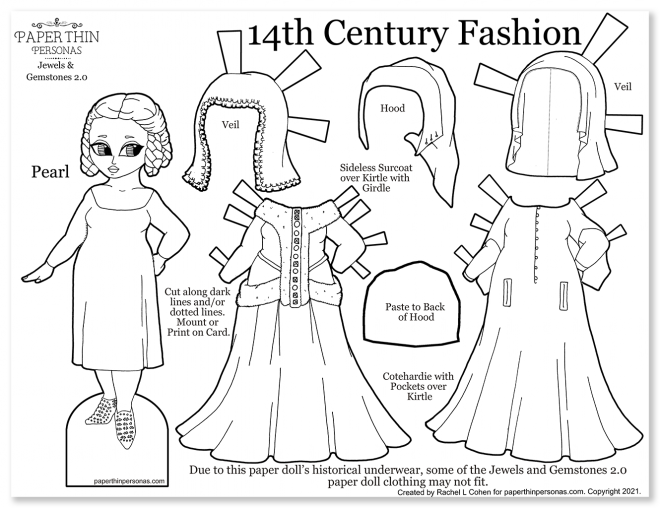
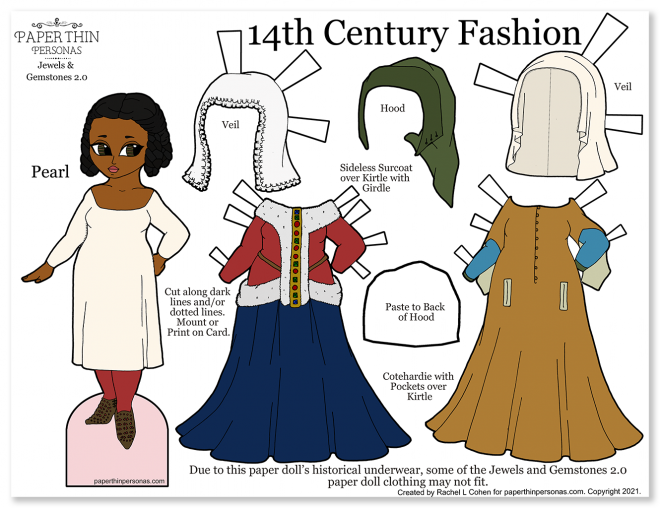
14th century women's clothing illustrated by printable paper doll coloring page with two gowns, veils and a hood. The paper doll wears a shift and has her hair up in braids. Her dresses are two different styles- a fur trimmed sideless surcoat and a cotehardie with pockets.
14th century women's clothing illustrated by a printable paper doll with two gowns, veils and a hood. The paper doll wears a shift and has her hair up in braids. Her dresses are two different styles- a fur trimmed sideless surcoat and a cotehardie with pockets.

Download Black and White PDF | Download Color PDF | More Jewels & Gemstones 2.0

I love historical fashion, I love book history and I love research. So, my medieval paper dolls are a chance to both draw paper dolls and spend way too much time doing research. Best part- I always learn something new. As I finished this super long post about today’s 14th century paper doll, I realized it mighty be a little much for people, so if you don’t want info on braids, sources, and scandalous surcoats of 14th century women’s clothing, stop now and just enjoy the paper doll and her pretty dresses.

One thing I learned since my latest foray into14th century women’s clothing is that I was wrong about how hair worked. I’d always thought that the hair was parted and then braided into two braids. I wasn’t sure what happened after that, but I assumed the end of the hair was tucked behind the ear. I now realize that the braid was actually tucked up under the front of the hairline. This is really clear in some of the manuscript illustrations. Pearl’s hair here is based on this illustration from the  Bodleian Library’s MS. Bodl. 264: Romance of Alexander (fol. 181v). Over their hair, women wore veils or hoods (think like, just the hood part of a coat). There’s a lot of different styles of these that I’ve seen.

Looking away from hair for a moment, 14th century women’s clothing (aka 1300s) involved layers of dresses over a shift. There’s a lot of inconsistency in words used for clothing. I am going to use surcoat for the outer most dress and kirtle for the inner dress. The kirtle went over a shift and then a belt (called a girtle) was often worn over the kirtle. Here’s a paper doll example of that. Over top of all that, a surcoat could be worn for keeping warm or for being fashionable. Some surcoat’s had slits in the front, so women could get to purses hanging off their girtles. This was an early form of pockets. If you had the money, fur lined the surcoats for warmth and fashion. Cotehardie‘s were surcoats with buttons, as I understand it.

Starting with underwear, Pearl’s shift is based one illustrated in Roman de Giron le Courtois (fol. 87v.) at the National Library of France from around 1370-1380. Her shoes come from Stepping Through Time by Olaf Goubitz. Pearl’s dress on the right is a cotehardie (aka: button fronted surcoat) over a kirtle which was inspired by MS. Bodl. 264: Romance of Alexander (fol. 097v) and (fol. 181v) from between 1338-1344, plus this casket lid.

And now, a word about sideless surcoats… (aka: the gown on the right.)

Sideless surcoats are basically gowns with huge armholes. You can see examples in BGE Ms. fr. 190/1 Des cas des nobles hommes et femmes (Fol.35v) housed at the Bibliothèque de Genève from 1410 and this one in Besançon BM MS.677 Fleurs des chroniques from the Bibliothèque municipale de Besançon (fol. 087v) from 1384-1400. This French 14th century tomb slab shows the same style. If you poke around on my 14th century Pinterest board I’m sure you’ll see more.

This fur heavy version seems to mostly be ceremonial. De claris mulieribus in an anonymous French translation (Le livre de femmes nobles et renomées) Royal 16 GV (fol. 02) (my source) is from 1440, but was trying to show things that had happened in the 1300s. By the time the mid-1400s rolled around, only Queens on court occasions seem to be wearing these furry surcoats.

I find that a little ironic, because the sideless surcoat was sometimes called “windows to hell” or “windows to purgatory” when it first showed up. It showed off so much of a woman’s kirtle that it was scandalous by 14th century women’s clothing standards. It’s interesting evidence that extreme forms of fashion eventually become an accepted part of society, even some 600 years ago.

Lastly, our paper doll has veils and a hood. While I am not totally certain about the “rules” involving veils, they were definitely common and I think more common if the woman was married. Her double ruffled veil comes from Universitäts- und Landesbibliothek, Speculum Humanae Salvationis (fol. 37r). However, the large number of illustrations that show women with their hair exposed, so I don’t think it was verboten for women to have exposed hair in this era.

Her hood is based on BNF Français 20090 Bible Historiale de Jean de Berry (fol. 290r) which is from the National library of France. I’m not 100% clear on how hoods fit into the social structure of the 14th century. I can’t imagine wearing one with that fancy fur trimmed surcoat, but then I doubt fancy fur surcoats were worn outside much.

And this is the end of this super long, super involved post on 14th century women’s clothing. If you made it to the end, good for you! By the way, Topaz with 12th century clothing and Lapis with 13th century clothing have the same basic shift and therefore can easily share clothing with today’s 14th century clothing paper doll. It’s a 300 year medieval paper doll trifecta. Yes, I did plan it that way.

13th Century Women’s Clothing Paper Doll Featuring Lapis

This was my second foray into medieval clothing for the Jewels and Gemstones and, at the time, my first foray into 13th century women’s clothing of Western Europe. I like to be specific, because this isn’t what folks were wearing in Asia or the Middle East in this era.

I tend to call these sorts of paper dolls “clothing” not “fashion.” While the idea of dress as a social marker existed in the 1200s, it wasn’t really fully defined yet. It wouldn’t be until the 1300s, and then introduction of tailoring, that you really start to see trends. By the 1400s, headdresses provide plenty of space for people to engage with fashion.

A paper doll celebrating 13th century women's clothing with several dresses and headdresses.

Download Black and White PDF | Download Color PDF | More Jewels & Gemstones 2.0

Okay, I took really good notes while I was working on this paper doll, so I have a mess of sources.

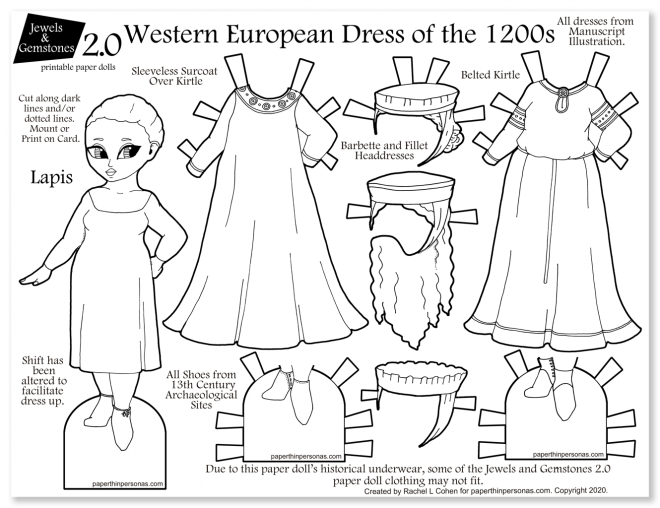
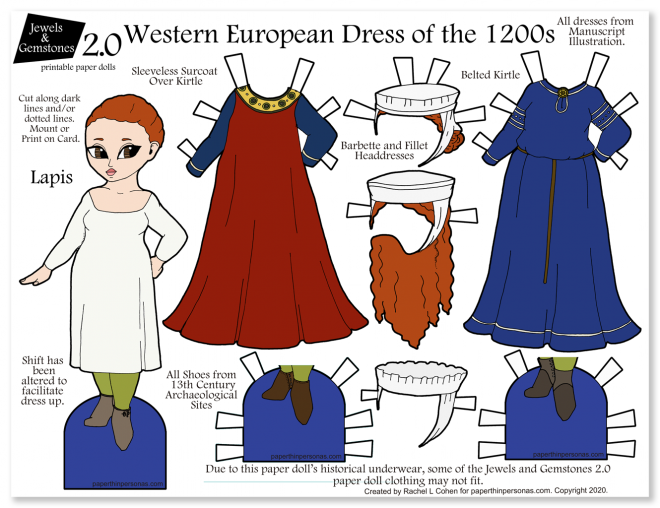
Lapis is wearing a shift based one illustrated in Roman de Giron le Courtois (fol. 87v).  I made the length is a little shorter and the style is quite fitted. Both of these changes were done to facilitate the paper doll layering clothing over the shift. The source material is 100 years post this paper doll’s era, but illustrations of women’s shifts are super rare. So I’ll take it.

As usual, the shoe designs come from Stepping Through Time by Olaf Goubitz, an excellent, if exceedingly dry, book on historical footwear. I love this book, but man… it is not a fun read. The illustrations are great though.  Sources for the dress on the left include Biblia Porta, Lausanne, Bibliothèque Cantonale et Universitaire, U 964 (fol.178r) and  Collection of poems in Old French, Bibliothèque de l’Arsenal- Arsenal 3142 (fol.292r).

You can see barbett and fillet headdresses in the Romance of Alexander, England, Cambridge University Library- Cambridge MS O.9.34 (fol.25v)

I based the right dress off of this dress from BNF Arsenal 5211 Bible de Saint-Jean d’Acre (fol.069v). The book dates from 1250-1254. The other inspiration was this dress from U 964 – Biblia Porta, housed at the Bibliothèque Cantonale et Universitaire. The brooch at the throat comes from this illustration in Morgan M.638 Maciejowski Bible (fol.33) dated 1244-1254.

A colorful 13th century women's clothing paper doll with two dresses and three headdresses.

Download Black and White PDF | Download Color PDF | More Jewels & Gemstones 2.0

So, I did have some issues with her headdresses. They are such a defining part of 13th century women’s clothing. The barbette is the piece that goes under the chin and the fillet is the pillbox hat looking piece that wraps around the head. One thing I’m not sure about is whether the fillet was open or closed at the top. This manuscript illustration and this manuscript illustration it looks closed, but this one is definitely open. Anyway, I settled on closed, but I’m still not 100% sure that’s right.

Anyway, disclaimers aside, I hope you enjoy today’s 13th century paper doll! One of her dresses was a Patron piece from last year and I encourage you to head over there if you’d like to get more paper dolls every week.

A 14th Century Surcoat With Tibbets and Headdresses

Dress up a paper doll in historically accurate 1300s clothing including a surcoat over a kirtle and two head-dresses.

Printable Black & White PDF Printable Color PDF More Paper Dolls & Clothes

First off 14th Century week continues with today’s surcoat over a kirtle and some headdresses. Second off Happy Thanksgiving to those who celebrated yesterday.

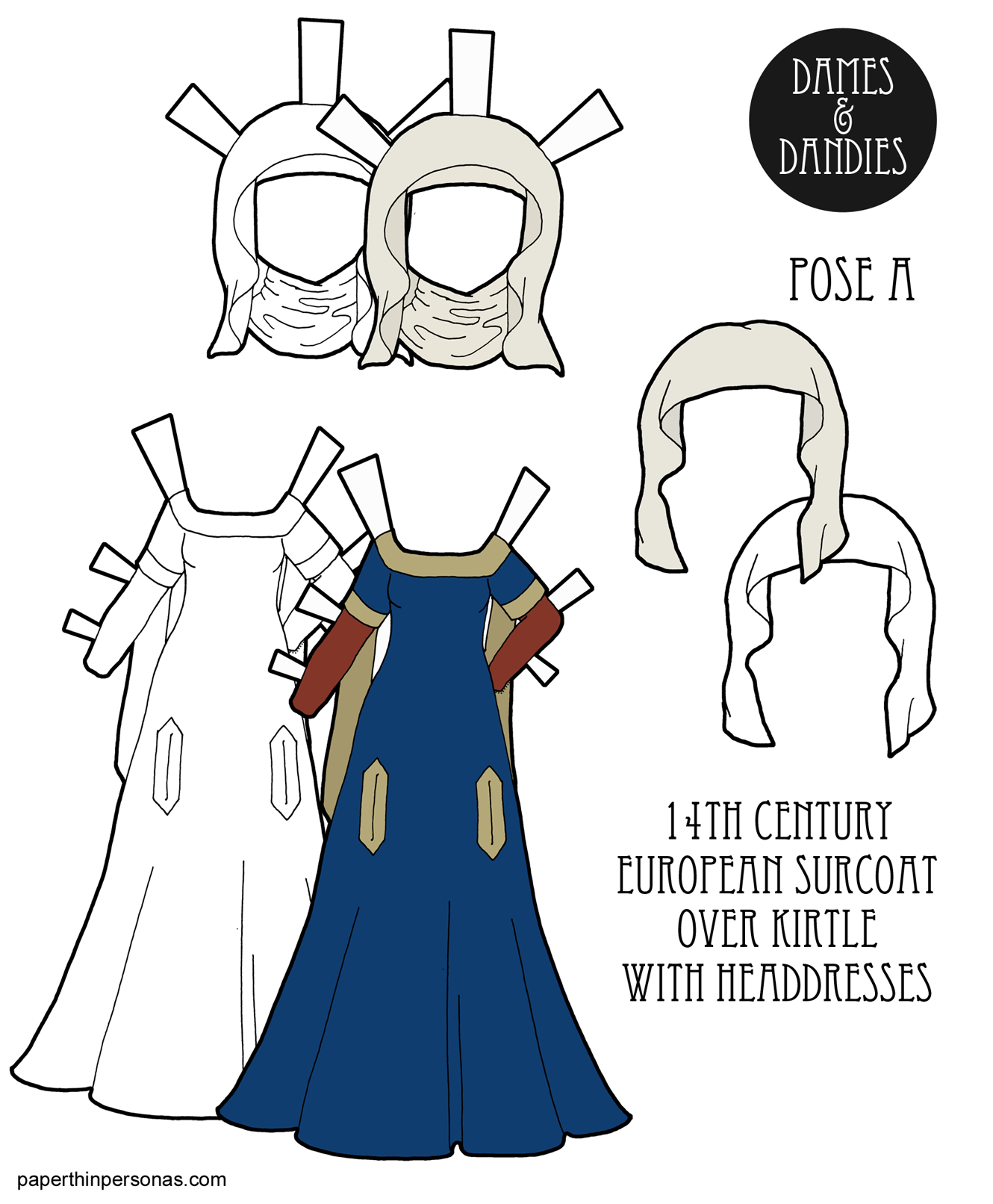
Surcoats were worn over kirtles (I did one of those on Wednesday). Like a lot of surcoats, today’s has slits in the front that provided access to the purse worn off the girdle underneath. Think of it as the 14th century solution to pockets.

Today’s paper doll surcoat with kirtle was inspired by the Romance of Alexander from the Bodleian Library MS. Bodl. 264. There’s a bunch of different examples of this short sleeved surcoat in there, but I based this dress off the red dress in this miniature and the blue dress (and pink dress) in this miniature.

One of the interesting things about those miniatures and many others from this era (check out my 14th Century Dress Pinterest board for more) is how many of them show women with their hair uncovered. Unlike later eras (and some earlier ones) the 14th century seems to be a time when women could go around without covering their hair.

(Women shown with uncovered hair in miniatures from other eras are often depicting vice and/or wickedness and this is indicated by the uncovered hair. The scandal of showing one’s hair in the 15th century was intense. )

However, some women did still cover their hair. Here’s one miniature with some hair covered and here’s another and here’s a third one. You also see head coverings in statuary. One thing I do when I am trying to decide what to include in these historical sets is to try to find multiple examples of something. That’s why you see some duplication of types of images on my 14th Century Dress Pinterest board.

That’s also why when I am dealing with an era I don’t know much about it can take me a long long time before I am comfortable drawing a paper doll of it. I learned a lot of history from Tom Tierney’s historical paper dolls and I want mine to be as helpful and accurate as I can make them.

If you want some say in the time periods I create paper dolls for, think about supporting the blog on Patreon. I tend to listen to my Patrons when they make requests. Here’s a post about what patrons have made possible from earlier this week.

Have you enjoyed 14th Century week? Let me know. I love to hear from you.

Need a doll to wear today’s paper doll clothing? All the A Pose Dolls & Clothing

A 14th Century European Kirtle & Shoes

A 1300s kirtle for a paper doll with matching shoes and headdress from paperthinpersoas.com. A great way to teach kids history and a super fun coloring activity.

Printable Black & White PDF Printable Color PDF More Paper Dolls & Clothes
In the world of 14th century dress in Europe, there’s a lot of layers. On Monday, you got to see the shift, the stockings and the shoes which were the first layers. Over that, women wore a kirtle.

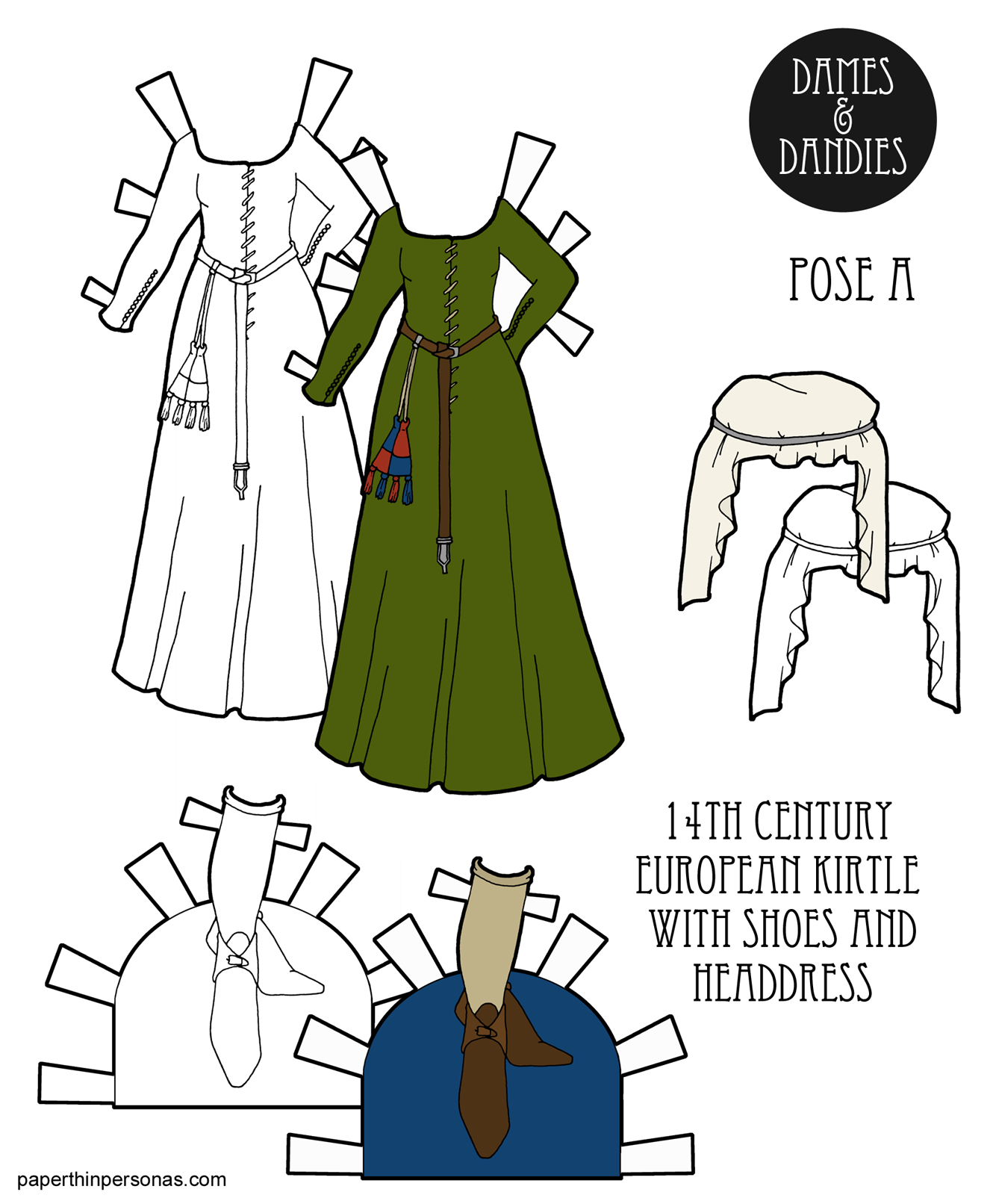
Technically, add a girdle (belt) to keep your purse (which was also as close as anyone got to having pockets in the 14th century) and you were fulling dressed. This kirtle example has a spiral laced front and buttons on the cuffs.

Her girdle is based on this example. I looked at a lot of carved sculptures of the Virgin Mary when designing this set like this one and this one.

Her shoes come from Stepping Through Time by Olaf Goubitz. It’s a great resource. Her stockings would have been held up by garters, because bias cut wool doesn’t stay up on its own. However, based on my current understanding, the stockings would be rolled down over the garters to cover them, so that’s why the garter’s aren’t visible.

If you want a historical doll to wear this example of 1300s clothing, than you can go grab Alice whose wearing a shift and has many pair of period shoes.

Right now, I am thinking about what to do with Paper Thin Personas in 2019. I have a poll and please answer it if you haven’t.

[poll id=”22″]

And leave me a comment if you like or consider supporting the blog on Patreon if you want to pledge. Here’s a post about how Patrons have helped.

Need a doll to wear today’s paper doll clothing? All the A Pose Dolls & Clothing

A 1300s Fashion Paper Doll

1300s-historical-paper-doll-logo Once again, we are dabbling in the 1300s with today’s paper doll. There’s no new sources for this one, so if you want to know what I referenced, than I would recommend returning to my last paper doll of the 1300s with a sources list at the bottom.
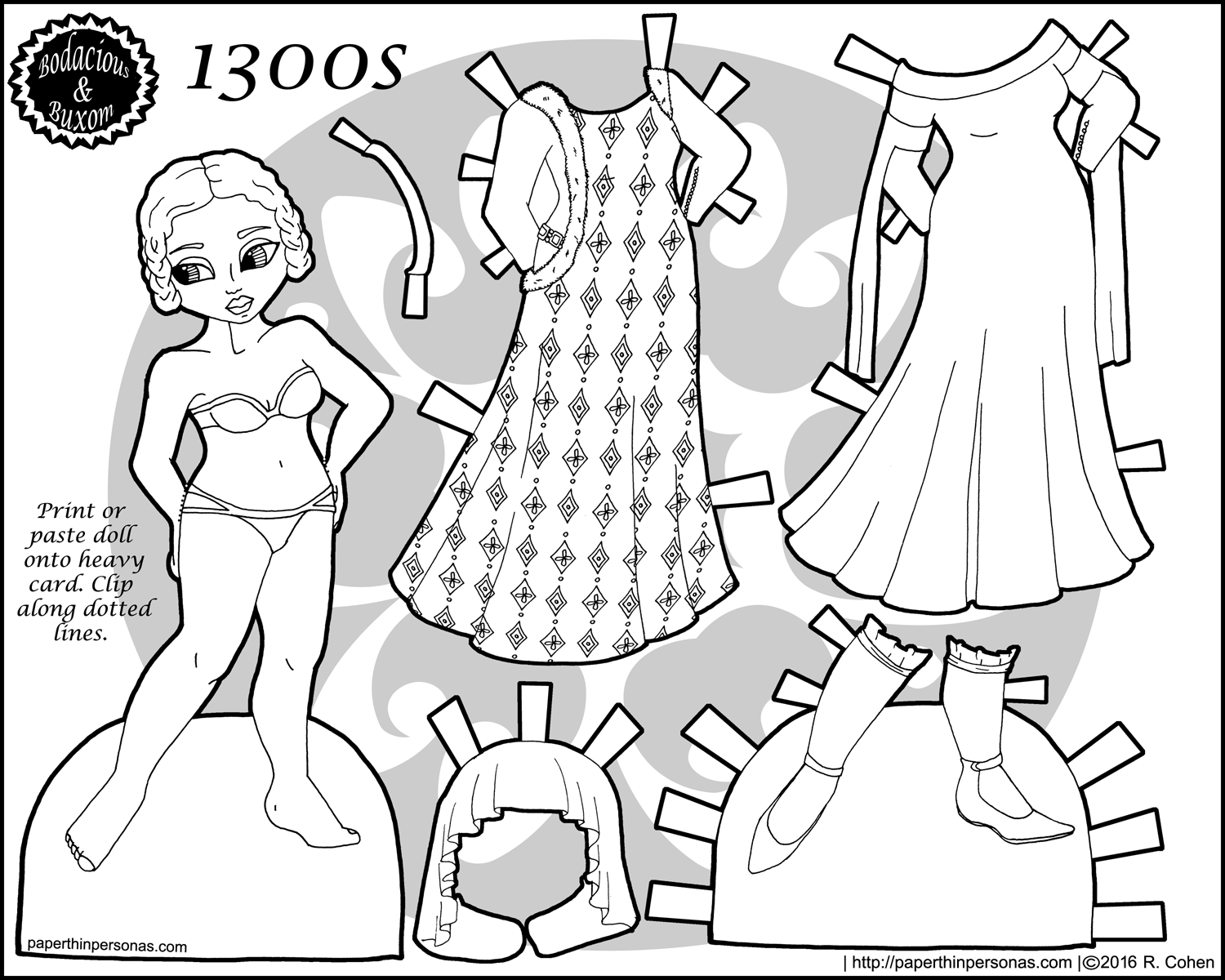
One of my goals for 2016 was to draw ten historical paper dolls. I confess I am far from achieving that goal and we’re halfway though the year (nearly), so I seriously need to get my act together on this one. So, my goal for the next few days is to buckle down and get some drawing, scanning and finishing done.

We’ll see how that goes.

I have a few days off work and I always start these things with a long list of “goals”, but I fear my plans are often larger than my capacity. Still, I’m out of backlog and nothing is as good as an artist motivation as desperation.

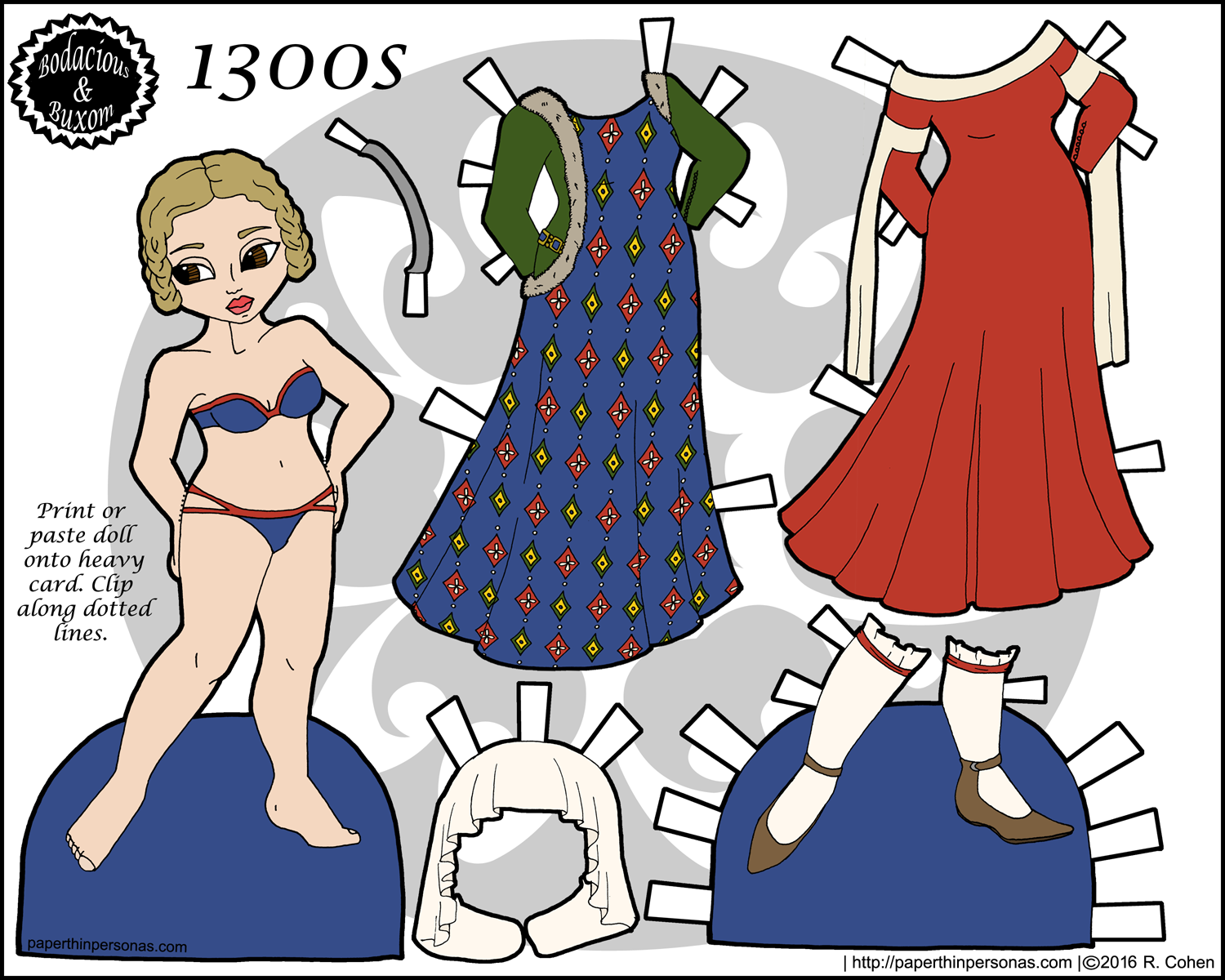
A 1300s fashion paper doll coloring page with a five piece wardrobe. Free to print and color from paperthinpersonas.com.

{Download a PDF of this paper doll to Color} {View a 150 dpi PNG of this Paper Doll to Color} {More Bodacious & Buxom Paper Dolls}

Picking out colors wasn’t very hard, since I seem to always come back to the same ones when it comes to the 1300s. I blame it on medieval manuscripts I have seen. I always think of the 14th century was being red and blue and gold.

Sterotypical, perhaps, but none the less. There we are.

A 1300s fashion paper doll with a five piece wardrobe. Free to print from paperthinpersonas.com.

{Download a PDF of this paper doll in Color} {View a 150 dpi PNG of this Paper Doll in Color} {More Bodacious & Buxom Paper Dolls}

Between my new 1300s Buxom and Bodacious paper doll, my viking paper doll, and my Cranach paper doll, we’re starting to get a pretty nice set of early Western Fashions. I keep promising myself I’ll do one from a decade of the 19th century, but I can’t pick one. So, 19th century B&B series suggestions would be welcomed.

Lastly, I hope everyone has a delightful week.

Tibbets and Kirtles in Color: A Printable Paper Doll of the 1300s

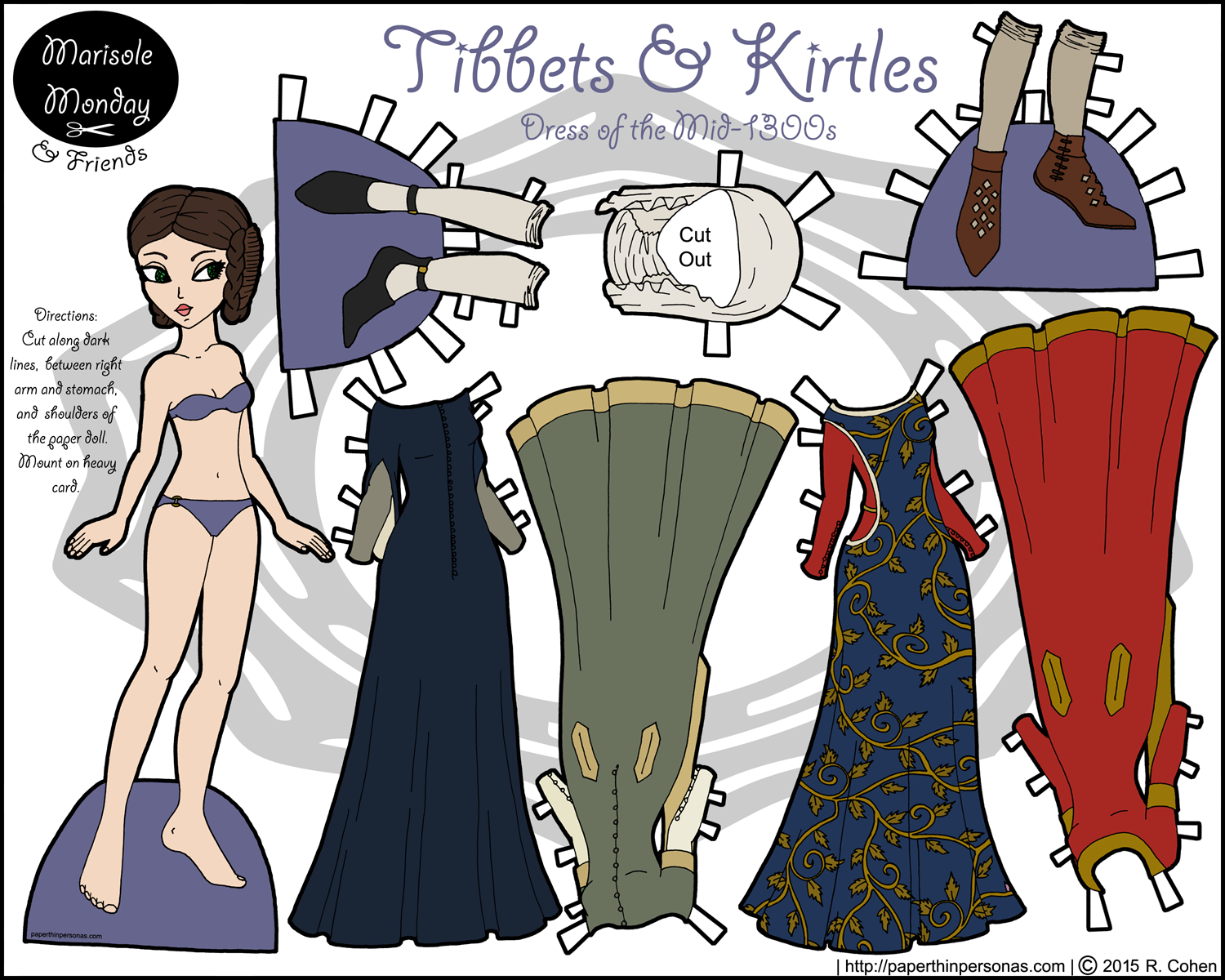
logo-1300-colorLast week, we got to see my mid-1300s paper doll set in black and white. This week, here she is in color. Historical printable paper dolls always make me a little nervous. In inevitably, choices have to be made about what to include or not include and how to render a period’s fashion. These choices are easier the more you know about the period and harder the less you know. One of the reasons I often turn to Medieval inspired or Renaissance inspired rather than actual historical paper dolls is the knowledge that I don’t know enough to always make appropriate choices.
What I am not comfortable doing is always trusting the many sites out there that don’t cite their sources with enough detail to actually find the material if you needed it or want to confirm it’s authenticity. While I love the internet, I find that I don’t use it that much when I am doing this sort of research. I seem to fall back on my library training and rely on reputable secondary sources published in scholars with names in the field, backed up my own knowledge of solid collections of digitized medieval manuscripts where I can dig for source images, plus a few tumblers and blogs that seem to know what they are doing.

And this method worked great until I got down the problem of color. Now, I always think of the 1300s as being richly red and blue and gold, because those are colors I have seen in medieval manuscripts. Just because, however, they made a dress red in a book doesn’t mean the dress was commonly red in real life. Pigments used for illumination aren’t the same a pigments used for dyeing cloth and medieval art is heavy on analogy and symbolism.

1300-historical-paper-doll-color
{Click Here for a PDF to Print} {Click Here for a PNG to Print} {Click Here for More Marisole Monday & Friends Printable Paper Dolls}
What I really didn’t want to do was do a ton a research on natural dye processes, because a lot of people have written a lot on the topic. Textile fragments like this one, an incredible velvet cope or this equally amazing cope from the V&A Collections proved to me that colors were rich in the 1300 hundreds. So, I used those images along with this Medieval Colors article from Aux Mailles Godefroy. The resulting colors are a little more muted than was probably possible in the 1300s, but I just couldn’t get over my preconceived notions of muted tones despite seeing examples of bright yellows produced with natural dyes. The truth is that both linen and wool, common fabrics in the 1300s, take dye really well. The world was likely a lot more vibrant than my preconceived notions of history suggest.

By the way, most of my primary and secondary sources for this paper doll set are listed on the black and white version. It was a long list and I didn’t want to repeat it here. So go check that out, if you want to see what I used to create my mid-1300’s paper doll.

Tibbets and Kirtles: A Paper Doll of the Mid-1300s

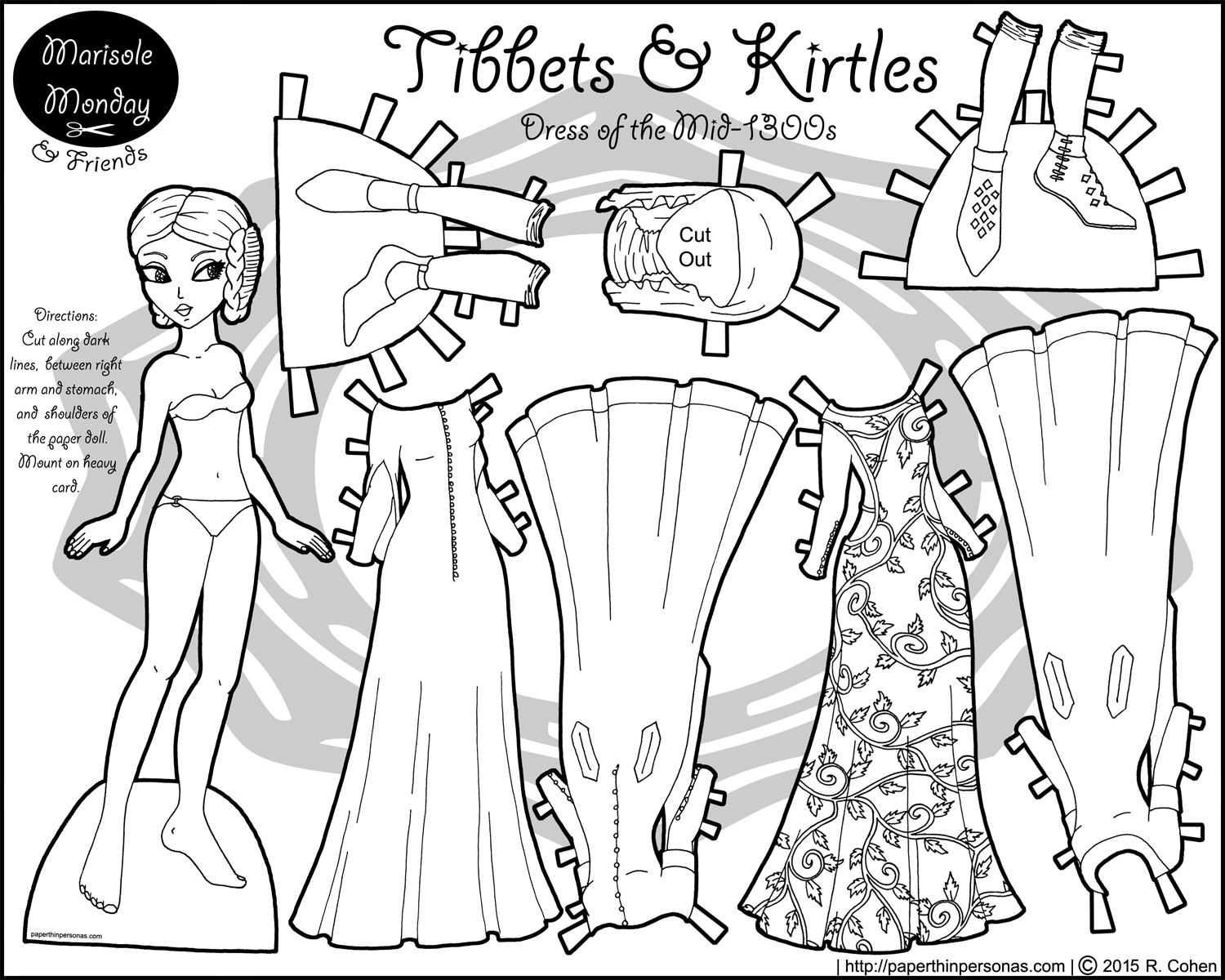
logo-1300-bwToday’s printable paper doll is from the mid-1300s when set in sleeves came into existence and fashion was all about layers and hanging strips of fabric off sleeves called “tibbets.”
There are topics upon which I can speak authoritatively and there are topics where I know basically nothing. I would say that I am fairly knowledgeable about certain periods of Western dress, but there are others that are beyond me. As someone who just isn’t that into the medieval period in Europe (though it is growing on me), I have never spent much time doing research. After last years adventures in the 10th century, I knew I wanted to explore some more early periods and the 1300s seemed like a smart choice.

I settled on the 14th century (or the 1300s), because I’ve been wanting to illustrate that period ever since I stumbled across the entire Roman d’Alexandre digitized from the Bodleian Library which is full of illustrations of ladies in fashionable dress. As I usually do, I cobbled together my decisions about this paper doll from a variety of secondary and primary sources. One website that deserves a shout-out is Illumanu which not only posts manuscript images, actually cites them properly. Makes the librarian in me so happy.

1300-historical-paper-doll-black-white
{Click Here for a PDF to Print} {Click Here for a PNG to Print} {Click Here for More Marisole Monday & Friends Printable Paper Dolls}
A few specific choices I should note. The pattern on the sidecut surcoat was from Romance of Alexander from the Bodlein Library. The far left dress is based on this casket lid from the Met and the Romance of Alexander from the Bodlein Library folio 181 verso. The green dress on the far left seems to have buttons down the front and hanging sleeves. The other two gowns are mixtures of literally dozens of primary and secondary sources. You can check out below some of the sources I used.

The stockings are scrunched below the knee. I wasn’t able to find any records of garters being worn in the 1300s. The shoes are both from Stepping through Time: Archaeological Footwear from Prehistoric times until 1800 which I would totally buy if I could find it for a reasonable price. I also designed a new face for this paper doll. I like it a lot, so it might become a regular member of the family. I haven’t decided yet. What do you all think?

Selected Sources:

Books:

Buren, Anne Van., and Roger S. Wieck. Illuminating Fashion: Dress in the Art of Medieval France and the Netherlands, 1325-1515. New York: Morgan Library & Museum, 2011.
Crowfoot, Elisabeth, Frances Pritchard, and Kay Staniland. Textiles and Clothing, C. 1150-1450. London: HMSO, 1992.
Goubitz, Olaf, Carol Van. Driel-Murray, and Willy Groenman-Van Waateringe. Stepping through Time: Archaeological Footwear from Prehistoric times until 1800. Zwolle: Stichting Promotie Archeologie, 2001.
Newton, Stella Mary. Fashion in the Age of the Black Prince: A Study of the Years 1340-1365. Woodbridge: Boydell, 1980.
Nunn, Joan. Fashion in Costume 1200-2000, Revised. Lanham: New Amsterdam, 2000.
Scott, Margaret. Fashion in the Middle Ages. Los Angeles: J. Paul Getty Museum, 2011.
Scott, Margaret. Medieval Dress & Fashion. London: British Library, 2007.

Manscript Illustrations:

Instructions for Kings, in French
MS M.456, 55v–56r
France, Paris(?) circa 1330–35
Morgan Library and Museum

Jacques de Longuyon, Vows of the Peacock, in French
MS G.24, 25v–26r
Belgium, Tournai circa 1345–50
Morgan Library and Museum

Speculum humanae salvationis
Hs 2505, 37r
Westphalia or Cologne, circa 1360
Technische Universität Darmstadt

Giovanni Boccaccio, De Claris mulieribus…
Français 598, 134r
Bibliothèque Nationale de France
France, circa 1403

Roman d’Alexandre
MS. Bodl. 264, 47r, 97r, 97v, 120v, 121r, 127v, 163v, 169r, 168v, 171r, 172r, 172v, 173r, 181r, 181v, 191r, 196v, 197v, 204r
Bodleian Library
Flanders, circa 1344