Hope: A Late 18th Century Paper Doll Set

logo-hope-1700sHope is based on the styles at the end of the 18th century. So, something major happened around the 1789 in France. It was, for those who weren’t asleep in high school history class, the French Revolution. To say that “everthing changed” wouldn’t be an understatement and the ripples of the events in France spread across Europe in dramatic ways. It is tempting when looking at the end of the 18th century to simply assume that after 1789 everyone just jumped into Empire styles and that was the end of it, but the reality is that there was a very slow evolution to the high waisted gowns we think of as “empire” or “Regency” dress.

So, I was less interested in worrying about the Empire look and much more interested in the every transitional styles that are easily forgotten and often ignored.

This all brings us rather neatly to Hope. Hope is our paper doll model for the later part of the 1700s. Her dresses will never get up the high waisted styles that characterized the transition into Empire. Rather, I think of her as being a woman of means right before everything gets radicalized. And, for her sake, let us assume she lives in England which was always behind on the fashions a bit anyway and a much safer place to be than France at the end of the 18th century. They don’t call it the Reign of Terror for nothing, after all.

hope-18th-cent-paper-doll-black-white

{Download a PDF to Print and Color} {Download a PNG to Print and Color} {More Pixie & Puck Printable Paper Dolls}

Hope’s hair is done up in a style known as coiffure à l’enfant. This was a style popularized by Marie-Antoinette in the early 1780s. The style is a frizzy halo of hair with several longer strands curled, braided or left straight. Here is a portrait that shows off the hair style from the Met and here is a fashion plate featuring it from the V&A. I have to confess that I am not totally pleased with her hair. I fear that it looks a little bit too “mad scientist” for my comfort.

hope-18th-cent-paper-doll-color

{Download a PDF in Color} {Download a PNG to in Color}{More Pixie & Puck Printable Paper Dolls}

Moving away from her hair for a moment, Hope has undergarments, of course, and then a gown known as a Redingote. Redingote’s started their lives as actual riding coats, but eventually transformed into women’s gowns which were coat like and then cut away to reveal the petticoat underneath. The word “redingote” is believed to be a French transliteration of the English term “riding coat”. Hope’s redingote was based on this gown from LACMA circa 1790. The term “redingote” sticks around into the early 20th century as a term of long coats.

Her hat is from this hat from the MINT circa 1770. Her shoes are based on this pair from the Met from 1780. Her muff and her mitts are both from Colonial Williamsburg.

I think that’s all the sources I need to list for Hope. I might have forgotten something, but I think that’s everything. Next Friday, there will be the last set of outfits for the 18th Century Pixie Series all from the later part of the 18th century.

Joy: An 18th Century Historical Paper Doll Set

logo-joy-1700sToday’s 18th century paper dolls is my second of three. Joy, all of these paper dolls will have virtue names, is from between the 1760s though 1780s. She has underwear and a gown in the polonaise style. Poloniase gowns had a skirt that is raised up and bunched over the petticoat. Usually a gown could be worn either with the skirt looped up in the polonaise or with the skirt down- offering some versatility to the 18th century silhouette. The polonaise gown sticks around into the 19th century and is sometimes mistaken for a bustle.

Joy’s gown was based on this pink silk gown circa 1770-1780 housed at the LACMA. Her shoes are based on this fashion plate from 1778. Her undergarments are based off a set held by the V&A museum dated to 1778.

joy-18th-cent-paper-doll-black-white {Download a PDF to Print and Color} {Download a PNG to Print and Color}{More Pixie & Puck Printable Paper Dolls}

As with the rest of this series, I based her color scheme off my 18th century color pallet which I introduced in the first part of this series. After seeing this gown from MFA in Boston I knew I wanted to do something in a rich red color. Despite myself, I tend to think of the 18th century as being muted in colors, but nothing could be further from the truth.

joy-18th-cent-paper-doll-color
{Download a PDF in Color} {Download a PNG to in Color}{More Pixie & Puck Printable Paper Dolls}

It has been so much fun to share this paper doll series over the last few weeks. We have four more pages with one more doll and three more sets of gowns. The whole collection, so far, can be seen here.

Since we’re talking the 18th century, I thought I would call attention to a cool project I discovered this week. The University of Michigan has begun to translate and make available online the Encyclopédie edited by Denis Diderot and Jean le Rond d’Alembert in the 18th century. The section of primary interest to those of us obsessed with dress is the plates on the Tailor of Suits and Bodices, but I’ve used the Encyclopédie to show students furniture manufacture and paper making circa 1790. I love this book and can get lost in it for hours.

18th Century Gowns: Round-Gown, Brunswick, and Sack-Back Gown

logo-18th-centToday, we have out first set of 18th century gowns for the paper dolls, including a round gown, a brunswick and a robe à la française.

Until the introduction of high-waisted dresses at the very end of the 18th century, most women’s garments consisted of a skirt or petticoat and a bodice. In garments like round gowns, less formal and/or worn by the middle classes, the bodice would fasten in the front and there would be a separate skirt. The far left paper doll costume is a round-gown, based on this round gown from the Philadelphia Museum of Art.

Sometimes, the bodice would come down partly over the skirt creating a jacket like affect. These mid-thigh length bodices were called caraco jackets. Here, for example, is an extant caraco jacket from the LACMA. Later in this series, there will be caraco jackets, but our middle gown is not a caraco jacket, but rather a brunswick. Brunswicks were traveling garments, often hooded, that had long sleeves. Though relatively practical, they were made of fine fabrics like silk- which makes one wonder about the whole “traveling” thing. Anyway, you often see Brunswick’s in art, but the V&A has a rare extant version which would have had removable sleeves. I based my Brunswick’s on two portraits- Lady Mary Fox and Alexander Roslin’s Portrait of the Girl Holding a Spaniel.

If the bodice and skirt were attached to each other in the 18th century, the skirt would be open in the front to reveal the petticoat underneath. This style of gown was called a robe à l’anglaise, closed bodied gown or an English gown if the pleats in the back of the bodice were stitched down. However, if the pleats were allowed to fall open and loose than the gown became sack-back gown or robe à la française. In modern times, this gown has been called a Watteau back or Watteau gown, after a painter who painted a lot of this style. The dress to the far right of today’s paper doll set is a sack-back gown, but I think the style is easier to see through extant examples like this robe à l’anglaise and robe à la française, both from the Met’s collection.

18th-cent-paper-doll-gowns-black-white{Download a PDF to Print and Color} {Download a PNG to Print and Color}{More Pixie & Puck Printable Paper Dolls}

Along with the gowns, today’s set includes a pair of slippers with overshoes based on this set from the Powerhouse Museum Collection. Over shoes were worn to protect the shoe from mud and muck, though I wonder how much protection a brocade and leather pair could have granted. I’ve also included several different styles of hats. My goal with the hats in this paper doll series is less to match specific dresses, but rather to provide enough variety for there to be plenty of choices. Women did not always wear their hair covered, but usually did.

18th-cent-paper-doll-gowns-color{Download a PDF in Color} {Download a PNG to in Color}{More Pixie & Puck Printable Paper Dolls}

My color choices for these gowns were taken from my 18th century color pallet which I showed off in last week’s paper doll post. I chose pale blue for the round gown, since the source gown is blue striped, bright yellow for the brunswick, and a rich teal-blue color for my first robe à la française. That is certainly the most formal of the gowns from today’s set. The shoes were done in a neutral light brown color to go with any of the dresses.

In case you missed part one of this series, here is the entire collection so far. Next week, we will have our second paper doll- Joy.

Ragamuffin Girl: Steampunk Printable Paper Doll in Color

logo-ragamuffin-colorYou’d think after having done hundreds of paper dolls that I would actually never struggle to come up with color schemes. And yet… I still have trouble.

The problem with steampunk or anything steampunk inspired, is that there’s a lot of brown. (This is actually the same problem I have with gothic things as well- too much black.) So, I selected several diverse shades of brown to use and then set them off with some ochre, orange, olive green, and teal. Pale blue was added so that every shirt wouldn’t be cream. I wanted to avoid red or pink- these are both colors I love and colors I tend to fall back on when I am trying to come up with color schemes and I also thought they were too girly for this menswear inspired set.

The tiny braids in Mia’s braided hair created a new series of challenges. There’s three choices when highlighting a feature like that- go darker than the main hair color or do lighter than the main hair color or go a radically different color than the main hair color. I knew I didn’t want to do option three and I decided the lighter braids looked better than darker braids.

ragamuffin-steampunk-paper-doll

{Click Here for a PDF to Print} {Click Here for a PNG to Print} {Click Here for More Marisole Monday & Friends Printable Paper Dolls}

I will confess that this set took forever to color and while I really like how it turned out, doing the layout of all these pieces was a pain as well. I need to remember my “10 to 11 pieces plus 2 pairs of shoes” rule when I’m drawing or else doing the layout takes forever. This set was 13 pieces and 2 pairs of shoes, plus a lot of these pieces are big. Anyway, it might not seem like a big difference, but it does make a difference.

Anyway, I hope everyone enjoys Mia in her steampunk get up. Next Monday, there will be ballerinas. Actually, we’ll have a whole month of ballerinas- because I might have gotten a little carried away. 🙂

Debuting my 18th Century Historical Paper Doll Set with Faith

logo-faith-1700sSometimes, I get started on projects and they don’t seem “insane” and then a few weeks later I find myself further into them and I am thinking, “Was I crazy to start this?” and, of course, “Will this ever be done?”

So, over the next seven weeks on every Friday, I will be sharing pieces from a historical paper doll project that started with a simple, “I should draw some 18th century clothing for the Pixies.”

18thcent-colors

It kinda grew a bit unexpectedly.

My original plan was to do three Pixie paper dolls, all with different skin-tones, and each would focus on the first part, middle part and then last part of the 18th century.

No plan, as they say, survives contact with the enemy.

Instead of three clearly defined sets, I ended up with three paper dolls and four pages of dresses and only one set, my late 18th century set, seemed clear cut. So, I did what any rational paper doll artist would do, I said, “Meh. I’m just going to go forward anyway.”

Today I am pleased to present the first of my three Pixie paper dolls and for the next six weeks, each Friday, there will be another Pixie paper doll or a set of dresses for the 18th century Pixies.

As you can see from my 18th Century Color Palette graphic above, I knew I wanted to use a consistent color palette through all of these seven pages of paper dolls. I chose to based my colors on a stomacher, also from the V&A Museum. I wanted all the colors to be fairly soft, but also rich, reminiscent of what you see in portraits of the era.

Today, I am pleased to present Faith, the first of this seven week series.

faith-18th-cent-paper-doll-black-white
{Download a PDF to Print and Color} {Download a PNG to Print and Color}{More Pixie & Puck Printable Paper Dolls}

Faith wear’s her hair in a style known as tête de mouton (or “sheep’s head”) and it was extremely popular in the 1750s. She, of course, has her hair powdered, through powder was not universally worn, despite what some people seem to think. Her underwear consists of stays and hoops. As with many of my forays into historical underwear, her undergarments won’t fit under all the dresses of this set. Her stays are based on Stays from the V&A Museum . These type of wide narrow hoops were usually used to support the wide skirted formal gowns of the 18th century, but Faith doesn’t have a formal gown on this page. Instead, she has a riding habit. Her riding habit is based on Riding Habit from the V&A museum dated between 1750 and 1759. Her small hat is a combination of a hat from the Met Museum and the hat in this portrait of Princess Marie-Thérèse-Louise de Savoie-Carignan which was sold at Christie’s.

faith-18th-cent-paper-doll-color
{Download a PDF in Color} {Download a PNG to in Color}{More Pixie & Puck Printable Paper Dolls}

The colors of her garments were, of course, influenced by the original riding habit, but also by the stomacher I showed above. I wanted a consistent color scheme across all these paper doll pages, for maximum mix and matching possibilities. Playability, a word I am not sure is a word, is something that I value very highly in my paper dolls. While I rarely cut them out and actually play with them, I like to think about how people would cut them out if they were going to do so.

Tune in next Friday for a page of dresses and then the next week a paper doll and then a page of dresses and then… well, you get the idea. 🙂

Ragamuffin Girl: Steampunk Paper Doll

logo-ragamuffin-bwI previewed this paper doll back in April, but even when I previewed it, the paper doll set had been sitting in my sketchbook for a month or more. I was dreading work on it, not because I didn’t like the paper doll, but because the idea of coloring all the detail was terrifying.

So, last week, when I was finally out of everything else I had drawn for Marisole Monday & Friends that I could feed the blog, I found myself finally tackling this paper doll set. Sometimes I have to be forced into these things.

All right, so inspirations for today’s paper doll set include the film Newsies and that’s really about it. Though I confess I do rather see today’s version of Mia hanging out with my airship mechanic Marcus. I mean they both have tools and newsboy caps.

ragamuffin-steampunk-paper-doll-bw
{Click Here for a PDF to Print} {Click Here for a PNG to Print} {Click Here for More Marisole Monday & Friends Printable Paper Dolls}
I try to create for all my Marisole Monday & Friend’s paper dolls somewhat evenly. Currently though, this is only Mia’s second set this year. That puts her behind well… everyone else. So, she’ll get some more love soon though since I’ve got a ballerina set in the works for her and Monica. (Yes, I tackled my fear of tutus.)

Today’s paper doll set will, of course, be up in color next week and then… I have no idea what’s next, actually. Probably ballerinas.

Alien Fashions for the Ms. Mannequin Paper Dolls

logo-alien-fashions Yesterday, I posted Xylra my new alien paper doll and I wanted to get her fashions up today. Not just because I think they are neat, but because I have been rather neglectful of the blog this July and if I post these this week then I won’t feel so guilty.

Blog guilt is a powerful motivating factor in my life.

Xylra is a fashionable intergalatic astrophysist and I confess I have no idea how practical any of these pieces would be for someone studying astrophysics. Truth be told, I have no idea what an astrophysicist does all day, but then I suppose most astrophysicists probably don’t know what Special Collection librarians do all day which makes us even. (For those of you who haven’t read my about page, I am a Special Collection librarian when I’m not drawing paper dolls.)

Anyway, one of my rules with paper dolls is to avoid being bogged down by practicality or common sense when designing fantasy or sci-fi clothing. A rule I haven’t violated here.

{Click Here for a PDF in Color} {Click Here for a 150 dpi PNG in Color}{Click Here for a PDF of Black and White} {Click Here for a 150 dpi PNG in Black and White}{Click Here for More Clothes}{Click Here for Paper Dolls to Wear These Clothes}

I did want to take a moment and talk about the colors in today’s set of paper doll clothes. Originally, I was planning on a more traditional cyberpunk color scheme, but I wanted to see if I would work with colors that I actually didn’t like. Perhaps an odd mental exercise, but important, I think, to growing as an artist. I considered doing two coloring jobs, one with colors I liked and one with colors I didn’t, but once I’d colored the paper doll clothes with my “ugly color scheme”, I found that I actually rather liked them. Perhaps spending time with the colors softened me up towards them or perhaps I just didn’t want to recolor the whole thing. Either way, enjoy my foray into an “ugly color scheme” and if you don’t like it, well… there’s a black and white version for a reason. Enjoy!

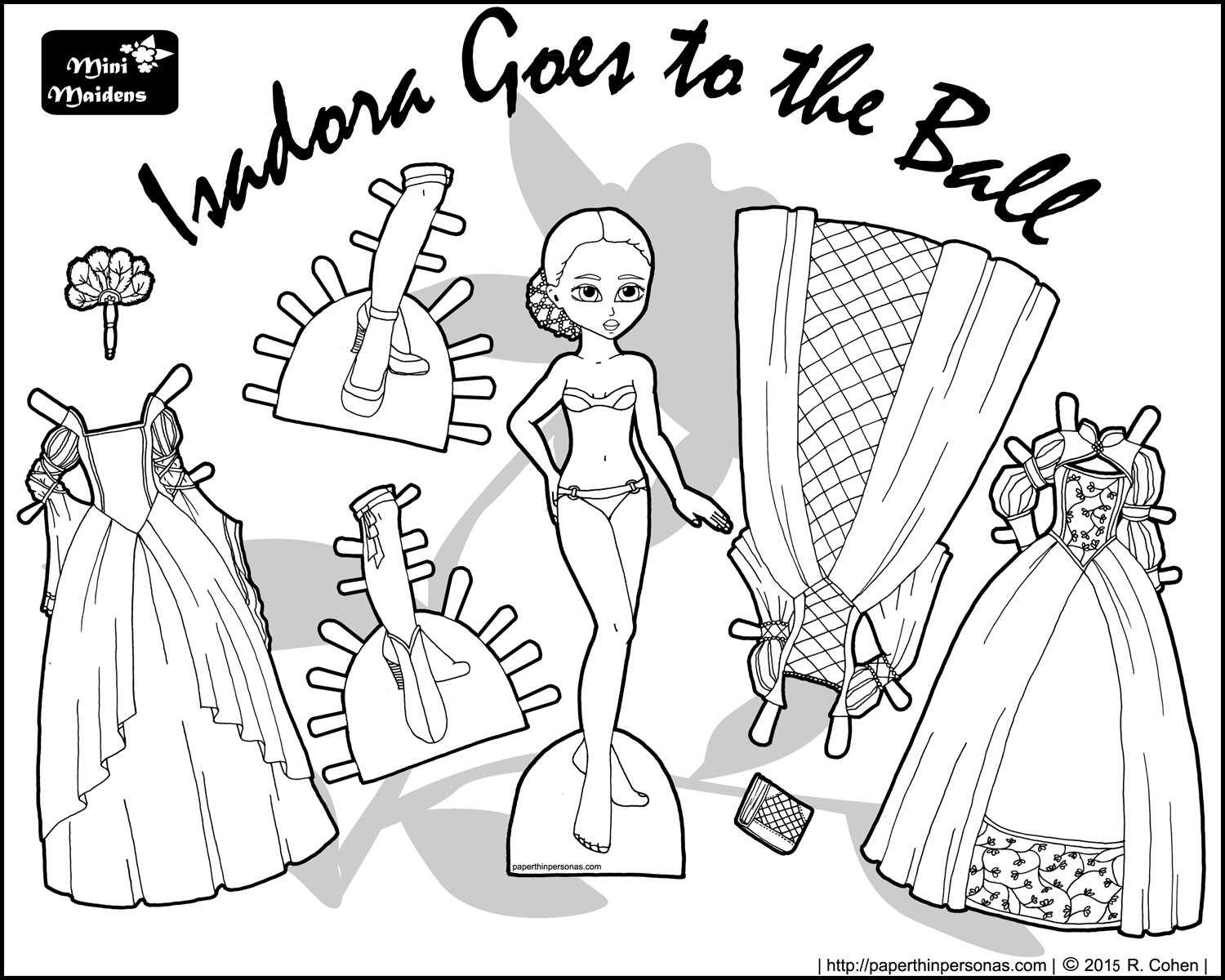
Isadora Goes to the Ball: A Fantasy Princess Printable Paper Doll Coloring Page

logo-isadora-ballgownThis is not an Independence Day paper dolls, but I have some links to a few down at the bottom of the post. This is a princess paper doll.

Let’s be honest for a moment: A lot of the appeal of princesses lies in their glorious dresses.

We all know intellectually that being a princess would kinda suck. (There’s a great video about this by Amy Schumer.) You’d have to marry someone who you likely didn’t choose. Your value would be entirely defined in your ability to produce an heir. Also, that person you would marry might end up being your cousin.

Never the less, your wardrobe would rock.

So, I’m not sure if Isadora would be a princess, because she doesn’t have a crown. Do princesses need crowns? I suppose they should if they are coronated. But once they get coronated than are they actually queens?

Royal stuff is complicated.
isadora-ballgowns-fantasy-paper-doll

{Download a PDF to Print} {View a 150 dpi PNG} {Check out some More Mini-Maiden Printable Paper Dolls}
These three gowns are all ball-gowns in my head, but the glory of paper dolls is that we can choose what they are. Maybe these are what Isadora wears to the grocery store. Actually, if I had these dresses, I might wear them to the grocery store, though I have been told that driving in a hoop-skirt is really difficult.

So, this is the fourth of July or Independence Day in the USA. I did not, however, get a thematic paper doll done. If you wish for one, then I recommend Hazel’s 4th of July set, my Marisole Monday & Friends 18th century 4th of July set or Marisole Monday’s Nautical set which, while not technically 4th of July related, does have a red white and blue color scheme.

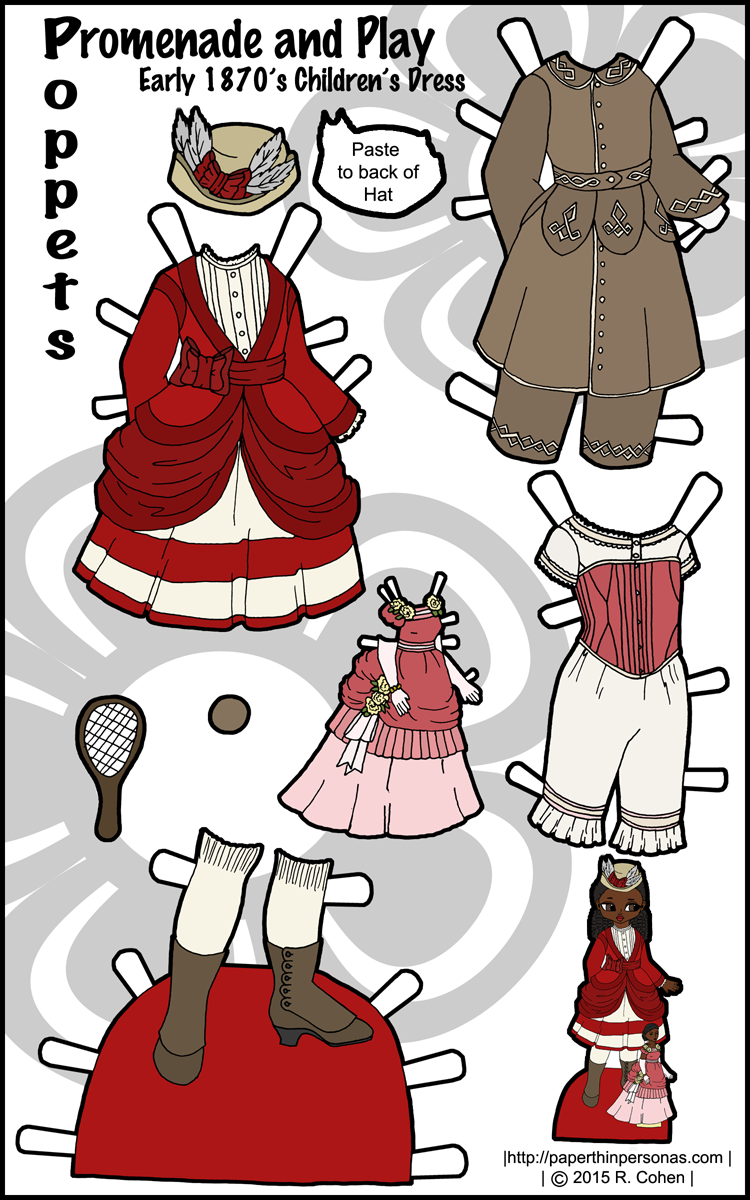
Promenade and Play: Victorian Paper Doll Clothes for the Poppets

logo-promenade-playSo, life this week has been a roller coaster of sickness and travel, but I promised a second page of clothes for Peach in the Park to expand her Victorian paper doll wardrobe and I am pleased to say that here they are.

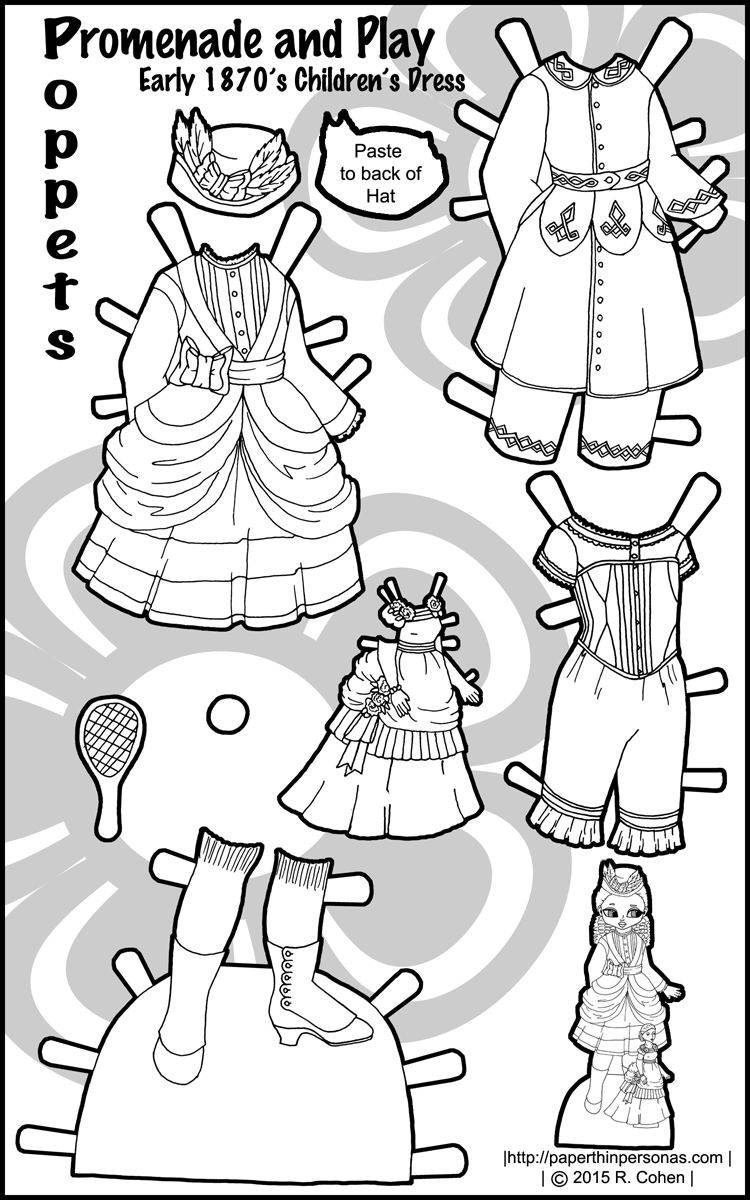
In no real order, in this set of paper doll clothes there is a promenade dress or afternoon dress, a gymnastics outfit and a set of underwear consisting of a chemise, drawers and a stayband or corset. She also has a pair of shoes with stockings and a ballgown for her doll. It is entirely possible that the doll’s little ballgown is my favorite piece of the entire set, though drawing that small was a challenge. (Seriously, the doll is like two inches tall in real life. I kid you not.)

I drew these designs based on illustrations from several different Victorian fashion magazines including Harpers Bazaar and La Mode Illustre, which as French. I highly recommend Dover’s excellent books of fashion plate reprints when working on Victorian period fashions- they bring a richness to the process of research that is of great value. Plus it’s fun to draw surrounded by open books (at least, I think it is fun.)

poppet-1870s-victorian-historical-paper-doll-dress-up-black-white
{Download a PDF in Color} {View a 150 dpi PNG in Color}{Download a PDF to Color} {View a 150 dpi PNG to Color} {More Poppet Printable Paper Dolls}
By the late 1860s, early 1870s, sporting activities were encouraged for children. Gymnastic’s costumes like the one in brown are often shown in magazines along with yachting and skating outfits. While it is hard to imagine a child really running around in the bustled up skirts of the era, it is possible to imagine them doing so in one of these more practical outfits.

I also think it is important to remember that while fashion magazines show perfectly coifed children, actual children’s garments are often more worn and simpler. Kid’s did get out in play even in the 1800s and parents did not dress them like little adults, despite what my fashion history teacher told me. The length of a girl’s skirt indicated her age. The poppets are, in my mind, between the ages of 8 and 11, so their skirts are mid-calve. The skirts would slowly lower until maturity when they would be floor length for many, thought not all, activities.

As a reminder, because I forget this sometimes too- any of the Poppet paper dolls can wear any of the other Poppet paper doll’s clothing. So, while I was thinking of Peach when I made these outfits, they could also be worn by Petunia, Paradisea, Poppy, Posey, Petal, or Primrose.

That is a lot of P names.

Anyway, enjoy the Victorian paper doll outfits.

Greta’s Trousseau: Spring Costumes

So, way back in December of 2013, I started a project called Greta’s Trousseau with this post. The idea was that I would draw a complete trousseau for a paper doll inspired by neo-Victorian and steampunk styles. This is the sixth page of Greta’s Trousseau. I don’t think it’s the last one, but we maybe getting close.

greta-trousseau-fashion-plate-spring-costume

Today, Greta has a carriage dress, a visiting toilette, a dinner dress, afternoon costume and morning dress. Her Carriage Dress is based on two gowns from Harper’s Bazar in 1873. One a watering place costume, published in the June 28, 1873 issue and the other a Carriage dress published in the July 5th issue of that same year. Harpers Bazar is a publication which is a little hard to find online. I used Dover’s book of reprinted fashion plates edited by Stella Blum, but you can see some issues of Harpers Bazar from the Home Economics Archive and others from the Hathi Trust. Hathi Trust has better image quality, but does not include the 1873 year.

Anyway, her visiting toilette has an additional hat, as does her carriage dress. Her dinner dress and afternoon costume are the same skirt with two different bodices, a common practice in the Victorian era. Her morning dress is, of course, the most simple gown she has and with it she has slippers, stockings and some correspondence.


greta-trousseau-spring-paper-doll
{Download a PDF to Print} {View a 150 dpi PNG} {Check out some More Mini-Maiden Printable Paper Dolls}
My goal was to create the massive wardrobe of an absurdly wealthy fashion obsessed neo-Victorian lady. Currently, Greta has sporting outfits including swimming, fencing, hunting, skating and riding. She has a seaside walking dress, two traveling suits, and clothing for exploring or hiking. For formal occasions, she has a ballgown with two bodices, opera toilette and two dinner dresses. For visiting, she has two outfits. There is a walking suit and a promenade costume. For the afternoons, she has an afternoon costume and a tea dress. For quiet days at home, she has a house dress and a morning dress. For the very rare occasion she might need one, she has a wedding dress and a diving suit.

Here is the rest of Greta’s paper trousseau in case anyone missed a page or something.

Cranach Gowns: A Paper Doll of German Rennisance Dress (Plus Resources)

Link to Cranach Gowns, a paper doll of a 15th century Saxony dress in Germany with two gowns, two hats, one pair of shoes in black and white or in full color for printingHappy Friday! Here’s a printable paper doll. 🙂

I first stumbled across Cranach dress or gowns in this rather gruesome painting of Judith with the Head of Holofernes months ago and her gown was fascinating. I didn’t know much about it, except that it was painted by Lucas Cranach. As it turned out, I discovered as I did more research, that the artist- Lucas Cranach the Elder- painted countless versions of this gown on countless both real and mythological figures.  Coming out of the Saxony area of Germany, Lucas Cranach was hired by Fredrick the Wise who to be the court painter of his court in 1505 and Cranach stayed there for the rest of his life. He was extremely prolific and his art is distinctly romantic and stylized. Even his portraits all rather do look the same after a while, I have to confess.

Around 1546, Cranach illustrated a manuscript for the Court at Saxony. This collection of portraits of Saxon princes and family known as Das Sächsische Stammbuch – Mscr.Dresd.R.3 is fascinating. I was immediately struck by the illustrations of the Saxon princesses (image 220, f. 89) and I knew I wanted to draw these dresses.

Cranach Gowns, a paper doll of a 15th century Saxony dress in Germany with two gowns, two hats, one pair of shoes in black and white for printing. Free from paperthinpersonas.com {Download a PDF of this paper doll to Color} {View a 150 dpi PNG of this Paper Doll to Color}{More Paper Dolls in the Bodacious & Buxom Series}
However, there is a debate as to whether or not Cranach’s gowns actually existed in the real world. Here’s my view: We don’t have an extant one, but then we don’t have very many extant garments from this era anyway. Should we find one the debate would be settled, but until then we have to work with the primary sources we have.  The value of fabric and the expense of clothing was so great the people usually chose to be painted to garments they actually owned.

Plus, I tend to approach history with the belief that in the absence of proof to the contrary, we should assume that people of the era were not trying to mislead people of the future. Why commission a family history with crests and portraits of your family, if you are not going to accurately render the people in the images? Das Sächsische Stammbuch – Mscr.Dresd.R.3 is a collection of portraits of Saxon nobles. Why put the princesses in imaginary gowns?

The first question I struggled to answer was if the nets of pearls so often seen the women’s hair in these portraits were actually nets of pearls, or rather some sort of cap. This article on these caps lead me to conclude it was a cap, rather than part of the hair. The paper doll’s shoes are fairly standard 15th century shoes with squared toes. Her hats are based on portraits of the era.

I picked out colors based on the main colors I saw in the portraiture which were red and black. I really wanted to do blue as well, like the illustrations of the Saxon princesses and so I did a blue gown as well. I did wonder, however, about the blue. Color is often symbolic in manuscript illustration and I wondered if perhaps blue was used to denote virginity (the Madonna was associated with blue) rather than to render the actual color of the gowns. Never the less, I thought they looked pretty and that was enough for me. I made the paper doll a redhead, because I have a thing for redheads and so did, it seems, Cranach.

ranach Gowns, a paper doll of a 15th century Saxony dress in Germany with two gowns, two hats, one pair of shoes in color for printing {Download a PDF of this paper doll in Full Color} {View a 150 dpi PNG of this Paper Doll in Full Color} {More Paper Dolls in the Bodacious & Buxom Series}
In my research, I am indebted to The German Renaissance of Genoveva , a blog devoted to recreating German Renaissance dress for reenactment and The Court Gowns of Saxony and article by Holly Stockley which was accessed via the Wayback Machine and The German Renaissance of Genoveva website.

Normally, this is where I would put my sources. The truth is that I was flummoxed in finding any really good secondary academic works on German Renaissance dress in English. I did use the Met’s collection of Cranach paintings, the Encyclopedia Britannica’s article on Lucas Cranach, this delightful bookplate from the National Gallery (USA), the National Gallery (UK) portrait of a noble woman, and this portrait of Princess Maria of Saxony.

The most useful document was Das Sächsische Stammbuch – Mscr.Dresd.R.3 and I owe a debt to the library that digitized it. It it through this digital work that people like me can see the great artifacts of Europe and study them. I am well aware of the risks and time such projects take, so I am grateful when libraries and museums undertake them.

As always, if you want to know when I update this blog, feel free to drop your email on the sidebar to be and be added to the updates mailing list. You can also follow me on twitter where you can see when the blog updates (though I usually tweet after I post by a few hours) and get to read about what I might be making for dinner.

And, of course, thoughts in the comments are always valued.

Lois: A Paper Doll of the 1930s

lois-logoI love the styles of the early 1930s and I wanted to create a paper doll that showed them off, so here is Lois- a paper doll of the early 1930s. That is to say, everything in it comes from 1930-1932.

It’s common to speak of the last century of fashion as though it happened in neat decade compartments. In reality, fashion doesn’t care what decade it is. It moves based on cultural and social shifts, often subtly, and then you look around and notice that the silhouette has shifted. Rarely, fashion changes dramatically over a short period, but only very rarely.

So, when looking at the early 1930s, as this paper doll does, you might be struck at how close these dresses are to the late 1920s. In truth, they are very similar, because fashion just doesn’t change that quickly. The Great Depression will catch up with the styles of the 1930s, it just hasn’t yet. All of these dresses are drawn from images in the book Everyday Fashions of the Thirties As Pictured in Sears Catalogs published by Dover. The Sears series from Dover is an inexpensive way to gather up books the show what people wore, rather than what fashion magazines thought people should be wearing. I own almost all of them.

lois-1930s-early-paper-doll-bw
{Download a PDF to Print and Color} {Download a PNG to Print and Color}{More Pixie & Puck Printable Paper Dolls}
I have mixed feelings about my color choices. I knew I wanted to pick a color scheme where I hats could go with either of the dresses, but I don’t know how successful I was. I really do like how the white hat contrasts with her dark skin and I like how rich the red coat looks, but I’m not so sure about the yellow dress. The early 1930s is a very art deco influenced period and that makes me happy. I love the asymmetrical styles and the often surprising details.

lois-1930s-early-paper-doll-color
{Download a PDF to Print in Color} {Download a PNG to Print in Color}{More Pixie & Puck Printable Paper Dolls}
Unlike my 1920s Pixie Lynn, I actually gave Lois some undergarments. She has a girdle decorated with flowers to go under her dresses. She should, technically, have a slip to go over that and panties to go under it, but its a start.

I would have to pour through all my posts to be certain, but I think this is my second 1930s paper doll ever. The first was way back in 2010 for my original Curves Series and is just called 1930s. I got totally distracted looking through those old paper dolls trying to find the 1930s set I was pretty sure was there. It’s strange to go back and look at things I drew four or five years ago.

Some of them paper dolls I still really like and others I don’t. It rather makes me want to take on a project like Julie’s toddlers where she goes back to older color schemes. I’ll have to think on it. I don’t want to “redraw” old things, but there are some ideas there that I think could be reexamined fruitfully.