 Hope is based on the styles at the end of the 18th century. So, something major happened around the 1789 in France. It was, for those who weren’t asleep in high school history class, the French Revolution. To say that “everthing changed” wouldn’t be an understatement and the ripples of the events in France spread across Europe in dramatic ways. It is tempting when looking at the end of the 18th century to simply assume that after 1789 everyone just jumped into Empire styles and that was the end of it, but the reality is that there was a very slow evolution to the high waisted gowns we think of as “empire” or “Regency” dress.
So, I was less interested in worrying about the Empire look and much more interested in the every transitional styles that are easily forgotten and often ignored.
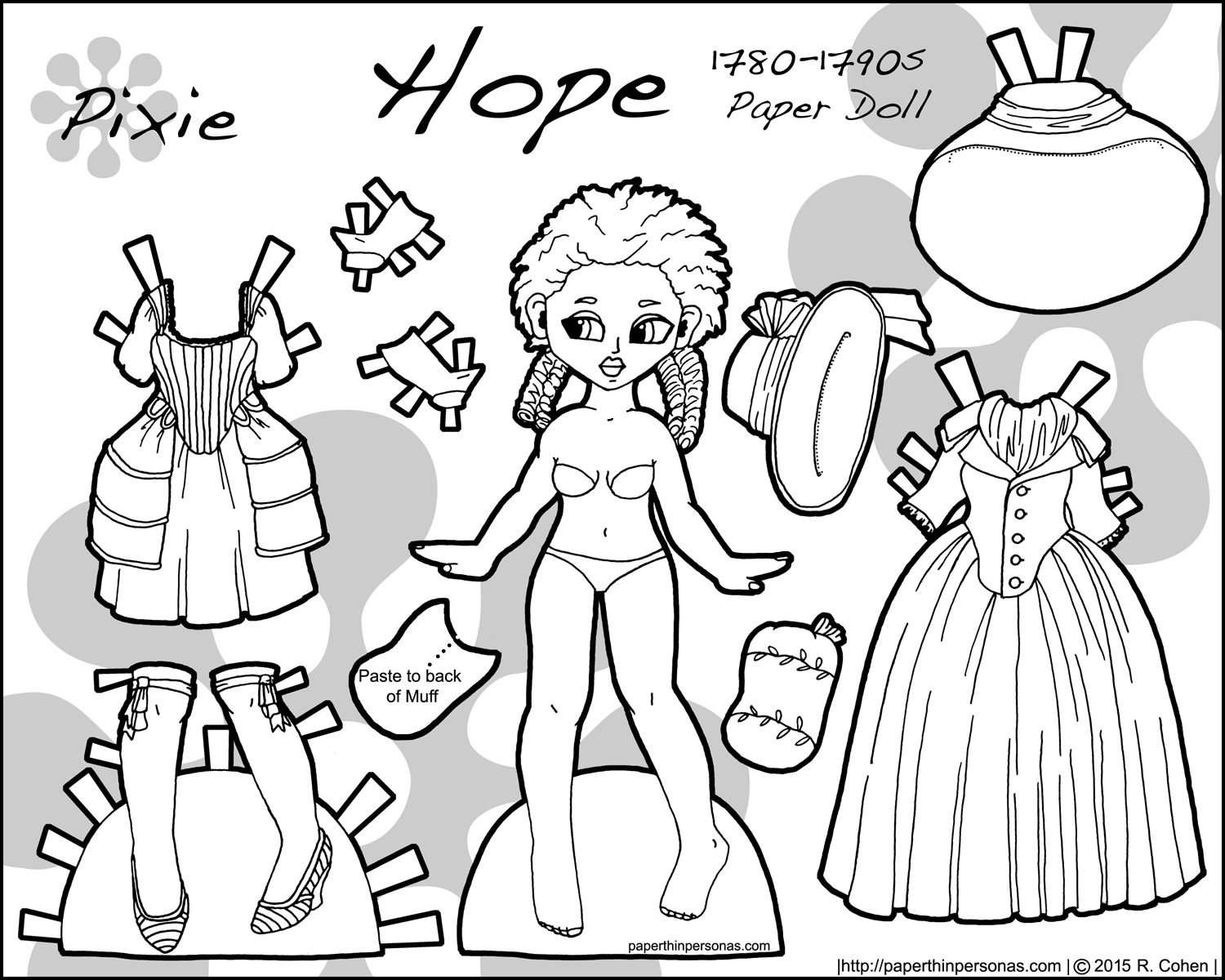
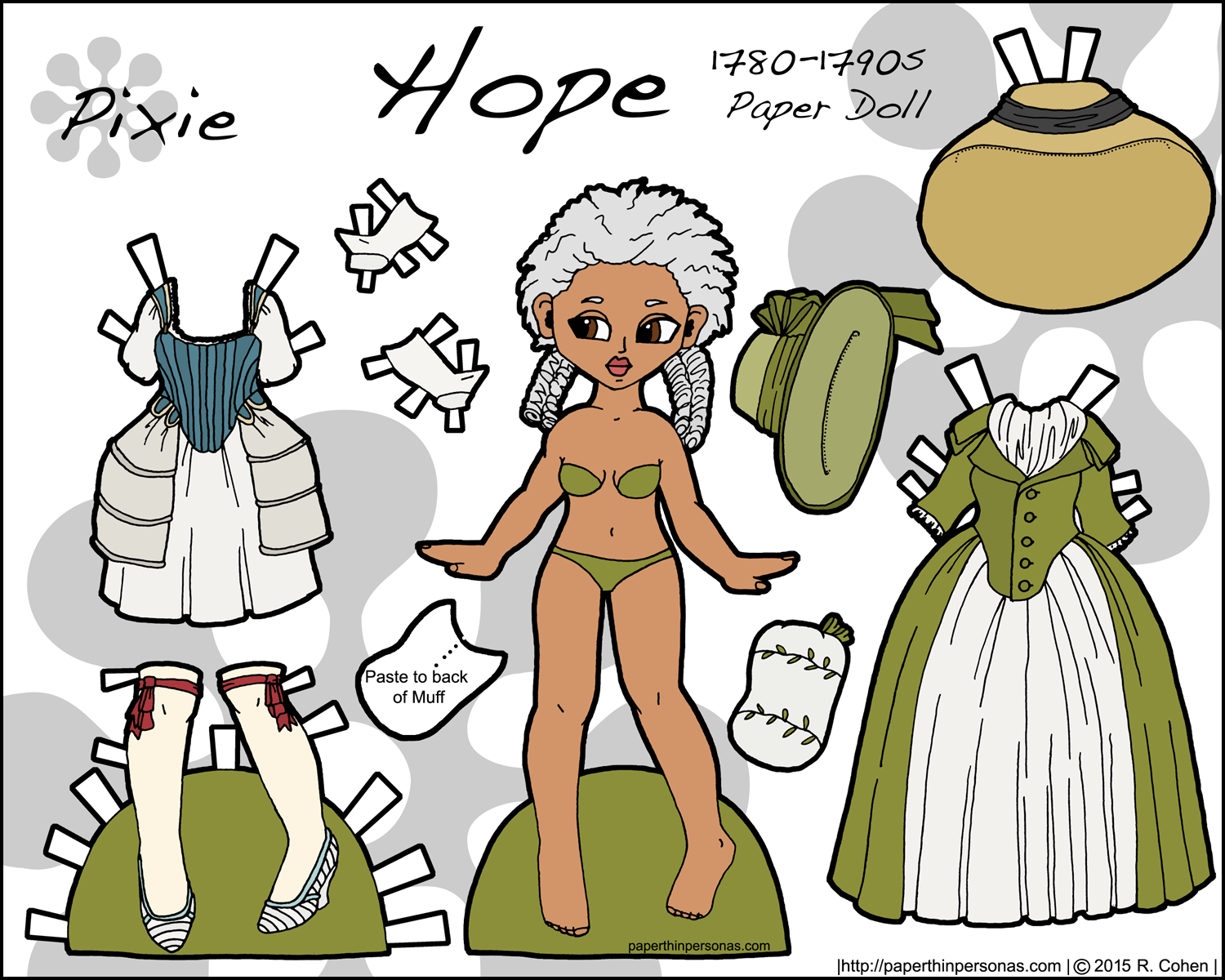
This all brings us rather neatly to Hope. Hope is our paper doll model for the later part of the 1700s. Her dresses will never get up the high waisted styles that characterized the transition into Empire. Rather, I think of her as being a woman of means right before everything gets radicalized. And, for her sake, let us assume she lives in England which was always behind on the fashions a bit anyway and a much safer place to be than France at the end of the 18th century. They don’t call it the Reign of Terror for nothing, after all.
{Download a PDF to Print and Color} {Download a PNG to Print and Color} {More Pixie & Puck Printable Paper Dolls}
Hope’s hair is done up in a style known as coiffure à l’enfant. This was a style popularized by Marie-Antoinette in the early 1780s. The style is a frizzy halo of hair with several longer strands curled, braided or left straight. Here is a portrait that shows off the hair style from the Met and here is a fashion plate featuring it from the V&A. I have to confess that I am not totally pleased with her hair. I fear that it looks a little bit too “mad scientist” for my comfort.
{Download a PDF in Color} {Download a PNG to in Color}{More Pixie & Puck Printable Paper Dolls}
Moving away from her hair for a moment, Hope has undergarments, of course, and then a gown known as a Redingote. Redingote’s started their lives as actual riding coats, but eventually transformed into women’s gowns which were coat like and then cut away to reveal the petticoat underneath. The word “redingote” is believed to be a French transliteration of the English term “riding coat”. Hope’s redingote was based on this gown from LACMA circa 1790. The term “redingote” sticks around into the early 20th century as a term of long coats.
Her hat is from this hat from the MINT circa 1770. Her shoes are based on this pair from the Met from 1780. Her muff and her mitts are both from Colonial Williamsburg.
I think that’s all the sources I need to list for Hope. I might have forgotten something, but I think that’s everything. Next Friday, there will be the last set of outfits for the 18th Century Pixie Series all from the later part of the 18th century.
 Sometimes, I get started on projects and they don’t seem “insane” and then a few weeks later I find myself further into them and I am thinking, “Was I crazy to start this?” and, of course, “Will this ever be done?”