Once in a while, I host little drawings for custom paper dolls. I do them rarely, because frankly they are time consuming.
Anyway, last June I held one. People submitted custom paper doll suggestions. You can see all of them on the original contest post. The winner of the drawing was Lina, but I added all the ideas to my paper doll ideas list. Today’s paper doll comes from an idea submitted back then. (See, I do sometimes draw things people request.)
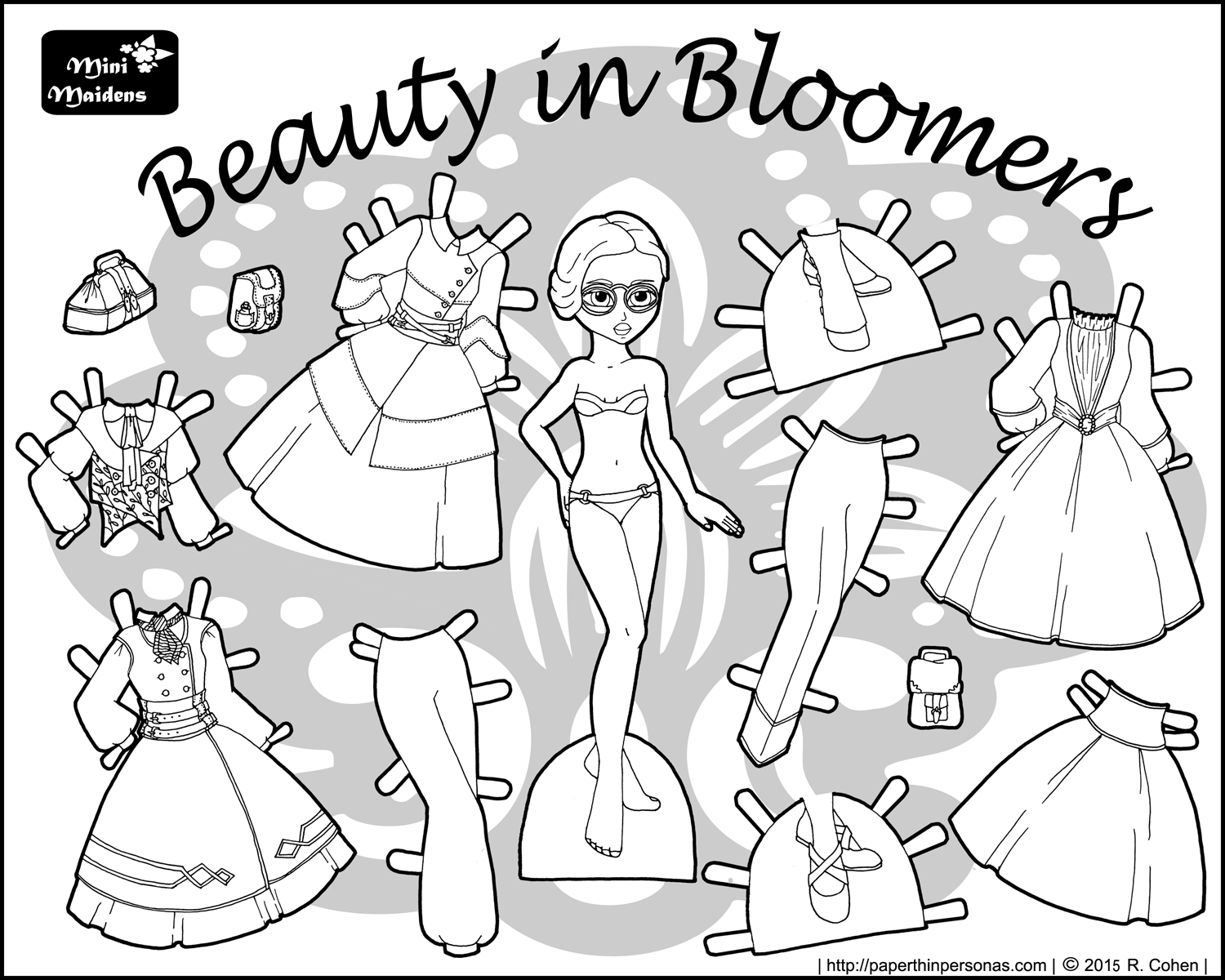
Erin Winslow proposed a steampunk set based on Amelia Bloomer’s women’s dress reform movement costume. My first thought was, “No Way!”
Because, honestly, I really didn’t like the Bloomer Dress. I’ve always thought it was both unflattering and kinda ugly. Why would I want to draw something I thought was ugly?
And then… rather unexpectedly, I found myself thinking… I should draw it because I find it ugly. I should tackle a style I dislike for a paper doll set. I should stretch. Plus I recently read a this book on Victorian dress reform movements.
First, I had to gather sources and ideas. You can see a collage of these below.

I remembered somewhere I had seen a photo of a female doctor wearing a Bloomer costume. That was where I started thinking about doctors cases and I found that Pat Stall, one of my favorite paper doll artists ever, had done an Amelia Bloomer paper doll set. I found some wonderful modern pieces and then a few great cartoons from various Victorian periodicals. I felt like I was on my way towards a set I might actually like.

Plus, I got to draw Victorian glasses and that was fun. 🙂
As most of my readers have figured out by now, I’m currently conducting a survey about developing products to open a Paper Thin Personas store in the next year and some other stuff. It’ll only take about 15 minutes and I’ll send you a thank you paper doll if you leave me your email at the end. (The emails are deleted out of the survey results immediately to keep things as anonymous as possible. So, no worries about that.)
Thanks again to everyone whose already done the survey! I’m closing it on Saturday, so I can begin to analyze the results. I’ll share some of my discoveries sometime in the next few weeks.
Today’s paper doll is named Shayna. Shayna is a Yiddish name that means “beautiful”. I also liked it, because it was close to Shauna which was the name of my best friend in college and, also, one of my roommates for several years. Shauna, it should be noted, looked nothing like my paper doll Shayna. I don’t really draw paper dolls of my friends, even though I do sometimes name them after them.

Meet the first Friend of Marcus! He doesn’t have a name yet- there’s a poll to vote for one below. Once he has a name, I’ll start calling him by it. For now, I think of him as Marcus’ bearded friend.


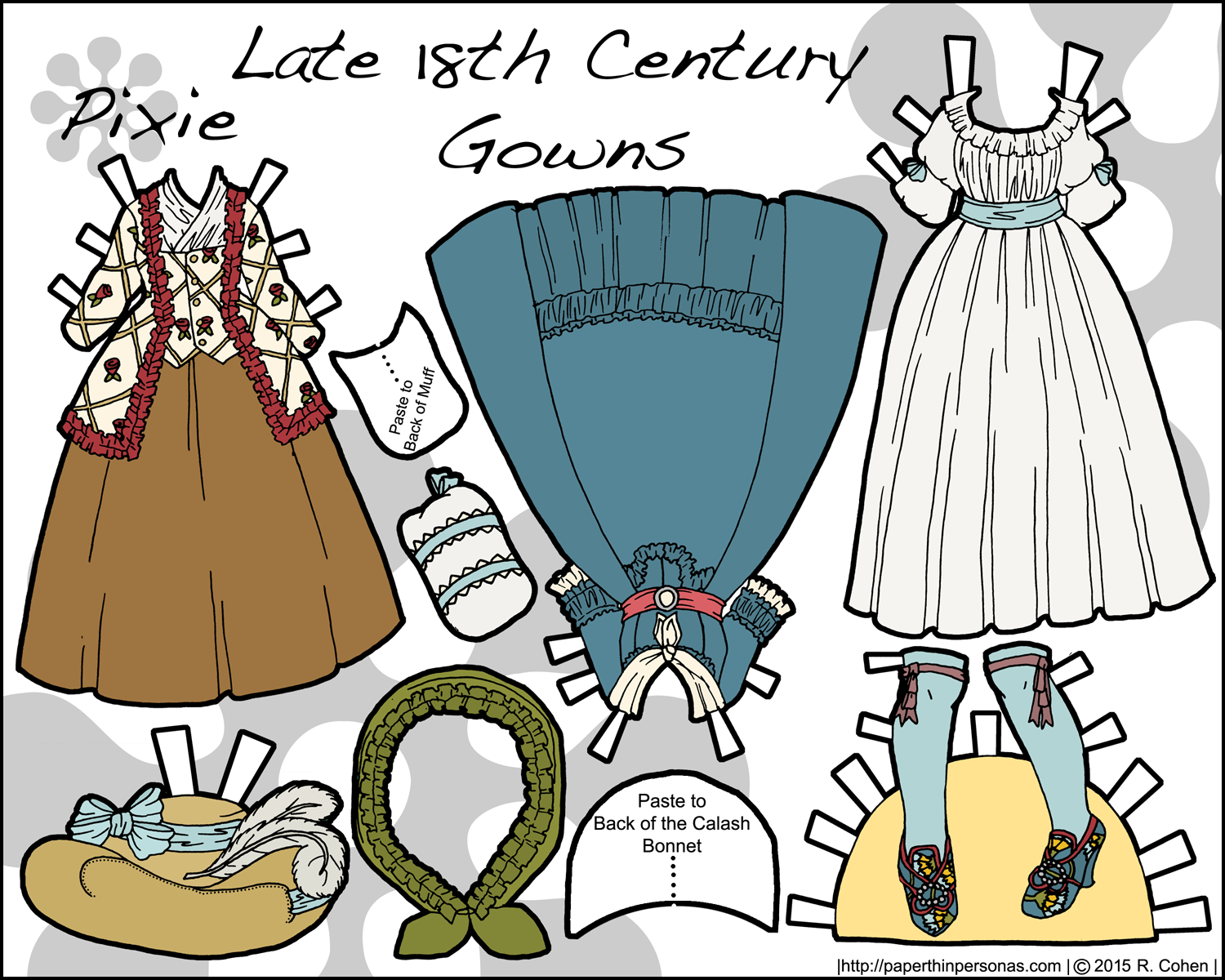
Late 18th Century gowns before the waist begin to rise at the turn of the century are often defined by simpler lines. You can see in some of them the beginings of the aesthetic and gave rise to the Greek inspired looks of the Empire period in France and the Regency period in England.

Many eons ago (okay so, like three months ago in June), I did 
Hope is based on the styles at the end of the 18th century. So, something major happened around the 1789 in France. It was, for those who weren’t asleep in high school history class, the French Revolution. To say that “everthing changed” wouldn’t be an understatement and the ripples of the events in France spread across Europe in dramatic ways. It is tempting when looking at the end of the 18th century to simply assume that after 1789 everyone just jumped into Empire styles and that was the end of it, but the reality is that there was a very slow evolution to the high waisted gowns we think of as “empire” or “Regency” dress.

Four more 18th century dresses for the Pixie paper dolls today. So, by now I think I’ve already covered the various sorts of gowns women wore in the 18th century with a fair bit of detail.


In my first page of gowns for my 18th century paper doll series, I talked a lot about different styles of gowns. I did not, however, talk about stomachers. So, a stomacher was a triangular shaped piece of cloth that was pinned or sewn in place to fill in the bodice of gowns. Most gowns had either an actual separate stomacher or something that looked like a stomacher. In today’s collection of gowns, they all have stomachers, except the polianse gown which is front fastening.

Today’s 18th century paper dolls is my second of three. Joy, all of these paper dolls will have virtue names, is from between the 1760s though 1780s. She has underwear and a gown in the polonaise style. Poloniase gowns had a skirt that is raised up and bunched over the petticoat. Usually a gown could be worn either with the skirt looped up in the polonaise or with the skirt down- offering some versatility to the 18th century silhouette. The polonaise gown sticks around into the 19th century and is sometimes mistaken for a bustle.

For years I avoided drawing a ballerina paper doll. I was asked a lot, but I always shied away.